
February 19, 2026
Mr. Clark Mercer
Executive Director
Metropolitan Washington Council of Governments
Re: Mid-Course Review of climate plan needs to include performance targets, housing
Mr. Mercer:
The Coalition for Smarter Growth appreciates COG’s mid-course review of the region’s 2030 Climate and Energy Action Plan and the hard work of staff. This information is critical for our elected officials and the public to determine our progress to date, and to ensure we take necessary action steps to meet COG’s approved goals.
The presentations by staff to date have provided an impressive cross section of data. However, CSG and several officials on the CEEPC have expressed concerns that the Mid-Course review to date is not showing progress relative to performance targets and is missing key data. Specifically, we bring these issues to your attention and provide the following recommendations to strengthen the Mid-Course Review report:
- Performance Indicators have not tracked progress toward targets – Of the ten sector performance indicators, only one shows the 2030 implementation target. There is no way for officials and the public to tell if the region is on track or not, which sectors are performing well and where we urgently need to do more work. For example, COG and TPB have EV adoption targets for 2030, but these are not included with the data on current adoption. Other indicators like Zero Waste, also have clear implementation targets (80% diversion rate) that have not been included with the presentation of the current level of diversion (40%). We understand that not all indicators have available data in the same format as the “Implementation levels needed”, but for many there are.
- TPB showed that transportation will fail to achieve COG GHG targets – Recent COG data from TPB’s Visualize 2050 plan (see addendum) show the region will miss 2030 and 2050 GHG reduction targets for the region’s most polluting sector, transportation. Unfortunately, despite CSG bringing this to the attention of COG Environment staff last summer, these forecasts have not been presented to the CEEPC.
- Housing is a core component of COG plans, including the climate plan, but is omitted. Housing in activity centers and near transit is one of the 2030 climate plan’s actions – and is a core component of COG’s adopted plans and policies (e.g., Region United, 2019 Housing Targets, Region Forward, Visualize 2050) – but has been excluded from the selected Mid-Course Review performance indicators. Land use is an underreported but key factor driving metropolitan area GHG emissions. Multiple studies show that walkable, mixed-use, compact land use is critical to meeting climate targets.
- Important context of current trends through 2030 is needed – Recent policies and data from our region that show troubling trends and projections For example:
- Far faster data center growth in the next five years. The pipeline for new data centers is five times Northern Virginia’s current data center volume;
- New fossil fuel powered electric plants (e.g., Dominion is planning six), and further fossil gas distribution infrastructure investment (DC, VA);
- Slower electric vehicle (EV) adoption;
- Hundreds of new lane miles of highways; continued high per capita VMT forecast
- Recent Maryland data showing the state will miss its 2031 GHG target, with the transportation sector highlighted for insufficient progress.
- On the positive side, the report should include recent data (2025 high public transit and bikeshare ridership, telework data from COG’s State of the Commute).
Several elected official members of the COG Climate Energy and Environment Policy Committee (CEEPC) raised the issue of lack of targets at the January 28 meeting. Staff responded that they intend to show more on progress indicators in the final report this spring.
Recommendations for the Mid-Course review report
CSG respectfully asks you and your team to:
- Ensure Mid-Course Review presentations and the final report clearly communicate progress versus 2030 performance targets in each sector and progress on key actions.
- Include assessment of the climate plan’s land use and housing actions. This is also needed to monitor progress toward the 2019 Housing Targets.
- Provide accountability on transportation emissions, incorporating recent TPB and other data that show the region is not moving fast enough to reduce car and truck pollution. See Addendum for more information on this.
- Show the full scale of data center proliferation, e.g., future growth, more dirty energy. 2023 data are not sufficient to convey the explosive growth; the report needs to include more recent permitting data and utility plans to provide critical context.
Please let us know if CSG and our partner organizations can be of assistance. Thank you.
Bill Pugh, AICP CTP
Transportation & Climate Director
CC: Hon. Cindy Dyballa, Chair, COG Climate Energy and Environment Policy Committee
Mr. Jeff King, Director, COG Climate, Energy, and Air Programs
Ms. Maia Davis, COG Senior Environmental Planner
Ms. Hillary Chapman, COG Housing Program Manager
Addendum: 2030 CEAP performance targets and land use and transportation progress
MWCOG 2030 Climate & Energy Action Plan Mid-Course Review
Transportation and Land Use Progress
Context: recent reports show the region is off track
For example:
- The State of Maryland is projected to miss its 2031 GHG target, reducing emissions only by 45% and potentially even less given further federal policy changes. The state’s transportation sector, in particular, was highlighted for its slow progress: three years ago it expected a 38% decrease in GHGs by 2031, but now a 23% decrease is forecast.
- TPB’s Visualize 2050 analysis showed last July that the region would fail its 2030 and 2050 GHG targets under the plan, with transportation pollution not falling at the pace needed in COG’s 2030 CEAP:
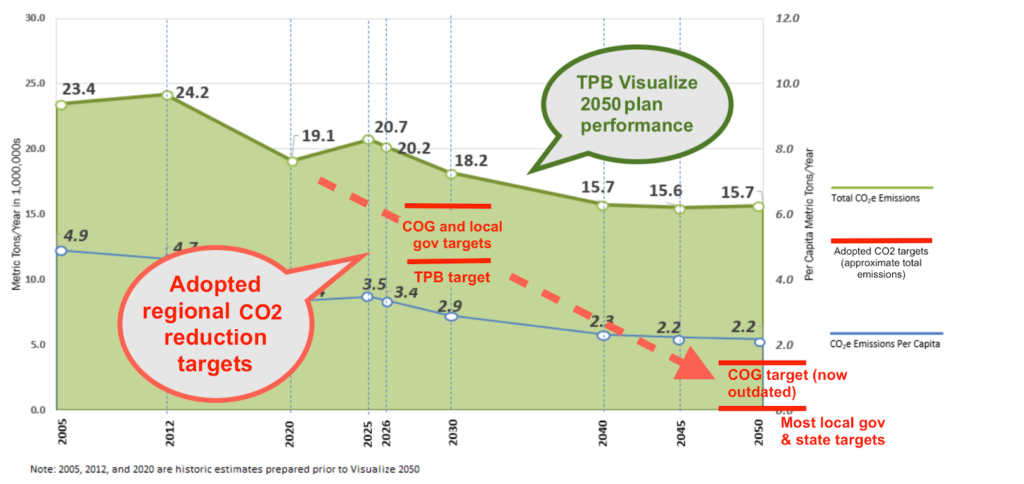
Regional On-Road Transportation Emissions under Visualize 2050
Source: TPB July 2025 presentation (download), with red annotations by CSG
Mid-Course Review must show per capita VMT target levels
TPB’s Climate Mitigation Study of 2021 showed that even if the National Capital region achieves COG’s goal of EVs totaling 50% of new car sales by 2030, the region still needs to shift trips and reduce trip distances through better land use planning and housing near transit to meet COG climate targets. Vehicle miles traveled (VMT) need to drop by about 20% by 2030 and further by 2050. National and state-level studies are consistent with this finding. This is why states like Maryland have set goals to reduce per capita VMT by 20% or more. These GHG reduction strategies also have significant co-benefits (safety, affordability, equity, economic development, other sustainability measures), much more than electric vehicles alone.
Visualize 2050 analysis shows that the region’s transportation and land use plans don’t do enough to prioritize walkable, transit-oriented, housing-rich communities over road capacity expansion ($20-30 billion and 600 new lane miles), and as a result don’t achieve the VMT reductions necessary:
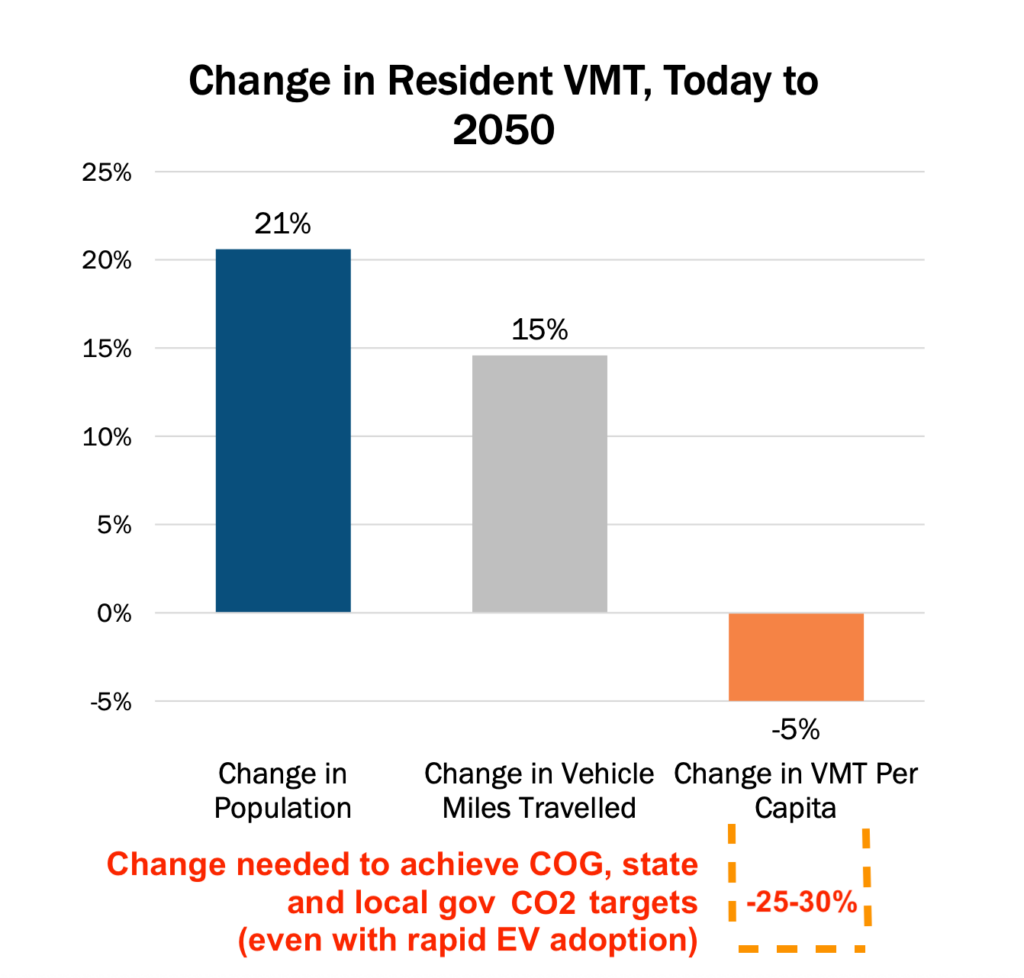
Source: TPB Visualize 2050, with red annotations by CSG
The Mid-Course Review should include this information from TPB in its performance indicator for Vehicle Miles Traveled and show the targets needed.
CSG appreciates COG’s work leading the DMVMoves initiative, which is critical to achieving these larger regional goals.
COG Housing Targets, Climate plan housing action
Housing is a core component of COG plans, and is an action in the 2030 CEAP, MSTB-2: Bring Jobs and Housing Closer Together, but is omitted from the Mid-Course Review. The target is clear and measurable: By 2030, 75% of new housing units are located in activity centers and near high-capacity transit.
Tracking progress toward the three adopted 2019 Regional Housing Targets has largely been left up to the non-profit HAND. HAND’s Housing Indicator Tool has done a great job tracking total housing production, dedicated affordable unit production, and the location of dedicated affordable units. But HAND has not had the resources to track the location of all housing production. COG, to our knowledge, has not tracked the location component of the 2030 housing targets, and there has been no comprehensive status update.
CSG has brought this up with COG housing, transportation and land use staff over the past several years, that this would be an appropriate role for COG to compile the date (similar to how they do for multi-family and commercial construction) and valuable information for the region. The COG Cooperative Land Use Forecasts suggest that the region is forecast to miss this target in the coming decades. Recent housing permitting data are needed to monitor actual progress this decade.
The Mid-Course Review should include MSTB-2: Bring Jobs and Housing Closer Together as a performance indicator. This can also be used as a progress update on the Regional Housing Targets.