
February 4, 2026
Mr. Sean Boyle
Project Manager, MD 214 (Central Avenue) Pedestrian Safety Action Plan Project
Maryland Department of Transportation, State Highway Administration
707 N. Calvert Street
Baltimore, MD 21202
Email: Sboyle1@mdot.maryland.gov
RE: January 2026 MD 214 SHA PSAP workshop concepts
Dear Mr. Boyle:
Thank you to the SHA MD 214 PSAP team for holding a workshop at Central High School on January 13, 2026.
We have worked with the community, including conducting a high school community walk audit of MD 214, attended by government planners and officials including SHA and MDOT. We also convened a complete streets training on April 2, 2024, led by Toole Design with the support and participation of MDOT and SHA, along with County officials, with special focus on MD 214. We submitted comments on the first MD 214 PSAP workshop.
Overall assessment – disappointing plan that fails to address deadly speed design of 6-lane road
The proposed concepts to address pedestrian safety on this segment of MD 214 are greatly disappointing and fall far short of where we believed we were headed with this project. The overarching problem with this roadway — high vehicle speeds, far in excess of posted speed limits — are largely generated by an overly wide 6-lane cross section, which is excessive for the traffic volumes. Retaining this 6-lane cross section sustains the high risk environment for all roadway users, most especially people walking and attempting to cross Central Avenue. While other pedestrian safety interventions are welcome – most especially a full traffic signal at Cabin Branch Road, the retention of the high-speed 6-lane cross section undermines the benefits of other safety interventions. This project should be solving for slower speeds on MD 214 – slower speeds for through traffic, and slower speeds for turning traffic, and reduced exposure of pedestrians to motor vehicle traffic.
Positive intervention highlights:
- A new traffic signal at Cabin Branch Road, which will make an important difference in getting Central High School students more safely across Central Avenue at the bus stops.
- Central Ave. Connector Trail and/or a shared use path to be constructed along the length of the project area. We applaud SHA for committing to the continuity for this trail.
Detailed comments regarding MD 214 PSAP project plans
A 6-lane to 4-lane conversion should be a top priority for a safety plan. Few interventions will slow traffic or make it safer or easier to walk across the wide cross section if the 6 travel lanes are retained. This wide cross section is distinctly different from DC’s East Capitol Street that begins west of Southern Ave. This change at the border should make a more significant change for MD 214, like lane reductions, easier to implement given it would better match the DC side, which allows off peak on-street parking, and forms a bottleneck during AM peak.
At the January 13 workshop, when we asked SHA representatives why they are not proposing reducing travel lanes (sometimes known as a road diet) to 4 lanes – the main argument was that it was too expensive to move curb lines and would take too long. However, low cost methods do not appear to be considered, like paint and flex posts. We know these practices are used by SHA. The FY 26 – FY 31 CTP states, regarding the PSAP projects:
The use of “quick build” Complete Streets demonstration projects, like flex posts and pavement markings, that will save lives today, will help those dollars go further and accelerate the Department’s ability to provide tangible safety.
We hope that the MD 214 PSAP project can use SHA’s best quick build, low cost practices to narrow the high-speed travel way from 6 to 4 lanes.
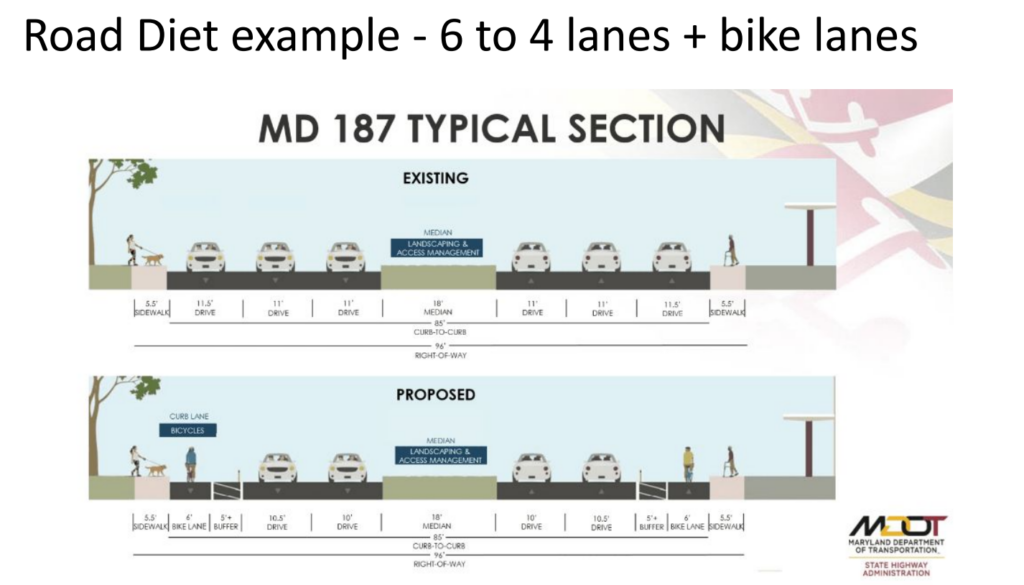
Other evidence that this is possible is from an SHA project for MD 187 in Montgomery County, which used flex posts and striping to convert a 6-lane road to a 4-lane roadway. This design does not move the curb line.
Other measures in the concept presented a mix of helpful interventions, along with measures falling short of what is needed, or consistent with Urban Street Design standards, or what we would expect from a PSAP project.
Travel lane widths are largely too wide and inconsistent with Prince George’s standards. The plan proposes travel lane widths of 10, 11, and even 12 feet. But mostly proposes 11 foot lanes – which is wider than the Prince George’s Urban Street Design Standard of 10 feet for inside lanes. Eleven-foot lanes are to be used for outside lanes, for bus/truck routes. While the plan would narrow some existing travel lanes, the proposed travel lane widths are largely not to standard. We ask that this plan follow Prince George’s standards.
Corner radii are largely too large throughout, though are tightened up in several places. Prince George’s standard is 15’ and 25’ (for bus/truck routes). Tighter turning radii slow vehicle turning speeds and shorten crossing distances for pedestrians. This safety plan should follow the Prince George’s standard.
Adding a full traffic signal at Cabin Branch Road is the main improvement to help Central High School students cross to and from the bus stop on MD 214. We applaud this as a major safety improvement. We hope the signal will achieve full compliance, despite no other real changes to the 6-lane cross section. We appreciate the proposed striped crosswalks, which could help with compliance. We ask for the addition of bus stop improvements at Cabin Branch Road to provide a safe, comfortable place for students and other riders to wait for the bus.
The proposed pedestrian hybrid beacon between Crown and Burgler St. is welcome, but we ask for more traffic signals and beacons to be added to this segment where there are long distances between signalized intersections, even close to the Capitol Heights Metro station.
The plan proposes to add nose caps and hardened medians, which we support. The plan also removes extra curb cuts and hazardous extra driveways, which is helpful. The plan tightens the corners of Southern Ave. and East Capitol Street/Central Ave., but the slip lane on the NE side is retained. This should be closed. As should the slip lane at Davey Street by the Capitol Heights Metro.
Buildout of the Central Avenue Connector Trail and an SHA-built 10’ shared use path is proposed – which is very welcome. Walking or biking along the highway will be safer and easier. This will improve access to important destinations like Central High School and the Metro stations. However, it’s the crossing of streets that will remain about as hazardous as it is today – except at Cabin Branch, with the new signal.
The Central High School community also has asked that sidewalks and crossings be built on Cabin Branch Road to connect to the high school entrance. While this is not a state roadway, we ask that the PSAP program consider supporting this safe route to school connection from MD 214.
Overall, this plan is terribly underwhelming, and not what we had expected from this program or administration. Thank you for the opportunity to comment. We look forward to following up on next steps to improve this proposal.
Sincerely,
Cheryl Cort
DC and Prince George’s Policy Director