
As Fairfax considers relaxing its accessory dwelling regulations, the county wants to hear from you via an online survey by Feb. 28. This is an opportunity to align Fairfax’s regulations with its neighboring counties and support one of the most affordable forms of housing.
Accessory Living Units (ALUs), or accessory dwelling units (ADUs), have become a major source of housing reform. Also commonly referred to as granny flats or backyard cottages, these types of homes can help address the housing shortage while providing a more affordable housing option – particularly for seniors, young adults, and working families.
It can be difficult to find good housing options in Fairfax. Prices are high and smaller homes can be few and far between, especially for young adults, downsizing empty nesters, singles and older adults living alone. One way the county can allow more housing is to liberalize its rules for ALUs. Several of the county’s ALU regulations are overly restrictive and exclude many homeowners from creating an accessory unit on their property
What is an ALU?
An ALU is a small, independent home located on the same lot as a single-family house. Legally, it must be subordinate to a single-family home and include separate areas for living, sleeping, cooking/eating, and sanitation. It may be attached – like a basement apartment or garage conversion – or detached, like a backyard cottage.
Other names for ALUs:
- Accessory dwelling units (ADUs)
- Granny flats
- In-law suites
- Backyard cottages
Fairfax County’s accessory dwelling regulations are far stricter than surrounding counties’, limiting the impact of this housing strategy. Since the most recent update to the county’s ALU rules, only 158 of the 407 permit applications have been approved.
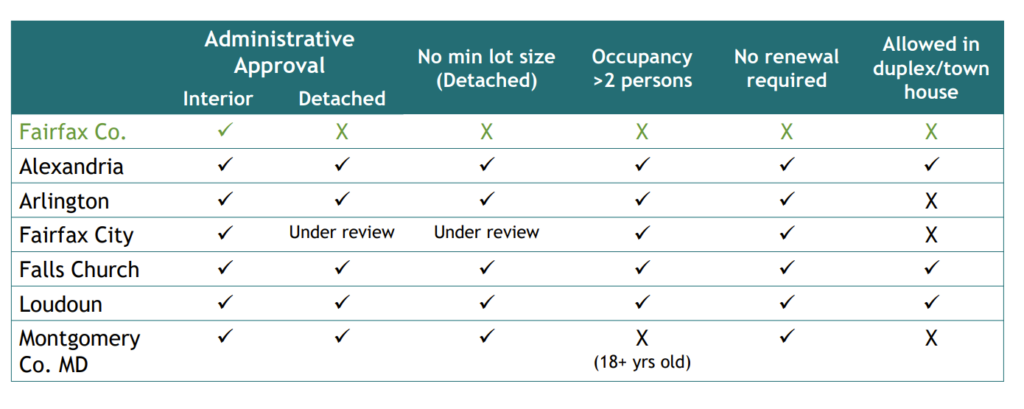
To create a more effective ALU strategy, county staff are considering streamlining approvals, revisiting minimum lot size rules for detached units, and potentially revising parking constraints. There are many ways to revise these standards to enable smart infill growth.
Detached ALUs: the 2-acre minimum lot size
Under the county’s current regulations, detached ALUs require an additional permit and can only be built on lots of at least two acres. That means you only get to build a backyard cottage if you have at least a football field and a half of land. This requirement massively constrains the ability for ALUs to be built near metros and other transit stations. Reducing the minimum lot size for detached ALUs and revising the setback rules would be hugely beneficial for the county’s policy.
Parking requirements:
Fairfax’s current parking standards for ALUs include one additional on-site parking space, in addition to what’s required for the principal dwelling. This is a prohibitive measure that drives up the cost of building an ALU and can result in loss of greenspace. This is a rule that should be relaxed, particularly in transit-accessible neighborhoods.
Why ALUs?
Due to their size, ALUs are typically the least expensive rental options in the places where they are built, offering an affordable option for seniors, young adults, and working families. This form of housing allows families to stay together as their life circumstances change and gives young professionals the opportunity to find their footing in new markets.
Many households in the county are looking towards intergenerational living as an affordability measure. As parents age and their children choose to move back home, ALUs can facilitate comfortable co-habitation.
Enabling homeowners to construct ALUs also grants them greater control over their properties and an additional source of income, which can be particularly beneficial for retirees on fixed incomes. Let us empower property owners to help us create the homes we need for the people who need them most.
For more information and to take the survey, visit Fairfax County’s Accessory Living Unit website.