
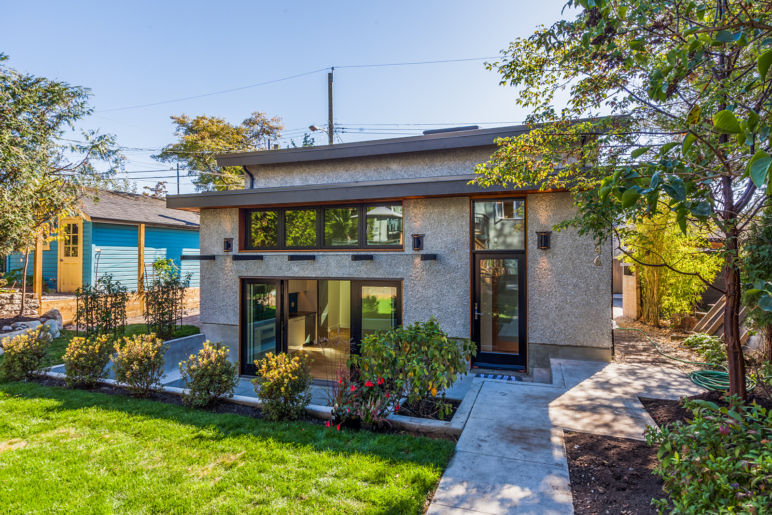
A detached backyard cottage, courtesy of the Sightline Housing Solutions Photo Library, CC BY 2.0 (cropped)
Fairfax County is reaching a critical decision point on its Accessory Living Unit regulations. Although recent staff recommendations reflect positive progress, the continued enforcement of minimum lot sizes for standalone ALUs creates an unnecessary barrier to accessing this housing option. Public advocacy is essential right now to eliminate these restrictions and secure an actionable ALU policy.
It can be difficult to find good housing options in Fairfax. Prices are high and smaller homes can be few and far between, especially for young adults, downsizing empty nesters, singles, and older adults living alone. One way the county can allow more housing is to liberalize its rules for ALUs. Many of the county’s current ALU regulations are overly restrictive and exclude many homeowners from creating an accessory unit on their property.
Accessory Living Units, also called accessory dwelling units, have become a major source of housing reform. More commonly known as granny flats or backyard cottages, these types of homes can help address the housing shortage while providing a more cost-effective housing option – particularly for seniors, young adults, and working families. Join us today in expanding this housing option in Fairfax County!
How can I take action?
If you haven’t yet, NOW is the time send a letter to the county. We need your voice to make these changes a reality!
Want to make an even bigger impact? Sign up to testify today!
We cannot over-emphasize the importance of testimonials. Luckily, Fairfax County make it pretty easy. We will be there in-person, but you can also call in with your comments or submit a video.
Please email becca@smartergrowth.net if you have questions – we are more than happy to help you with signing up, drafting comments, or finding the right format for you.
How can I testify?
1) Pre-Recorded Video TestimonySubmit a pre-recorded YouTube video expressing your support. Your testimony will be shared during the hearing, but you won’t have to wait to testify. Record a video using your device, upload it to your personal YouTube account, and share the link via plancom@fairfaxcounty.gov by 9am the day prior to the public hearing, Oct. 28. Contact me if you would like help!
2) Phone Testimony
Testify by phone from the comfort of your own home. You’ll receive a call just before your turn to speak at the public hearing.
3) In-Person Testimony
Join me and fellow supporters at the Fairfax County Government Center (12000 Government Center Pkwy, Fairfax) to provide your testimony in-person.
What is an ALU?
An ALU is a small, independent home located on the same lot as a single-family house. Legally, it must be subordinate to a single-family home and include separate areas for living, sleeping, cooking/eating, and sanitation. It may be attached – like a basement apartment or garage conversion – or detached, like a backyard cottage.
Other names for accessory homes:
- Accessory dwelling units (ADUs)
- Granny flats
- In-law suites
- Backyard cottages
Why accessory dwellings?
Known as granny flats, in-law suites, or backyard cottages, accessory dwellings are among the most versatile and cost-effective housing options available.
- Flexibility for Every Stage of Life: ALUs allow older adults to age in place with dignity, offer young adults a place to live while saving money for college or their first home, and make intergenerational living accessible.
- Affordable by Design: Because of their smaller footprint, ALUs are naturally lower cost to construct and rent, expanding housing choices without requiring massive infrastructure changes.
- Meeting Our Housing Goals: Fairfax County needs tens of thousands of new homes over the next decade to meet our housing needs. Letting homeowners safely build ALUs on their own property is one of the easiest ways to increase our housing supply.
What is the county considering?
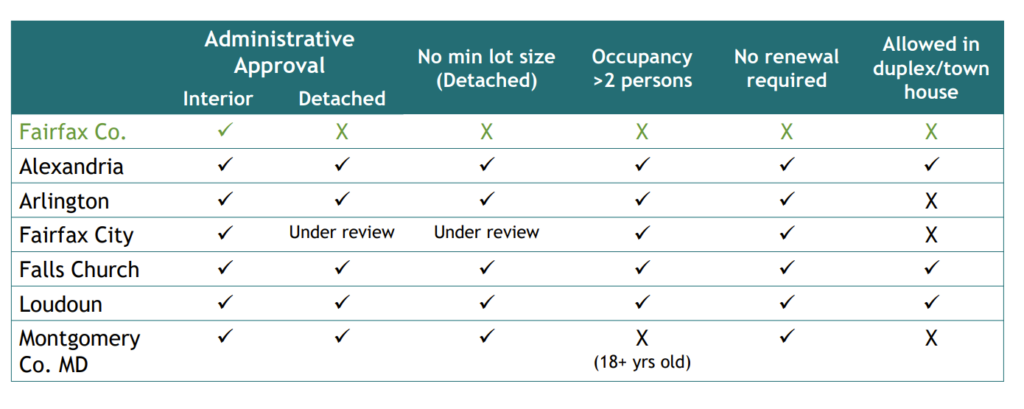
Fairfax County’s accessory dwelling regulations are far stricter than surrounding counties’, limiting the impact of this housing strategy. Since the most recent update to the county’s ALU rules, less than half of permit applications have been approved.
So – what’s in the latest Staff Report?
First, the good news. County staff heard your voices and supported key recommendations we pushed for in our initial campaign, including:
- Removing mandated parking requirements (this is big!)
- Dropping owner-occupancy requirements.
- Allowing standard-compliant ALUs by-right, without the need for additional administrative permits.
- Dropping permit renewal requirements.
- Permitting at least three occupants per unit, with the potential to go up to four.
The proposed minimum lot size requirement excludes 86% of homeowners from building backyard cottages, and is particularly challenging for homeowners with smaller, transit-adjacent lots. This creates a major tripwire that will undermine the intention of this policy to create access to a flexible, cost-effective housing option. Help us finish the campaign strong by sending a message to the county – we want to see real housing reforms!
What are the key components of the policy?
Minimum Lot Sizes for Detached ALUs
Loudoun and Montgomery Counties, as well as much smaller jurisdictions like Alexandria, Arlington, and Falls Church, have no minimum lot sizes at all for detached ADUs. The proposed minimum lot size requirement excludes 86% of homeowners from building backyard cottages, and is particularly challenging for homeowners with smaller, transit-adjacent lots. This creates a major tripwire that will undermine the intention of this policy to create access to a flexible, cost-effective housing option. Help us finish the campaign strong by sending a message to the county – we want to see real housing reforms!
Interior ALUs in Townhomes
Allowing townhome owners to create self-contained ALUs through attic or basement conversions can enable them to maximize small, often unused spaces.
Maximum ALU Sizes
All ALUs in Fairfax must be “subordinate,” or visibly smaller than their primary dwellings, no matter the maximum square footage the county allows. Given that the median size of a home in Fairfax County is over 2,000 square feet, it makes sense to allow footprints of 800-1,200 feet. All ALUs will still be governed by rules relating to lot occupancy, setbacks, and other environmental regulations
Occupancy Limits
All counties in Northern Virginia allow more than two people to occupy accessory dwellings. Relaxing this rule increases the level of impact this housing strategy can have and gives flexibility to residents undergoing life changes, such as young couples looking to start families.
Owner Occupancy
Owner-occupancy requirements create another limiting factor in the ability of ALUs to be a truly effective housing solution. There are many circumstances under which homeowners may not be able to occupy their primary dwellings, such as military or State Department personnel who spend long stretches of time abroad.
Parking Requirements
As believers in smart growth principles, we see mandatory parking as mandatory paving. Parking minimums inherently drive up the cost of home production while increasing impervious surface areas that degrade our environment. requiring an additional space on large lots. Don’t forget that waiving this requirement would not preclude homeowners from including a parking space for their ALUs, should they so choose.
By-right Approvals
The reason we take time at the outset to establish thoughtful, standardized requirements for new developments is to ensure a straightforward and predictable process. If a homeowner is willing to follow the county’s rules to contribute to this housing solution, they should not have to undergo a special hearing for changes they are already legally allowed to make to their own property.
We have the ability to make ALUs a powerful tool in the effort to expand access to housing for more Fairfax residents. We hope you will express your thoughts to the county in support of relaxing the current ALU regulations and making this an actionable housing strategy.
Take action today!
Please let us know if you would like to participate in the upcoming hearings, and don’t forget to send a letter to the county today!
Oct. 29 – Planning Commission
Nov. 17 – Board of Supervisors
Please email becca@smartergrowth.net if you have questions – we are more than happy to help you with signing up, drafting comments, or finding the right format for you.