Category: Stopping Sprawl & Highway Projects
REPORT: Rethinking the Bi-County Parkway
The Virginia Department of Transportation’s (“VDOT”) own traffic modeling data reveal that the proposed Bi-County Parkway (“BCP”) would worsen, not relieve, traffic congestion. The same model shows that the comprehensive alternative offered by our coalition (termed the “Substitute Vision” by VDOT) will better address congestion in the study area, and better serve the dominant need for east-west traffic capacity—now and in the future.
Public Gets First Input On Transportation Bill Projects
Members of the public from Loudoun, Arlington, Fairfax and Prince William counties got their first chance to speak to the full board of the Northern Virginia Transportation Authority Thursday night in a public hearing discussing the projects that could receive funding from the General Assembly’s transportation bill that passed earlier this year.
Twenty-two people, including legislators, representatives of local advocacy groups and individuals giving their opinions, went before the board, and dozens more reviewed the almost 50 projects the NVTA is considering. The NVTA’s priority is finalizing a list of projects that will receive funding for FY14, when there is expected to be $190 million available.
NVTA Chairman Martin Nohe, the Coles District Supervisor in Prince William County, gave a 30-minute presentation before anyone spoke, explaining what the NVTA is and how board members plan to implement the funding. $1.6 billion is expect to come to Northern Virginia over the next six years from HB2313, 70 percent of which will be dispersed by the NVTA and 30 percent going directly to each locality: the four counties and the cities of Manassas, Manassas Park, Falls Church and Alexandria.
The money is intended, essentially, to relieve the high levels of congestion that have plagued the area for years, and only figure to get worse. The main bone of contention among those who spoke was the best way to go about doing that.
“There’s a lack of quantitative information right now to evaluate projects with different modes and different types,” Del. Jim LeMunyon (R-67) who was the first to speak, said. “For every million dollars we spend, how many hours are we putting back into the lives of Northern Virginians? We need to know that.”
Residents in Prince William and Loudoun counties almost unanimously applauded the NVTA’s to fund the widening of several segments of Rt. 28 in Loudoun, Fairfax and Prince William counties.
The projects proposed for FY14 funding are “hot spot” improvements between Sterling Boulevard and the Dulles Toll Road in Loudoun, expanding from two lanes to a four-lane divided roadway from Linton Hall to Fitzwater Drive in Prince William, and widening from three to four lanes southbound between the Dulles Toll Road and Rt. 50 and northbound from McLearen Road to the Dulles Toll Road in Fairfax County.
“I’m here to commend your decision to include the Rt. 28 hot spot improvements,” Jeff Fairfield, speaking on behalf of the Rt. 28 Tax District Landowners Advisory Board, said. “These improvements will alleviate congestion. There’s been a tremendous improvement on removing traffic lights, yet we now experience congestion due to a lack of lane capacity.”
“Rt. 28 relief is needed now,” Gary O’Brien of Manassas said. “There are currently several disconnected projects. What it needs is more transportation capacity, right through the system. Try to consolidate the little plans into a larger system.”
Arlington County Supervisor Chris Zimmerman, the chairman of the Project Implementation working group, said the list of projects proposed for funding was built from existing transportation plans, such as the NVTA’s TransAction 2040, and are closest to “shovel-ready.”
“Our aim has been to, No. 1, follow the law” Zimmerman said. “We began by reviewing what the statutes require of us. In developing criteria, that was first and foremost. It has been our intention to use objective criteria and quantifiable criteria to the greatest degree possible. That is what we have been trying to accomplish.
“Many of the projects, by their nature, will take multiple years to do and have multiple parts. It’s a very complex network; there isn’t a silver bullet. It will take a lot of fixing in different places.”
Many Prince William County residents spoke against potential funding of the Bi-County Parkway, a controversial transportation project stretching from I-95 to Rt. 50 in Loudoun, but the project is not among those included for FY14 funding or on the Six-Year Plan.
Perhaps the most scrutinized debate will be how many funds are devoted to transit projects, pedestrian or bicycle projects, and how much will simply be devoted to increasing capacity on the roads network.
“In a great metropolitan area, you cannot ‘get the red out,’” Stewart Schwartz, the executive director of the Coalition for Smarter Growth, said about relieving intense traffic jams. “We have to account for induced traffic. For the peak-hour commute, there’s nothing better than high-capacity transit. I urge you to resist a return to the old approach, which didn’t work, and focused on a transit-oriented, walkable bikeable future that we need to have.”
The NVTA will hold another public hearing July 24 before deciding upon the final FY14 list at 6 p.m. Wednesday, July 24, at Fairfax City Hall. The public comment period before the Project Implementation’s next working group will close next week. The form, and submittal information, can be found here.
Photo courtesy of Leesburg Today.
Six-Year Improvement Program: a Blueprint for Failure
With the adoption of the new Six-Year Improvement Program, the details of Governor Bob McDonnell’s transportation priorities plan are coming into clearer focus. There are some worthy elements to the plan but glaring deficiencies guarantee that Virginia will see minimal benefit from the billions of dollars dedicated to new construction.
On the positive side of the ledger, it is heartening to see that Virginia will get serious about meeting its statutory maintenance obligations. The Virginia Department of Transportation (VDOT) will spend an estimated $2.3 billion over the next six years to rehabilitate aging bridges. Roughly one in eleven bridges in the state is rated “structurally deficient.” (See “Bad Bridges” for details). VDOT also will dedicate 25% of its formula revenues to repairing deteriorating pavement on state interstates and primary roads. (It’s not clear from published reports, however, whether this work will address the aging sub-structure of these roads, which account for much of the deterioration.)
Second, VDOT will apply 5% of formula revenue to “smart roadway” projects, which will utilize sensors, video, wireless communication, artificial intelligence and other advanced technologies to do a better job of synchronizing traffic signals, clearing accidents and communicating information to drivers. If executed properly, these investments can increase the capacity of existing traffic arteries at significantly lower cost than constructing more lanes.
On the other hand…. Stewart Schwartz, executive director for the Coalition for Smarter Growth, sums up the negatives in a press release issued yesterday after the Commonwealth Transportation Board meeting:
“We are shocked by the lack of discussion of the spending priorities in the Six-Year Plan, by the failure to tie the program to specific policy goals, and the assumption that simply adding road capacity will solve our transportation problems. The plan includes a number of wasteful mega-projects that have been strongly criticized as unnecessary including Route 460 ($1.4 billion), the Coalfields Expressway ($2.8 billion), Charlottesville Bypass ($244 million), N-S Corridor ($1 billion plus), and a long range $11.4 billion plan for I-81.
The CTB doesn’t understand the benefits of more efficient land use – of cities, towns, and compact transit-oriented development – along with transportation demand management programs (carpooling, telecommuting etc), that reduce driving demand. They don’t understand changing demographics and market demand that have led to big declines in vehicle miles traveled. The plan includes just 9% of the total for transit even though 69% of the state population lives in the Urban Crescent.
In short, we believe this program will be remembered for squandering billions of tax dollars while making Virginia’s patterns of development less efficient, more oil dependent and less competitive.”
I couldn’t have said it better. My only point of difference with Stewart is that I have no faith that the extra $500 million allocated to rail and public transportation (bringing the total to $2.9 billion) will be spent any more effectively than the money dedicated to roads. When funding decisions are based upon politics rather than objective Return on Investment analysis, the potential exists for rail and public transit projects to be every bit as wasteful as road projects.
Virginia’s decision-making process for allocating transportation dollars is a mess. It is bureaucratic, cumbersome and lengthy. Once projects make it into the pipeline, they rarely get re-evaluated in the light of changing travel trends or market conditions. The CTB exercises no independent review over the priorities handed down by the McDonnell administration. Functioning as regional advocates and conduits of information to the administration, CTB representatives do their most important work behind the scenes. By the time projects are formally reviewed during CTB meetings, the decisions have already been made. Additionally, there are major transparency issues associated with Public Private Partnership mega-projects. The need for confidentiality when the state negotiates with private-sector partners conflicts with the need for public disclosure before the final deal has been struck.
The McDonnell administration has made no effort whatsoever to address these process issues. It has made no effort to re-evaluate projects in the funding pipeline in the light of new demographic, travel and development trends. And it has made no effort to better align transportation planning and land-use planning. The entire approach has been marked by spending as much money as possible to build as many projects as possible. Bottom line: The McDonnell administration has borrowed billions of dollars and raised our taxes in order to pour more money into a broken system.
Photo courtesy of James Bacon.
STATEMENT: Virginia Commonwealth Transportation Board Approval of $17.6 Billion Six-Year Capital Spending Program: A Road to Ruin?
Statement on Virginia Commonwealth Transportation Board Approval of $17.6 Billion Six-Year Capital Spending Program
A Road to Ruin?
Today with no debate, the appointed Commonwealth Transportation Board approved the largest transportation spending program in Virginia history, $17.6 billion in capital spending.
“We are shocked by the lack of discussion of the spending priorities in the Six-Year Plan, by the failure to tie the program to specific policy goals, and the assumption that simply adding road capacity will solve our transportation problems. The plan includes a number of wasteful mega-projects that have been strongly criticized as unnecessary including Route 460 ($1.4 billion), the Coalfields Expressway ($2.8 billion), Charlottesville Bypass ($244 million), N-S Corridor ($1 billion plus), and a long range $11.4 billion plan for I-81.
The CTB doesn’t understand the benefits of more efficient land use – of cities, towns, and compact transit-oriented development — along with transportation demand management programs (carpooling, telecommuting, etc.) that reduce driving demand. They don’t understand changing demographics and market demand that have led to big declines in vehicle miles traveled. The plan includes just 9% of the total for transit even though 69% of the state population lives in the Urban Crescent.
In short, we believe this program will be remembered for squandering billions of tax dollars while making Virginia’s patterns of development less efficient, more oil dependent, and less competitive.”
Stewart Schwartz, Executive Director
About the Coalition for Smarter Growth
The Coalition for Smarter Growth is the leading organization in the Washington D.C. region dedicated to making the case for smart growth. Our mission is to promote walkable, inclusive, and transit-oriented communities, and the land use and transportation policies needed to make those communities flourish. To learn more, visit the Coalition’s website at www.smartergrowth.net.
###
Preservation Virginia lists land slotted for Tri-County Parkway as ‘endangered’
Historic Civil War parkland slotted for a controversial new parkway that would connect the counties of Prince William and Loudoun has made the “endangered” list of one of the oldest non-profit preservation organizations in the country.
Preservation Virginia, founded in 1889, focuses on the preservation of historic sites around the state, including Jamestown and the Cape Henry Lighthouse in Virginia Beach. For the first time, the group included land slated for the proposed Tri-County Parkway, a 10-mile, four-lane thoroughfare that would connect I-66 in Prince William with Route 50 in Loudoun, on its list of “most endangered” sites for 2013.
“The Tri-County Parkway would run directly past the August 28, 1862 position of the right flank of Confederate troops led by Stonewall Jackson and the left flank of the Union General Pope’s troops, taking up to 20-35 acres of land from the national park and historic district,” the group said on its Web site.
“Opponents of the highway…believe that it would negatively impact the national park and historic district and predict that the parkway and connecting roads will open up rural land in Prince William … and Loudoun County.”
The group joins a chorus of preservation advocacy groups raising concerns about the project, including the National Trust for Historic Preservation, National Parks Conservation Association, Piedmont Environmental Council, Coalition for Smarter Growth, and Southern Environmental Law Center.
The administration of Gov. Robert F. McDonnell (R) and the business community in Prince William and Loudoun believe the road is vital to the success of the fast-growing region. Supporters say the parkway — which could eventually connect farther east to Interstate 95 — would create jobs and drive economic development in the area, ease congestion and provide a key connection to Dulles International Airport and between two rapidly growing counties.
Elizabeth Kostelny, the executive director of Preservation Virginia, said that the organization is interested in the project in part because the National Park Service has pushed for assurance that if the parkway is built, Route 29 through the battlefield would be closed at Route 234 and a bypass around the park would be built.
“We’re not opposing it outright,” Kostelny said of the Tri-County Parkway. “We remain concerned about the traffic through the Manassas battlefield [and] having assurances those roads will be closed to commuter traffic.”
The Prince William Board of County Supervisors recently delayed a vote on Prince William’s state transportation priorities due to an outcry about the road. The parkway proposal has long had the support of both Prince William and Loudoun supervisors.
Prince William Board Chairman Corey A. Stewart (R-At Large) said in an interview that the board’s delay does not mean that supervisors plan to pull their support. He also said that despite setback and opposition, he believes the proposed parkway will move forward.
“I think they will be successful,” he said of the state’s plans for the road. “The reason is this … we have two of the fastest growing counties in the United States that do not have adequate connections to each other.”
Despite opposition in recent weeks — including from six state area Republican legislators and U.S. Rep. Frank R. Wolf (R-Va.) — state officials say they plan to press forward and hope to explain their plans for the parkway more clearly and how it would benefit residents.
PG planners propose bold new smart growth future
Prince George’s County has diverged from its smart growth goals, says the county Planning Board in a searing assessment. The board says residents have a choice: push for more transit-oriented development and walkable communities, or “be resigned to business as usual.”

Largo Town Center. Photo by the author.The board released a policy paper called How and Where We Grow as part of an update of the county’s 20-year plan for growth and development. It offers aggressive proposals to tame sprawling, scattered development and focus public resources at Metro stations and priority urban centers.
While official plans and rhetoric say transit-oriented development is important, land use trends show a different story on the ground. The county must recommit to managing its growth in a sustainable way by preserving open space and focusing development around Metro stations, says the board. Otherwise, the county will remain a place known for bedroom communities, underutilized Metro stations, and weak job growth.
Members of the public can offer their input on the county’s future at a day-long town meeting next month.
Prince George’s is at a crossroads
“Prince George’s County is at a crossroads,” the Planning Board states. “Will we choose bold action or business as usual?”
The document recounts how the 2002 General Plan vision for growth and land use fell short of its original goals over the years. Without commitment to a new direction, the county can expect more spread out development, continued failure to capitalize on the promise of transit-oriented development, and lagging investment to spark revitalization of communities inside the Beltway.

Tier boundaries from the Prince George’s County General Plan.Between 2002 and 2010, residential growth in the county departed from the General Plan by spreading out into over 6,400 acres of the “Developing Tier,” a rapidly suburbanizing area outside the Beltway. The lion’s share of the county’s development occurred there, including 73% of residential and 60% of commercial growth.
In the “Developed Tier,” inside the Beltway, growth lagged. It fell short of goals by capturing 25% rather the hoped-for 33% goal. However, what was built there consumed just 5% of the county’s land area.
Development in the pipeline, which has been approved but not yet built, promises more of the same. More than 79% of residential units in the development pipeline are single-family detached houses in the Developing Tier. Yet according to the Planning Board, demand forecasts show that more than 60% of the new housing units to be built should be multifamily units located in walkable communities at transit-accessible locations.

All photos by the author unless otherwise noted.How and Where We Grow points to the costs of these growth patterns: spread-out development at densities that are difficult to support with quality transit or retail services, long commutes, and a future as a bedroom community to the region. Over the past 40 years, a third of the county’s open space, agricultural, and forested land were converted to low-density residential development. The loss of open space has fragmented natural areas and undermined the agricultural economy.
Furthermore, the board notes that the county has attracted the fewest number of new residents of an area jurisdiction from 2000 to 2010. “Without recalibration of county priorities and policies that promote TOD [transit-oriented development] and high-quality, mixed-use development,” the paper says, “it is likely that the county will be at a continued disadvantage to its neighbors when it comes to attracting residents and employers who value the connectivity and amenities that other such communities provide.”

The county needs a unified vision
The board notes that the structure of county government undermines unity and fosters internal competition through the lack of at-large council members on the county council. “While the County Executive can focus and coordinate resources, the nine different Council members, oftentimes with nine different priorities, it is difficult to agree upon a single vision for the county,” says the paper. “In practice this means that public dollars get spread across the county, instead of being concentrated in a few places to make a truly significant impact.”
A “clear mismatch in stated goals and actual infrastructure investment” emerges when assessing the county’s transportation spending priorities, the board finds. There’s also far more commercial and mixed-use zoning than the market can support. The paper notes that the county’s weak commercial tax base makes it a challenge to compete for employers or have the financial resources to address community needs, like crime and poor schools.
Given these tough observations, the planners put forth a realistic agenda for the future with this set of specific recommendations aimed at leveraging existing infrastructure:
- Define density targets and growth goals for the tiers to shift the focus of development to the centers and the Developed Tier.
- Make a stronger commitment by targeting new growth to the Developed Tier and increase the growth objectives for the tier.
- Locate the new hospital center and key government functions at a transit-oriented development location.
- Reduce the backlog pipeline development (which can linger for decades). Prioritize and phase development by requiring bonding for infrastructure improvements. Also use the water and sewer process to more aggressively discourage greenfield development.
- Prioritize and fast track building permits in targeted areas (County Council is currently advancing a bill to do this).
- Revise surcharge fees for schools and public safety, encourage development in the Centers and Developed Tier by reducing fees, and phase growth in the Developing Tier through fee increases.
- Adopt new zoning ordinance and subdivision regulations. Ensure they are supportive of the General Plan goals, including encouraging transit-oriented development.

The planning board’s honest, stern assessment of the county’s challenges and practical list of reforms offer the chance for Prince George’s County to change its ways. County leadership has shown some appetite for meaningful reforms. At the request of the county council and executive, the state delegation enabled the county to reduce fees for developments around Metro stations during the last Maryland legislative session.
The County Council is also advancing a bill to expedite development review for projects close to Metro stations. Meanwhile, the debate over where to locate the proposed Regional Medical Center has shifted away from expansive open sites to parcels around the Largo Town Center Metro station.
However, the county’s spending priorities still reflect business as usual, with a focus on building costly intersections for new communities like National Harbor and Konterra instead of investments to enhance access to transit stations or improve bus service. Expensive sprawl-supporting highway projects remain high on the county’s wish list for state funding, such as roads to support the 6,000-acre greenfield Westphalia development located outside the Capital Beltway and miles from the nearest Metro station.
Despite the mixed and sometimes contradictory priorities pursued by the county, the Planning Board and staff are making waves by pointing out the costs of continuing old ways that will allow the county to fall further behind.
Check out the Plan Prince George’s 2035 website, and plan to attend the half day town meeting on June 15 beginning at 9:30 am at the University of Maryland College Park.
Photos courtesy of Greater Greater Washington.
State’s Transportation Board delays vote on North-South plan
Virginia’s Commonwealth Transportation Board on May 15 delayed a vote to accept the state’s North-South Corridor master plan that includes a proposal to more directly link Loudoun and Prince William’s roadways.
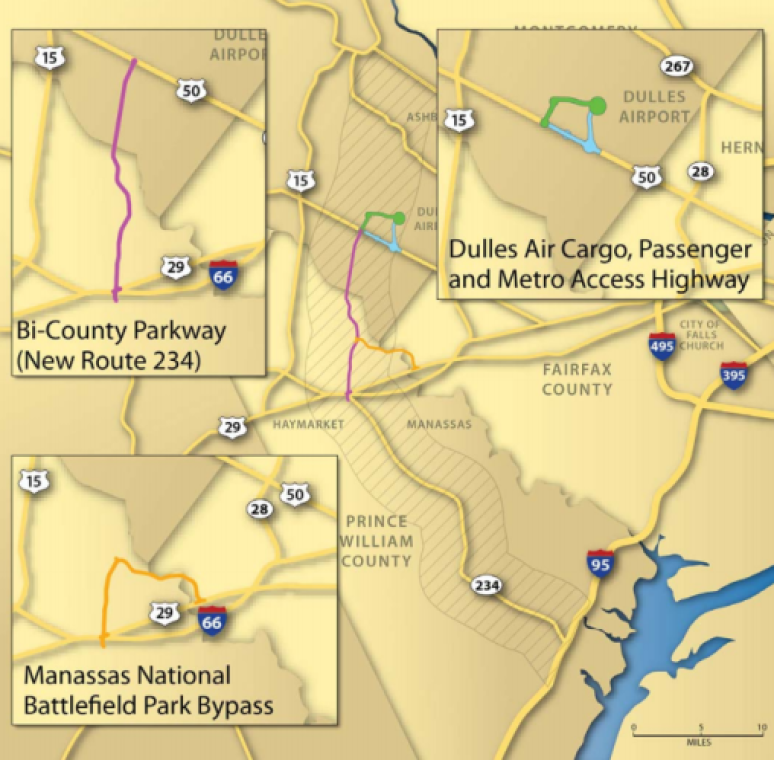
The North-South plan includes several regional projects, including the so-called Bi-County Parkway, which extends Route 234 from I-66 in Prince William to Route 50 and Northstar Boulevard in Loudoun. The project is meant as a north-south alternative to U.S. 15 and Route 28 that would provide greater connectivity between the two counties.
Pro-business officials from both Loudoun and Prince Williams have been adamantly in favor of the plan, while environmentalists and more conservative-growth groups are doing their best to thwart the project.
Tony Howard and Rob Clapper, presidents of the Loudoun and Prince William chambers of commerce, receptively, favor the Bi-County proposal. They issued a statement in late April after the study was released expressing their support for the project and dismissing the vocal opponents, whom they claim are misleading the public.
“The need for improved north-south connectivity between Loudoun and Prince William Counties has been well-documented by transportation and regional planning experts for decades,” the chamber presidents said in a prepared statement. “ … improvements to Route 234 and construction of a new Bi-County Parkway (Route 234 Extended from I-66 to Route 50 and Northstar Blvd.) will not require closure of Route 29 through the Battlefield. In fact, the closing of Route 29 through the Battlefield could only be triggered by construction of the Manassas Battlefield Bypass, a project for which there is currently no funding and, in our belief, is a project that is unlikely to occur.”
U.S. Rep. Frank Wolf (R-10th), however, is urging thoroughness in the review and advancement of the project. Before last week’s vote Wolf sent a letter to Gov. Bob McDonnell pushing for the delay.
“Thousands of people have moved to Prince William and Loudoun counties since the project’s master plan was approved in 2005,” Wolf said. “More public hearings must be held and more citizen input must be received before any final decision is made about the North-South Corridor.”
Opposition has been firm from environmental groups, notably the Piedmont Environmental Council (PEC) and the Coalition for Smarter Growth. PEC officials have gone far enough to call the proposed project an “outer beltway,” something project advocates have quickly dismissed.
“Rather than solve traffic problems, a billion dollar Outer Beltway will spark higher levels of residential development within the Prince William Rural Crescent and the Loudoun Rural Transition Area, adding more traffic to already congested east-west commuter routes. It will bring noise and pollution, split properties and neighborhoods, and reduce community access to local roads and services,” states a section on PEC’s website.
Living Laboratory: Sprawl & Stormwater on Rt. 1
Over 2 dozen people joined us to learn about Quander Brook and mixed-use development on this walking tour in Fairfax’s Route 1 corridor.
Should Virginia Build Another Highway? Study for “Outer Beltway” Released
Plans for a major highway in Northern Virginia are taking shape. Officials say the billion-dollar road would spur growth, but opponents say that premise is flawed.
The Virginia Office of Intermodal Planning and Investment state has released a study to the influential, 17-member Commonwealth Transportation Board (CTB) of a limited access, north-south highway between I-95 in Prince William County and Rt. 7 in Loudoun County, arcing west of Dulles International Airport.
The 600-foot wide “corridor of statewide significance” will eventually extend 45 miles by building upon existing infrastructure, carrying car commuters and express buses to meet forecasted job and population growth. Both counties have in their comprehensive master plans the additional lane capacity, although land use disputes may arise in towns with property in the planned corridor.
“We are in the visioning stage. We have very little money in this project. We have only put $5 million dollars on the project to date,” said Deputy Secretary of Transportation David Tyeryar, who presented the corridor study to the CTB last week. The board is expected to accept the study at its next meeting in May.
“We are still in a phase where we are meeting with the transportation departments of the localities and the landowners and trying to determine a vision for the corridor,” Tyeryar added.
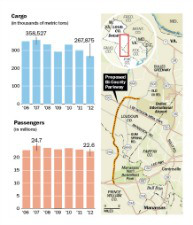
As Transportation Nation has reported, a north-south corridor could theoretically serve multiple purposes: help existing residents avoid traffic congestion, provide lane capacity for expected new residents and businesses, and help turn Dulles Airport into the East Coast’s premier freight hub.
“It’s going to be essential that this route eventually be established and hopefully built,” said Gary Garczynski, the CTB’s Northern Virginia representative and long-time real estate developer. “I’ve been around for 40 years in Northern Virginia and when you see the population and employment figures in this study… you need to have the vision to say we are going to need these roads.”
But studies have shown that building new roads doesn’t necessarily alleviate traffic, and opponents are marshaling objections to the estimated $1 billion price tag as well as the state’s employment and population forecasts in western Prince William and eastern Loudoun.
“Much of the growth projections are based upon plans of the local jurisdictions, not necessarily based upon some sort of demographic and economic analysis,” said Stewart Schwartz, the executive director of the Coalition for Smarter Growth, which favors transit-oriented projects to road building.
“We just raised taxes for transportation, but we didn’t do it to throw away the money. And we have such significant needs in Northern Virginia on the key existing commuter corridors, the funding of Dulles Rail, and fixing I-66,” Schwartz added.
The coalition’s director is also concerned about the public process, accusing the CTB of acting like a “rubber stamp” for Virginia road projects.
“One of the things we’re starting to think we need is an independent transportation planning agency separate from the Virginia Department of Transportation,” Schwartz said.
The CTB would be irresponsible to ignore the need to better move people and goods in Northern Virginia, Garczynski said. “The population and the employment growth is going to happen whether we build the road or not.”