
Tag: moco brt

RELEASE: New report identifies key ways to make Montgomery County’s bus rapid transit succeed

FOR IMMEDIATE RELEASE
September 1, 2015

CONTACT
Pete Tomao, Coalition for Smarter Growth
202-675-0016
pete@smartergrowth.net

MONTGOMERY COUNTY, MD — In 2013, the Montgomery County Council unanimously approved a plan for an 81-mile Rapid Transit network based on modern bus rapid transit. Today, appointed citizen task forces are working with county and state staff and consultants to design the network’s first three corridors. But the success of the system depends on getting the details right in order to provide high-quality, frequent, reliable and rapid service.

A new report, “Best Practices in Rapid Transit Design,” provides a roadmap for what’s needed to make Montgomery County’s Rapid Transit System a success.

DOWNLOAD OR VIEW THE FULL REPORT [PDF]
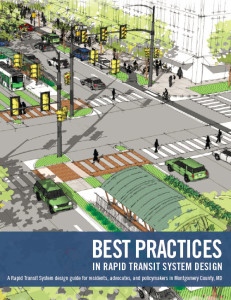
RTS-Best-Practices-thumbnail

The report, released jointly today by Communities for Transit and the Coalition for Smarter Growth, draws lessons from successful bus rapid transit systems throughout the US and Canada. “As of 2015, there are more than 30 bus rapid transit systems in operation across the US and Canada and more than 25 others in planning. Many have been running since the early 2000s, and have greatly exceeded expectations for ridership and service,” said Pete Tomao, the Coalition for Smarter Growth’s Montgomery County Advocacy Manager. “In Eugene, OR, for example, the Emerald Line has doubled transit ridership in the corridor it serves.”

“Our report is designed to assist the citizen task force members, elected officials and staff in their deliberations,” said Tomao. The report identifies and describes over a dozen features of successful bus rapid transit, including:

  • dedicated lanes for vehicles to bypass traffic
  • frequent and reliable service
  • stops spaced farther apart than local buses
  • 10’ general travel lanes
  • comfortable stations
  • offboard fare collection
  • level boarding
  • easy, safe access for people walking and bicycling
  • real time arrival information.

“BRT systems can produce travel time savings of up to 25% compared to other transit and can move far more people between home, work, school and services along our crowded arterial corridors than can single-occupant vehicles,” said Tomao. “The county’s ability to manage growth and traffic, and to attract the next generation workforce and companies, depends on investing in a well-designed system that attracts passengers because of its quality, efficiency, speed, and reliability.”

“In our research, we’ve found that successful systems around the country consistently share the same features, which we outline in our report and which we hope will be incorporated into Montgomery’s system,” Tomao concluded.

Earlier this year, Montgomery County appointed citizen task forces for each of the network’s first three bus rapid transit corridors: Route 355, Viers Mill Road, and Route 29. The task forces began meeting in Feb 2015 and are split into five groups — MD 355 North, MD 355 South, US29 North, US 29 South, and Veirs Mill Rd. Key decisions include whether to provide dedicated right-of-way, street and station design, fare collection, stop locations and more.  The corridor task forces are separate from the Transit Task Force appointed to recommend how to finance the system and who should operate it.

About the Coalition for Smarter Growth

The Coalition for Smarter Growth is the leading organization in the Washington DC region dedicated to making the case for smart growth. Its mission is to promote walkable, inclusive and transit-oriented communities, and the land use and transportation policies and investments needed to make those communities flourish.  Learn more at smartergrowth.net.

About Communities for Transit

Communities for Transit (CFT) educates the public on the planned & unanimously-approved Rapid Transit System for Montgomery County, MD. CFT focuses on community outreach to build awareness of the compelling case for rapid transit as an effective response to our unsustainable traffic problems.  Learn more at communitiesfortransit.org


###

Fact sheet: Benefits of Rapid Transit for Montgomery’s Veirs Mill Rd corridor

Fact sheet: Benefits of Rapid Transit for Montgomery’s Veirs Mill Rd corridor

RESIDENTS ALONG VEIRS MILL ROAD NEED THE RTS AS A TRANSIT OPTION
• More than 6,000 (15.4%) of commuters along the Veirs Mill Road corridor have commutes longer than 60 minutes.
• Since 1990, the number of residents in this corridor with these mega-commutes has nearly doubled.
• 22.7% of corridor residents take transit to work: nearly twice as many as in 1990. Almost half of these transit riders
take the bus to work.
• The median income of Veirs Mill Corridor residents is nearly $20,000 less than the median income in Montgomery
County overall. Almost 44% of Veirs Mill Road corridor residents are foreign-born.

Fact sheet: Benefits of Rapid Transit for Montgomery’s US-29 corridor

Fact sheet: Benefits of Rapid Transit for Montgomery’s US-29 corridor

RESIDENTS ALONG THE US 29 CORRIDOR NEED THE RTS AS A TRANSIT OPTION
• Almost 9,500 (17.2%) of commuters in the US 29 corridor have commutes longer than 60 minutes.
• Since 1990, the number of residents in this corridor with these mega-commutes has nearly doubled.
• 17.5% of corridor residents take transit to work: nearly twice as many as in 1990. Almost half of these transit riders
take the bus to work

Fact sheet: Benefits of Rapid Transit for Montgomery’s 355 corridor

Fact sheet: Benefits of Rapid Transit for Montgomery’s 355 corridor

Today, transit access is more important than ever. Residents along the 355 corridor need the RTS as a transit option.
• Nearly 12,000 (14.5%) of commuters along the 355 corridor have commutes longer than 60 minutes.
• Since 1990, the number of residents in this corridor with these mega-commutes has more than doubled.
• 18.1% of corridor residents take transit to work: nearly twice as many as in 1990.
• The median income of 355 corridor residents is over $8,000 less than the median income in Montgomery County overall. Nearly one t…

Montgomery paves the way for bus network that could zip by traffic

With Montgomery County Executive Ike Leggett running for a third term in November, transit advocates are planning an agenda for his next term. Leggett will run against Republican James Shalleck in an overwhelmingly Democratic county. For transit advocates, this means a push to turn projects such as the Purple Line, Corridor Cities Transitway and a bus rapid transit network into reality.

Discussing the Future of Rapid Transit in Rockville

On Wednesday, June 25th, Communities for Transit and Coalition for Smarter Growth are holding a free, open event from 6:30-8:00 p.m. at Rockville Memorial Library to discuss Montgomery County’s planned 81-mile bus rapid transit (BRT) system. What is bus rapid transit, and how would it affect our city?

RECAP: Silver Spring Rapid Transit Open House

On Wednesday, February 26, Communities for Transit and the Coalition for Smarter Growth debuted a new public meeting format during our Silver Spring Rapid Transit Open House. The meeting, attended by 44 local residents, contained a short presentation with videos to show different road treatment options and station features.  Following the presentation, attendees were invited to visit different kiosks around the room, where eight large information boards were placed, in order to learn more and ask questions about the matters of RTS that were most important to them. The Seventh State blogger, David Lublin, describes his take on the Open House and the RTS plan, including our new RTS Map, designed like the WMATA Metro Map.

To read original article, please click here. 

Photo courtesy of Communities for Transit.

RELEASE: Strong majority of Montgomery voters support county’s plan for a Bus Rapid Transit Network, according to new poll

A poll commissioned by the regional advocacy organization Coalition for Smarter Growth found strong support among Montgomery County voters for investment in a new Bus Rapid Transit network (BRT). After listening to a list of positive and negative perspectives on Montgomery County’s planned BRT network, likely Montgomery voters expressed support for the system by a margin of 71 to 22 percent.