
Over 2 dozen people joined us to learn about Quander Brook and mixed-use development on this walking tour in Fairfax’s Route 1 corridor.
Author: admin
Friends Around Town
Your Friends have been out in the community over the last month and we’re grateful to our partners for engaging us in these fascinating opportunities. Dan Reed and I were both panelists during a Montgomery Housing Partnership breakfast focused on social media in community engagement.
Montgomery Housing Partnership’s mission is to expand and preserve affordable housing in Montgomery County – something that will become an issue in White Flint if the county truly wants to draw a younger demographic. MHP doesn’t just advocate, they also walk the talk by “acquiring, rehabilitating, building and managing quality affordable housing.”

Friends of White Flint was very proud to be part of Coalition for Smarter Growth’s Walking Tours and Forum Series. ”White Flint: From Drag to Desirable” was the topic that kicked off this season of walking tours – and to a sold out crowd! Nearly sixty people joined Stewart Schwartz of CSG, Nkosi Yearwood of the Planning Department, Tommy Mann from Federal Realty and me on a beautiful morning’s trek through the past, present and future of White Flint.
The tour was a great way to feel and see the differences between streets that solely car-focused, as opposed to those that consider all travelers. Features like tree buffers, bike lanes, benches and trash cans equalize priorities among pedestrians, bikers and drivers. Many of our main White Flint streets still have a long way to go in becoming truly walkable.
Friends of White Flint also hosted a Developer Showcase on April 30th in the Whole Foods Rockville café. It was an opportunity for the community to browse new projects in White Flint’s future, and meet the people behind the ideas. Paladar Latin Kitchen, Montgomery County Parks Department (Wall Park), LCOR (North Bethesda Center), Lerner Enterprises (White Flint Mall), and Federal Realty Investment Corp (Pike & Rose) were all available to chat, show their plans and share guacamole. Friends of White Flint member Chevy Chase Land Company was also present with information about their plans for Chevy Chase Lake.
Over 100 visitors checked out the exciting plans for White Flint and appreciated seeing the images up close. If you weren’t able to join us that rainy morning, let us know if you’d like us to host a similar event on an upcoming evening!
Finally, Friends of White Flint has begun a monthly presence at the Pike Central Farmers Market! Find us among the food trucks and produce and learn more about your community while you browse!
And, wherever you see us – don’t hesitate to share your thoughts on the plans for White Flint. We’re here to have a positive and consensus-building conversation. Join in!

14th Street: Past, Present, and Future
The Greater U Street area of 14th Street NW has witnessed dramatic change in just a few short years. Over 1000 housing units are under construction or newly built, about 85,000 square feet of retail space have been added, and dozens of restaurants have opened in the past few years. What makes this historic district such a magnet for new development? How has historic preservation and the arts district coexisted with dramatic redevelopment all along the corridor? What’s being done to preserve and build affordable housing? We heard about the story of the rapidly changing 14th Street NW corridor from the people who live and work here.
Testimony before the Hon. Muriel Bowser, Chair of the Committee on Economic Development and Housing re: FY 2014 Budget Oversight for DMPED and DHCD
Please accept these comments on behalf of the Coalition for Smarter Growth. We are a regional organization based in the District of Columbia focused on ensuring transportation and development decisions are made with genuine community involvement and accommodate growth while revitalizing communities, providing more housing and travel choices, and conserving our natural and historic areas.
DMPED should recommit to leveraging public land dispositions for affordable housing
We are greatly disappointed in DMPED’s reduced expectations for affordable housing in new public land dispositions. Given the increasing challenge of housing affordable to our residents, we urge the Council to ensure DMPED recommit to leveraging public land dispositions for affordable housing, including for very low income households. In our 2012 report, Public Land for Public Good, we show that the District has and can do great things with its city-owned land. We are disappointed that DMPED is departing from the practice of the past decade to ask for 20-30 percent of affordable housing in public land dispositions affordable to households earning 30%, 50%, 60% and 80% Area Median Income (AMI). We are also surprised that the Mayor’s Housing Task Force dropped any recommendation to make the most of public land sales for affordable housing and sent this issue to the future study list.
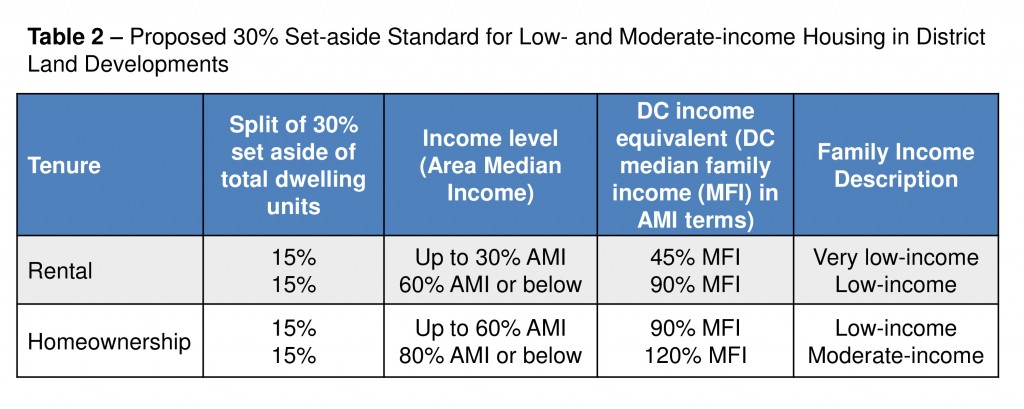
Under DMPED’s current leadership, commitment to affordable housing in solicitations for public land dispositions has steeply declined. DMPED no longer asks for a specific percent of affordable housing or specific income levels. Instead, DMPED asks that proposals comply with or exceed the Inclusionary Zoning (IZ) law, which is already required for most residential development. IZ sets a minimum of 8-10 set aside at 50-80% AMI, with most income targeting at 80% AMI. To compensate, developments receive a 20% bonus density. Given the city can (and used to) leverage the value of its own land to subsidize housing, we should expect much more from public land deals. We recommend that DMPED restore the earlier practice of to asking for a 20-30% set aside with income targeting at the 30% AMI, 60% AMI and no more than 80% AMI income levels. (See tables 1 & 2 below).
This drop off in affordable housing in public land dispositions as a priority is particularly surprising given the attention the administration has put on renewing efforts to preserve and create more affordable housing. Public lands are an important tool for creating new affordable housing that the administration should not abandon now. We ask the council to ensure we are making the most of the unique opportunity to leverage the value of the District’s land to create more affordable housing through the public land disposition process. Public land disposition and development requests should clearly ask for and prioritize proposals that offer substantial amounts of affordable housing, including units affordable to those earning 30 percent AMI. As was the practice in the past, we ask that requests specify the city is seeking 20 percent to 30 percent of the total number of residential units affordable at 30 percent and 60 percent AMI for rentals, and up to 80 percent AMI for ownership. We suggest table 2, below, as a model. In addition, we ask that DMPED better coordinate with other agencies to pool resources to ensure the production of housing affordable at deeply affordable levels as a part of larger mixed income or all affordable development.
DHCD – support $100 million to affordable housing, ensure IZ & ADUs have support they need
Regarding DHCD’s budget, first and foremost, we want to express our support for the $100 million commitment to affordable housing, with $87 million going to the Housing Production Trust Fund. We commend the Mayor for this commitment and ask the Council to support this. These funds are critically important to addressing our city’s escalating housing prices that are burdening a large share of D.C. households with higher and higher housing costs.
Inclusionary Zoning & affordable dwelling unit management
IZ administration has experienced significant problems in the start up phase. DHCD has indicated that is making headway addressing these significant challenges. DHCD will propose revisions to overly cumbersome administrative regulations, which should improve the process. DHCD has worked with Office of Planning and the Zoning Commission to resolve conflicts with FHA mortgage lending standards. DHCD has solicited for additional assistance to implement IZ and Affordable Dwelling Unit (ADU) programs. These are all important steps to addressing the major administrative challenges IZ implementation has encountered. We remain concerned that the office responsible for administering IZ and ADUs is understaffed. We suggest that at a minimum, and new Capital City Fellow be added to their small team.
I want to thank Director Michael Kelly and his staff for their openness and responsiveness to us.
Thanks also to Chairman Bowser’s keen interest in ensure these programs work, and affordable housing opportunities are increased.
Thank you for your consideration.
Sincerely,
Cheryl Cort
Policy Director

Testimony before Martin Grossman, Director of the Office of Zoning and Administrative Hearings in Opposition to Special Exception Request for S-2863, Costco Wholesale Corporation
Dear Hearing Examiner Grossman:
Please accept these comments on behalf of the Coalition for Smarter Growth. Our non-profit organization works to ensure that transportation and development decisions in the Washington, D.C. region, including the Maryland suburbs, accommodate growth while revitalizing communities, providing more housing and travel choices, and conserving our natural and historic areas.
We want to express our opposition to the Special Exception request for the Costco automobile filling station – a large scale gas station which will attract vehicle trips from outside the local area. We believe this proposal is wholly inconsistent with the 2012 Wheaton CBD and Vicinity Sector Plan, and antithetical to the goal of promoting transit-oriented, pedestrian-friendly development within one half mile of a Metro station. The Wheaton Sector Plan area not only offers high quality Metrorail service, but also extensive bus service and a planned rapid transit service. This concentration of transit services will increase the share of trips made by transit, encourage more walking, and reduce how much people drive in the area.
As a regional organization, we advocate for well-designed transit- and pedestrian-oriented development which focuses more housing and commercial activities within an easy walk of Metro stations and other high quality transit services and historic downtowns. We seek to mitigate existing automobile-oriented uses in transit districts, and prohibit new ones. Reducing auto-oriented uses and their impacts are important to fostering a public realm and private development that better cater to pedestrians rather than prioritize the movement of motor vehicles. Uses such as gas stations, automobile repair services, drive thrus, and similar uses that attract motor vehicular traffic and encourage automobile-oriented designs such as additional driveways, wider driveways, surface parking, and curb cuts should be minimized, reduced, and in some cases, prohibited in transit districts like the Wheaton Sector Plan area. The proposed, a high volume gas station, is an unnecessary new auto-oriented use that would detract from the county’s and our efforts to create a more pedestrian-friendly environment around the Metro station.
The Plan specifically identifies the existing “auto-oriented uses” of the area as one of the key issues to be addressed through the implementation of the Sector Plan. The addition of a large scale gas station would compound the “auto-oriented uses” problem identified in the Sector Plan. We recognize that the site of the gas station is on the outer part of the mall property and Plan boundary. Yet we find the proposed use not a neutral use related to our goals to improve the pedestrian environment, but rather a use that actively degrades the pedestrian environment and works against Sector Plan goals. With such a large scale gas station, additional vehicle trips will be attracted to the transit district from outside the local area simply for the purpose of refueling vehicles with cheaper gasoline. This regional automobile service use contradicts the Sector Plan’s and our goals to reduce vehicle miles traveled. Introduction of a new large scale gas station would directly oppose the Plan’s guidance to:
“Provide better pedestrian connectivity and support safe, secure, and appealing street level activity” (p. 25)
In an area like the Wheaton Sector Plan area, we have often found that the transition from auto-oriented land uses take time, but can be phased in to create more transit-oriented and pedestrian-friendly development. The Wheaton Sector Plan accommodates the existing auto-oriented regional mall surrounded by surface parking, but seeks to manage the negative impacts on pedestrians but proposing pedestrian access improvements, pedestrian-oriented street design changes, and encouragement of redevelopment to a more pedestrian-friendly design. Preventing new uses that would further degrade the transit district is also an important part of progressing towards a more pedestrian-friendly Wheaton Sector Plan and Metro station area. The large scale gas station would degrade the pedestrian environment by attracting additional automobile trips to the area and force more automobile-oriented designs for public rights-of-way to accommodate this auto-oriented use. Preventing this kind of use also promotes our overall goals to support greater use of transit, and build safe, walkable places, especially around major transit hubs.
For all of these reasons, the Coalition for Smarter Growth urges denial of the Special Exception application for the Costco automobile filling station.
Thank you for your consideration.
Sincerely,
Cheryl Cort
Policy Director
Testimony before the City of Alexandria City Council re: Coordinated Development Districts #21/#22 and Design Standards for Beauregard Small Area Plan
Good afternoon. I am Stewart Schwartz, Executive Director for the Coalition for Smarter Growth.
The Coalition for Smarter Growth closely tracked the planning for the redevelopment of the Beauregard corridor and testified in support of the new plan. We have studied the staff report for the new Coordinated Development Districts in great detail.
Our review of the staff report, community advisory committee reports and other supporting documentation indicates a very high degree of due diligence and analysis. The city has invested significant resources in ensuring all the pieces fit together in this complex rezoning, including the design standards, the staging related to transportation improvements, and the developer commitments to financing public infrastructure and affordable housing. The city also established community advisory committees to collect ongoing input and provide independent recommendations to the staff, Planning Commission and Council.
Mixed-use, mixed-income development in walkable, transit-oriented development offers the best way for our region to grow while managing traffic, increasing access to jobs for all incomes, and reducing energy use and pollution, including greenhouse gas emissions.
Understandably, the key area of ongoing concern has been affordable housing and we understand the concern of existing residents who depend on affordable rents. Entendemos. The Coalition for Smarter Growth has included affordable housing policy as a core component of our work including support for housing trust funds, inclusionary zoning, use of public land, zoning and other tools.
Market rate affordable housing is under pressure and at risk due to the region’s continued population growth and the traffic that is encouraging residents to live closer to jobs and transit. It is this demand to live close to jobs, transit and the core, that has developers like JBG seeking out larger parcels of land with the potential for significant redevelopment, such as the garden apartments within the Beauregard community.
Most of the garden apartments are found in an area that the city included in CDD #4 a number of years ago, which created an incentive for purchase and redevelopment, but without a set-aside or other affordable housing preservation strategies for the area. Given the current situation, CDD #21/#22 offers the best opportunity to secure long-term committed affordable housing and a range of other community benefits.
We are glad that the city conducted a tenant survey to better understand the needs, and that as a result, the city has made adjustments to the affordable housing plan, tenant transition, and associated financing plan, including increasing the number of units for households with incomes at 40% of Area Median Income and below.
The plan’s housing goal and an effective strategy to create 800 long-term committed affordable units are essential. It includes the largest developer contribution ever made to affordable housing in our region – $66 million, and the city’s substantial commitment using tax increment financing. It appears to now be better tailored to the needs identified in the tenant survey with a focus on people earning $15,000 to $65,000 per year, depending on family size. Over 50% of the 800 units will be at 40% AMI and below.
Redevelopment of the garden apartments will happen over many years, providing time for creative affordable housing deals, especially with non-profit housing developers, and other strategies to offer additional committed affordable housing units. Espero que; creo que la Ciudad va a hacer lo que es necesario para ayudar a la communidad con este cambio.
The city has drafted an Affordable Housing Master Plan, which is much needed. We’ve lost too much because of not doing enough in the past. The plan should also be improved with clear numerical goals, dedicated funding, and the city’s priority attention to adopting the policies and programs necessary to more effectively preserve and expand affordable housing. At the same time, the city also needs the tax base from well-planned, competitive transit-oriented redevelopment to create the taxpayer resources necessary for this affordable housing strategy.
In conclusion and weighing the information before you today, we recommend that you support the rezoning to Coordinated Development Districts 21 and 22. Thank you.
Stewart Schwartz
Executive Director
D.C.-region smart-growth organization releases transit report
Earlier this week, the Coalition for Smarter Growth issued a report on the Washington, D.C. region’s public transportation, including a set of nine principles to guide long-term regional planning for the next generation of transit. The Coalition for Smarter Growth, a non-profit, works to promote smart growth in the Washington, D.C. region.
For those living or working in Washington, D.C., Maryland or Virginia who ever tried to travel to one of the three major area airports, work, or activities and errands without driving a car, they know that Metro serves as a backbone of our regional public transportation network, and they understand that this network includes numerous transit entities that cross local jurisdictional lines.
Relying in part on 2012 and 2013 reports on next-generation transit goals issued by the Metropolitan Washington Council of Governments and Washington Metropolitan Area Transit Authority, respectively, the March 4, 2013 Coalition for Smarter Growth’s primer summarizes plans to grow the Metro system and to expand public transportation.
The report discusses six ongoing transit initiatives: Metrorail’s 23-mile Silver Line extension in Virginia; a new eight-line light-rail and streetcar network throughout D.C.; Metrorail’s Purple Line cross-county connection in Maryland; a new 5-mile streetcar service along a mixed-use corridor in Arlington and Fairfax Virginia; three rapid bus transportation corridors in Alexandria and Arlington, Virginia; and a 160-mile rapid bus transportation system in Montgomery County, Maryland.
The report, “Thinking Big Planning Smart,” states that its purpose “is to get you involved in creating a vision and plan for the new public transportation investments we need to link together our region’s ever-growing number of livable, walkable centers and neighborhoods.” The Coalition offers the 35-page report as a primer on the next generation of transit and a resource on already-planned regional transit proposals in progress.
As Aimee Custis, Communication Manager at the Coalition for Smarter Growth, wrote on the popular blog Greater Greater Washington, “[the] report is both a call to action and a baseline resource.”
Photo courtesy of Doug Canter.
Read the original story here >>
Testimony before Ms. Françoise Carrier, Chair of the Montgomery County Planning Board re: Long Branch Sector Plan Comments
Dear Chair Carrier and members of the Board:
Please accept these comments on behalf of the Coalition for Smarter Growth. Our organization is a regional organization focused on ensuring transportation and development decisions are made with genuine community involvement and accommodate growth while revitalizing communities, providing more housing and travel choices, and conserving our natural and historic areas.
We appreciate this planning effort to prepare for the Purple Line stations and ensure that land use and the street network can support a more walkable, transit-oriented community. While we support the plan overall, we have specific concerns related to preservation of the affordable housing in the area, and the retention of small, local businesses.
Affordable Housing
The plan provides a useful analysis of anticipated trends in housing, showing increasing rents of low priced rental housing with or without the Purple Line, but the loss of a substantial number of market affordable units in the redevelopment scenario envisioned by the plan. Under either scenario, greater commitment by Montgomery County government is needed to preserve and expand housing opportunities for low and very low income households in the area. Without this commitment, we will either lose the affordability of low rent market affordable units slowly through rising rents, or more rapidly with the arrival of the Purple Line. We urge the Planning Board to work with the county to create an affordable housing strategy in conjunction with the sector plan. This effort should coordinate with the Department of Housing and Community Affairs to identify resources and properties that could be acquired and redeveloped with additional subsidy to secure and expand affordable housing in the area.
The sector plan relies almost exclusively on MPDUs as the response to the need for maintaining affordable housing in the area, while acknowledging much more needs to be done. We commend the 15% MPDU requirement, however, this standard falls short in a number of ways. The 15% standard for the plan can help address concern that the CR zones are reducing production of MPDUs to the minimum required. The 15 percent requirement, however, needs to be matched with assurance that the 22 percent bonus density is achievable. Where the CR zone standards are a constraint in achieving the 22 percent bonus density, this constraint should be removed. The height limit is often the key constraint to achieving the 22 percent bonus, thus this limit should be modified to allow for the full realization of the MPDU bonus.
Given the challenges with finding resources to preserve and build affordable housing in this area, we urge the Planning Board to leverage its use of MPDUs to create more below-market rate units. We suggest further incentive by creating a new 20% MPDU set aside standard that offers additional FAR and height.
Complete Streets
We appreciate the plan’s goal to create a safe, walkable environment and the intention to designate the area as a Bicycle and Pedestrian Priority Area. We ask that as streets are redesigned, particular attention is given to improving the safety of pedestrian movements at major intersections. State and county street design standards should be reconsidered in light of the goal that public rights of way are places are truly inviting for pedestrians and shared spaces for all users.
Small business retention and assistance
We appreciate the plan seeking to retain small businesses and encourage public private partnerships to support affordable space for businesses providing unique products and services. The specifics of how this will be accomplished, however, need to be better addressed. The ability of the CR zone to support this goal should be carefully assessed. Assistance from county programs should also be better connected to the changes the plan seeks through rezoning.
Overall, all we appreciate the efforts of this plan to anticipate and guide change. We remain concerned however, that this plan and a coordinated response with the county is falling significantly short of addressing the housing needs of low income families in the area. We ask that the Planning Board reconsider the tools it can leverage, as well as better coordinate a response with the county which can provide resources and programs to address housing and small business needs.
Thank you for your consideration.
Sincerely,
Cheryl Cort
Policy Director
The Regional Medical Center belongs at a Metro Station
All Prince George’s County residents have a vested interest in getting the decision right about where to locate and how to design the new county and state-supported $650 million Regional Medical Center with a workforce of more than 2000 employees. To leverage the most competitive healthcare benefits and economic development opportunities, we need state-of-the-art urban design at a Metro station.
Building a new Regional Medical Center at a Metro station means:
- A regionally transit-connected center of medical excellence that can attract the best in class workforce using a walkable urban design that integrates into the surrounding context;
- Less traffic, more access for workers, and more convenient access to quality healthcare for everyone, including individuals who must rely on transit;
- Jumpstarting other quality mixed-use development, delivering a big economic boost for Prince George’s and the surrounding area.
Largo Town Center Metro station is the best option
- Largo Metro has a vacant 20 acre site (old parcel D) just east of the entrance owned by PNG Schwartz that already has 1 million square feet approved for a federal HHS office building on just half of the site (Commons at Largo). 20 acres is plenty of room for a state-of-the-art hospital and medical office buildings. The 69-acre Boulevard at Capital Centre is on county owned land and could be part of a larger medical complex in the future.
- Largo Metro station has ample vacant land, multiple roadway connections, rail & bus service, nearby retail, office and residential uses.
- Combined with a pedestrian-friendly urban design, a hospital center could drive economic development as an anchor for a mixed-use destination and downtown district for Prince George’s.
- The medical center can be sensitively located in the existing community around the Largo Town Center Metro station to manage traffic and ensure that existing residents will have improved access to the Metro, nearby services, offices, and new jobs.
Why the 2 non-Metro sites would be a major missed opportunity for the county
- Both the Woodmore Towne Centre and the Landover Mall sites are located a mile and half from the closest Metro station – too far to walk & too far to leverage Metro access for more transit-oriented economic development.
- Far from Metro, Woodmore Towne Centre is a sprawling 245-acre, automobile-oriented, outside-thebeltway greenfield site that hasn’t been able to attract the investment it promised.
- Landover Mall needs reinvestment but its distance to a Metro station and lack of connectivity to a mixed-use district makes it a poor candidate for a competitive Regional Medical Center.
- These sites would generate more traffic since it would be difficult for anyone to access the medical center without a car.
Coalition for Smarter Growth: Sign the petition & learn more at smartergrowth.net/PGmedicalcenter
Testimony before the Prince George’s County House Delegation in Support of PG 420-13: School Facilities Surcharge
Please accept these comments on behalf of the Coalition for Smarter Growth. Our organization works to ensure that transportation and development decisions in the Washington, D.C. region, including the Maryland suburbs, accommodate growth while revitalizing communities, providing more housing and travel choices, and conserving our natural and historic areas.
We urge you to support Bill PG 420-13 – School Facilities Surcharge, in order to take reasonable measures to catalyze transit-oriented development by removing unnecessary barriers to investment near transit stations. The bill lessens the burdens on multifamily housing construction near major transit stations which is exactly what is needed for Prince George’s to compete for the workforce and employers of the future.
Multifamily units, especially studio units, produce a fraction of the school-aged children that single family housing generates, thus the reduction in the school facilities surcharge will not overburden the county. It will, however, strengthen the tax base by attracting more of the largest segments of our population — young professionals and retirees seeking to live in a more urban, transit-accessible environment.
The recent assessment by the Prince George’s Planning Department in “Where and How We Grow Policy Paper,” urges the county to depart from its historic pattern as a spread out bedroom community. Instead, it urges the county to encourage development in Centers and the Developed Tier by reducing fees. It cites regional growth forecasts showing that economic development and workforce housing preferences will demand a major increase in multifamily housing near transit:
“[M]ore than 79 percent of units in the [County’s] pipeline are single-family detached units intended for the Developing Tier; however, to meet future demand, more than 60 percent of new housing units to be built should be multifamily units located in walkable communities at transit-accessible locations.
“Furthermore…between 2000 and 2010 Prince George’s County acquired one of the lowest numbers of new residents in the region. Without a recalibration of county priorities and policies that promote TOD and high-quality, mixed-use development, it is likely that the county will be at a continued disadvantage relative to its neighbors when it comes to attracting residents and employers who value the connectivity and amenities that other such communities provide.”
Again, we ask that you support Bill PG 420-13 – School Facilities Surcharge. Thank you for your consideration.
Cheryl Cort
Policy Director