Click here to watch our Active Transportation Webinar featuring transportation officials in the Northern Virginia region discussing how they are responding to COVID-19. The event was cosponsored by Fairfax Alliance for Better Bicycling, the City of Fairfax, Fairfax County, and George Mason University’s Department of Parking and Transportation.
Author: Elena Sorokina
Sligo Creek Trail Crossing Safety Improvement Sign-on Letter
Mr. Tim Smith
State Highway Administration
707 North Calvert Street
Baltimore, Maryland 21202
Dear Mr. Smith,
We, the undersigned, request the Maryland State Highway Administration (MDSHA) implement pedestrian and bicyclist crossing improvements at highways MD-212/Riggs Road and MD-410/East West Highway which intersect M-NCPPC Sligo Creek Trail and highway corridors near the park trail.
These popular Sligo Creek Trail crosswalks at state highway intersections present a significant threat to vulnerable pedestrians and bicyclists as a consequence of inadequate signal facilities, excessive driver speed for conditions, substantial crossing distances, several multi-threat travel lanes, exposure from high vehicle volume, lack of shoulders and center median (MD-410), and obstructed crosswalk visibility. In short, these crosswalk systems are compromised.
We request the following suite of Safe System elements be implemented by MDSHA to provide adequate crosswalk safety:
- Narrow Travel Lanes
- Remove Visibility Obstructions and Barriers
- Build a Pedestrian Island Refuge (MD-410)
- Extend Bike Lanes (MD-212)
- Implement a Road Diet (MD-212)
- Implement Context-Driven Safe Speed
- Upgrade the Crosswalk Beacons
These Safe System elements work together as an ensemble to keep vulnerable crosswalk users and drivers safe. These recommended Safe System elements are summarized in Table 1.
This is a major safety issue.
- Vulnerable pedestrians and bicyclists on key trail crossings, which include school children, are currently exposed to high speed, high volume (23,000 vehicles per weekday) traffic, crossing several dangerous multi-threat lanes with inadequate or non-existent shoulders. The crossing systems are also compromised by obstructed sightlines from the presence of blind (sag) curves, utility poles, and bridge wall visibility blockages.
- These compromised trail crossing systems have resulted in numerous documented Maryland State Police crashes resulting in the crossings being identified as medium to high pedestrian and bicyclists crash “crash hot spots” in the MDOT Maryland Bicycle and Pedestrian Master Plan (2019).
The design ignores equity and land use contexts.
- These highway corridors serve a highly disadvantaged and chronically underserved majority-minority community and included within Maryland Equity Emphasis Area, Priority Funding Area, and Health Outcomes SocioNeeds Area.
- These trail crossings serve a dense urban community (10,000 residents per square mile) with extremely high percent of no-car households (30%) satisfying demand created by numerous nearby (<0.25 mile) amenities including elementary schools, park and recreation centers, and shopping centers.
Sligo Creek Trail is a major part of our transportation system.
- These trail crossings are an integral component of the Anacostia Tributary Trail System (ATTS) serving seven regional and national trail systems thereby helping Maryland promote its rich and diverse cultural, historic, and environmental, and heritage.
- These trail crossings provide 23,000 residents critical links six transit stations from four rail lines (WMATA Purple, Red, Green, Yellow Lines and MVA/MARC Camden Line) meeting growing demand for accessibility within the region’s multi-modal transportation system which include significant Transit/Trail Oriented Development, upgraded nearby bicycle facilities (MD-500, MD-193, Ager Rd), and the 670 bicycle fleet Prince George’s County Bike Share Program.
Our request is consistent with MDOT/MDSHA’s “context driven” engineering guidelines. These MDSHA guidelines include safe speed limits, continental crosswalks, and specialized signals. Similar Safe System elements are being implemented by MDSHA through the MD-500/Queens Chapel Project. Prioritizing Sligo Creek trail crossings is also congruent with MDOT policy goals promulgated by the Maryland Bicycle and Pedestrian Master Plan (2019).
Finally, our Sligo Creek Trail crossing Safe System recommendations are consistent with Federal Highway Administration (FHWA) Safe Transportation for Every Pedestrian (STEP) recommendations, MDOT/MDSHA urban mobility-focused streetscape policy, and MDSHA cost-effective pedestrian safety countermeasures currently being undertaken.
Thank you for your urgent attention to making the M-NCPPC Sligo Creek Trail crossings safe.
Sincerely,
Capital Trails Coalition
Coalition for Smarter Growth
Table 1. Crosswalk System Deficiencies, Risks, and Recommended Safe System Elements
| Crossing System Deficiency | Risk | Recommended Safe System Element | MD212 /Riggs Road | MD410 /East West Hwy |
| Excessive Crossing Distance, Pedestrian & Bicyclist Exposure, Streetscape Encourages High Driver Speed | Pedestrian & Bicyclist Exposure, Unsafe Driver Speed especially with presence of blind curves and obstructions | Narrow Travel Lanes, Decrease Exposure, Encourage Drive Safe Speed, Decrease Stopping Distance | X | X |
| Crosswalk Barriers, Utility Poles, Bridges, Walls, and Blind Curves | Drivers and Vulnerable Crosswalk Users fail to see each other, increasing risk of crashes | Remove obstructions and barriers, improving visibility | X | X |
| Speed Limit Excessive for Trail, School, and Shopping Urban Environment | Likelihood of death for Pedestrians and Bicyclists struck by vehicles traveling faster than 30 mph is High | Implement Safe Speeds consistent with Context-Driven multimodal, urban conditions | X | X |
| Multi-Threat Travel Lanes, Excessive Crossing Distance, Streetscape Encourages High Driver Speed | Drivers Vision of Vulnerable Users Blocked, Significant Exposure to Vulnerable Users, Streetscape Encourages High Driver Speed | Build a Pedestrian Island Refuge (24 inch wide) in Median, Reduce Exposure from Multi-Threat Travel Lanes, Encourage Driver Safe Speed | X | |
| Multi-Threat Travel Lanes, Excessive Crossing Distance, Poor Driver/Vulnerable User Vision | Drivers Vision of Vulnerable Users Blocked, Significant Exposure to Vulnerable Users, Streetscape Encourages High Driver Speed | Extend Bike Lanes on MD212 from Sargent to MD410/East-West Highway Intersection, Reduce Exposure from Multi-Threat Travel Lanes, Encourage Driver Safe Speed | X | |
| Multi-Threat Travel Lanes, Excessive Crossing Distance, Poor Driver/Vulnerable User Vision | Drivers Vision of Vulnerable Users Blocked, Significant Exposure to Vulnerable Users, Streetscape Encourages High Driver Speed | Implement Road Diet (6 ->4 Travel Lanes), Extend Crossing Queuing Area using Curb Extensions/Bump-Outs as supported by highway Volume/Capacity, Encourage Driver Safe Speed | X | |
| Crosswalk Width (6ft) does not provide early warning of presence of Vulnerable Users in Crosswalk | Drivers speed and braking distance is excessive for conditions; risk of collisions elevated | Widen Crosswalk width from 6ft to 10ft, an, Encourage Drive Safe Speed | X | |
| Existing Circular Yellow Beacon Provides Inadequate Vulnerable User Crosswalk Safety for Highway Speed, Crossing Distance, Multi-Threat Travel Lanes, High Vehicle Volume and Vulnerable User Demand, Lack of Shoulders and Median, and Obstructed Visibility | Number of Crashes at and near crosswalks is high, risk of serious injuries and fatalities is significant | Upgrade crossing signal to Pedestrian Hybrid Beacon / HAWK or Full Signal (preferred) to provide adequate crosswalk safety for Vulnerable Users | X | |
| Existing Circular Yellow Beacon Provides Inadequate Vulnerable User Crosswalk Safety for Highway Speed, Crossing Distance, Multi-Threat Travel Lanes, High Vehicle Volume and Vulnerable User Demand, Lack of Shoulders, and Obstructed Visibility | Number of Crashes at and near crosswalks is high, risk of serious injuries and fatalities is significant | Upgrade crossing signal to Rectangular Rapid Flashing Beacon (RRFB), Pedestrian Hybrid Beacon / HAWK (preferred) or Full Signal to provide adequate crosswalk safety for Vulnerable Users | X |
RELEASE: Advocates Alarmed at 18,000 Page Environmental Impact Statement on Gov. Hogan’s I-495 and I-270 Widening Plan
July 10, 2020
FOR IMMEDIATE RELEASE
Friday, July 10th, 2020
CONTACT:
Lindsey Mendelson, Maryland Sierra Club
lindsey.mendelson@mdsierra.org | (240) 706-7901
Jeanne Braha, Rock Creek Conservancy
jbraha@rockcreekconservancy.org | (301)-312-1471
Advocates Alarmed at 18,000 Page Environmental Impact Statement on Gov. Hogan’s I-495 and I-270 Widening Plan
MARYLAND- Today, the Maryland Department of Transportation State Highway Administration (MDOT SHA) and the Federal Highway Administration (FHWA) released an 18,000 page Draft Environmental Impact Statement (DEIS) on Gov. Hogan’s plans to expand I-495 and I-270 with two private toll lanes in each direction. The DEIS outlines the impacts of the plan on the region’s air, water, parks, noise levels, traffic and other categories.
Residents and community organizations have just started to sift through the 90 pound document to assess the damage that the over $11 billion project could cause to Maryland’s environment, health, and economy, especially in the midst of a global pandemic and economic downturn. Advocates are concerned that the DEIS, despite its size, does not adequately examine key alternatives to the widening such as public transit and better land use planning nor effectively examine telecommuting’s role in reducing congestion.
In the last two weeks, over 40 organizations and U.S. Senators Ben Cardin and Chris Van Hollen and Congressmen Anthony Brown and Jamie Raskin asked for the comment period to be at least 120 days to accommodate the public’s ability to comment during the pandemic and complete the approximately 600 hours it would take to read through the document completely. Despite this request, the public comment period remains at 90 days, which would not be enough time for a person reading 40 hours a week to get through all the pages of the document.
“The Draft Environmental Impact Statement weighs 90 pounds. That alone indicates that this project warrants intense scrutiny. We are concerned that this massive highway project will exacerbate harm to our health and environment. The Sierra Club and other organizations have been denied, delayed or charged $300,000 for public information requests that would have shed more light on this project. We need more time to comment on this controversial proposal.” –Josh Tulkin, Director, Maryland Sierra Club
“Experience shows that highway expansions increase, not decrease, driving demand. By fueling more long-distance living and commuting, toll lanes are a massive, generational alteration of our landscape and come at high cost to homes and neighborhoods, people and health, and the natural environment.” – Jane Lyons, Maryland Advocacy Manager of the Coalition for Smarter Growth
“The $11 billion I-495/I-270 expansion is too big and will affect too many lives over the next 50 years for Marylanders to accept an 18,000 page draft environmental impact statement that offers vague assurances that pollution and flood risk won’t increase and parks and communities will be protected. We urge MDOT to give the public the time it needs to review this draft statement and to release the secret traffic and revenue studies being used to justify this massive, high-risk project. Maryland cannot afford a repeat of the crisis plaguing the Purple Line, the Hogan administration’s first public-private partnership. –Brad German, Co-Chair, Citizens Against Beltway Expansion
“This proposed expansion threatens our national parks, including Greenbelt Park, C&O Canal, George Washington Memorial Parkway, Suitland Parkway, and Baltimore-Washington Parkway, without solving the region’s transportation needs. Should this proposal move forward, over 300 acres of local parkland – including valuable green space in an increasingly urban area — could be paved over. Instead of pursuing this new and costly highway expansion, the National Parks Conservation Association urges the Maryland Department of Transportation to examine the many alternatives available that will address our transit needs without sacrificing our parks.”-Pamela Goddard, Mid-Atlantic Senior Program Director, National Parks Conservation Association
Rock Creek is just one of the many special places that will be impacted by the proposed $11 billion expansion of I-495 and I-270. These impacts will extend far downstream, including into the creek through the nation’s first urban national park, Rock Creek Park. The public deserves a full range of alternatives for these sensitive waterways, habitat corridors, and public lands and time to fully consider them.-Jeanne Braha, Executive Director, Rock Creek Conservancy
“How precious is breathing? How important is it to preserve natural spaces and protect the health of residents of this region? We at the Audubon Naturalist Society want MDOT and the SHA to tell us, because the delivery of this 90-pound EIS for an $11 billion project with only 90 days to review it suggests that our health and well-being are not a top priority. Taxpayers deserve better.” –Denisse Guitarra, Maryland Conservation Advocate, Audubon Naturalist Society
“MDOT gave assurances that the public would have an opportunity in the DEIS process to actively participate in the consequential decisions related to the I-495 & I-270 project. However, in releasing an 18,000-page DEIS in the middle of a health and fiscal emergency, and then failing to provide adequate time for document review, MDOT shows disregard for public input. No one knows what post-pandemic commerce, employment, and traffic patterns will look like — the entire effort should be paused until the pandemic subsides.”-Linda Rosendorf, Don’t Widen 270.
Had the Governor and the Maryland Department of Transportation followed a process that allowed for sufficient constituent input and alternative proposals before announcing this massive, destructive plan, the citizens of Maryland would not be in the position of pointing out the obvious. The plan is deeply flawed and may very well cause more harm than good.- Cecilia Plante, Maryland Legislative Coalition.
###
CSG Testimony Supporting Montgomery County Bill 13-20
July 8, 2020
Montgomery County Council Council Office Building
100 Maryland Ave.
Rockville, MD 20850
Bill 13-20, County Property – Disposition – Affordable Housing (Support)
Public Testimony
Jane Lyons, Maryland Advocacy Manager
President Katz and Councilmembers, thank you for the opportunity to submit written testimony on Bill 13-20. Please accept these comments on behalf of the Coalition for Smarter Growth, the leading organization in the D.C. region advocating for walkable, inclusive, transit-oriented communities. We strongly support any efforts to make better use of our public land for affordable housing.
Bill 13-20 would require any disposition of property that will be used primarily for housing development must be 30 percent income-restricted, with 15 percent as moderately priced dwelling units (MPDUs) and the other 15 percent for households earning 50 percent of less of the area median income (AMI).
For too long, the county has not used its public land for its full potential. With many county properties located near high-capacity transit and land being a significant cost of construction, subsidized land costs makes deeper levels of affordability possible. At a time when we need 75 percent of new housing in the region to be affordable for low and middle income households, this legislation is common sense.
We would like to see this legislation go a step further. If county land dispositions meet certain requirements, such as being a certain distance from transit, it should be required for that land be used for affordable housing. There is nothing under current law prioritizing or requiring certain uses to be considered, or giving preference to experienced affordable housing developers as partners.
We need to re-imagine how we use public land, when being disposed of and when redeveloping. Libraries, community centers, and other public facilities should all be co-located with housing. Our region already has several examples of housing co-located with public facilities. We hope this legislation will be a first step for better using public land for the public good.
Therefore, we urge you to support Bill 13-20 and seek provisions to make it even stronger. Thank you for your consideration.
RELEASE: CSG and Montgomery Open Streets Coalition Ask SHA for 19 Miles of Shared Streets
July 1, 2020
Mr. Greg Slater
Maryland Secretary of Transportation
7201 Corporate Center Drive
Hanover, MD 21076
Mr. Tim Smith, Administrator
Maryland State Highway Administration
707 North Calvert Street
Baltimore, MD 21202
RE: Shared Streets Treatments on Maryland State Roads in Montgomery County
To: Tim Smith MD SHA Administrator
Dear Secretary Slater and Mr. Smith,
On behalf of the undersigned organizations, we would like to offer a list of State Highways that would benefit greatly from a “Shared Streets” approach as is being used by Montgomery County Department of Transportation. Recently, SHA itself coordinated with MCDOT and Councilmember Tom Hucker’s office in the closing of the right northbound lane on MD-97 in downtown Silver Spring to facilitate outdoor dining.
We are proposing a similar treatment of longer stretches of some State roads to promote greater connectivity for bicyclists and pedestrians and make it safer for those who do not want to drive or do not have access to a car to make trips throughout Montgomery County walking or by bicycle. These could be commuting to work trips, or shorter ones to go buy groceries, visit the doctor, connect with trails or do other errands. It is vital to provide alternatives to cars that are safe, affordable and are useful in getting people between different parts of the County or even within a short radius of where people live.
The list below amounts to almost 19 miles of state roads. We understand that SHA may want to pilot this concept of partial closures to cars and suggest that the stretch on University Boulevard is a good place to start as it would connect the Wheaton CBD with Sligo Creek Parkway and neighborhoods east of the Parkway as well.
We look forward to your response and hope that you can work with MCDOT and members of the Maryland House and Senate and the Montgomery County Council.
Here is the list of roads we propose as candidates for a Shared Streets approach:
- University Blvd/MD-193 from Colesville Road/MD-29 to Viers Mill Road/Md-586 (3.0 mi) (Connects from Four Corners neighborhood to Sligo Creek Parkway and Trail to Wheaton CBD)
- Viers Mill Road/MD-586 from MD-193 to Matthew Henson Trail (works best in pairing with no. 1 above (2.7 mi) (Connects Wheaton CBD to Matthew Henson Trail)
- Frederick Road/MD-355 from Germantown Road/Md-118 to MIddlebrook Road (.8 mi) (Connects Montgomery College/Germantown Campus and Holy Cross Hospital/Germantown)
- Piney Branch Road/MD-320 from Sligo Creek Pkwy to New Hampshire Ave/MD-650 (1.4 mi) (Connects Sligo Creek Parkway and Trail, New Hampshire Elementary School, Flower Ave and Northwest Branch Trails)
- Old Georgetown Road/MD-187 from I-495 to Executive Blvd (2.6 mi) (Connects Bethesda Trolley Trail, Ratner Museum, Wildwood Shopping Center, Josiah Henson Museum and White Flint)
- Georgia Ave/MD-97 from Norbeck Road/MD-28 to OlneySandy Spring Road/MD-108 (3.5 mi) (Connects Leisure World, ICC Trail and Olney CBD)
- Georgia Avenue/MD-97 & 16th Street/MD-390 from I-495 Overpass to Colesville Road (1.5 mi) (Connects Forest Glen Metro and Montgomery Hills Shopping Center)
- East-West Highway/MD-410 from Georgia Ave/MD-97 to Connecticut Ave/MD-185 (3.2 mi) (Connects Silver Spring CBD, Rock Creek Trail, and Chevy Chase)
Paul Goldman, President, Action Committee for Transit
Jane Lyons, Maryland Advocacy Manager, Coalition for Smarter Growth
Alison Gillespie, President, Forest Estates Community Association
Kristy Daphnis, Chair, Pedestrian Bicycle Traffic Safety Advisory Committee
Peter Gray, Vice President, Board of Directors, Washington Area Bicyclist Association
cc: Montgomery County State Delegates and Senators, Montgomery County Council, Director MCDOT
RELEASE: Housing and transit advocates support legislation to build more homes at Metro sites
FOR IMMEDIATE RELEASE Monday, July 6, 2020
CONTACT:
Jane Lyons, Coalition for Smarter Growth
jane@smartergrowth.net | (410) 474-0741
Housing and transit advocates support legislation to build more homes at Metro sites
Montgomery County, Md – This afternoon, the Coalition for Smarter Growth stood alongside Montgomery County Councilmember Hans Riemer as he publicly introduced legislation to support high-rise construction on Metro stations.
Transit-oriented development is necessary to build sustainable communities. The legislation would offer a 15- year property tax abatement for high-rise construction located on land leased from the Washington Metropolitan Area Transit Authority (WMATA).
“This is a promising approach. Housing on top of Metro stations is key to meeting housing demand without putting new cars on the road,” said Jane Lyons, CSG’s Maryland Advocacy Manager. “This strategy will help the county meet its climate, economic development, and housing goals.”
Multiple housing construction projects on Montgomery County’s Metro stations have either been delayed or cancelled due to the financial difficulty. Rents are not often enough to cover high construction costs, especially outside of downtown Bethesda. Development on WMATA property can face additional costs due to parking replacement practices and engineering challenges.
“High-rise construction on Metro stations gives us the most bang for the buck,” Lyons said. “More homes means more Metro riders, more transit revenue, and more permanently affordable housing.”
The tax abatement is estimated to incentivize up to 8,600 units, including 1,300 affordable units. The affordable units will be created through the county’s affordable set-aside of 12.5 to 15 percent of units for households at 70 percent of the area median income. Montgomery County has resolved to meet its regional housing target of 41,000 new housing units by 2030. This proposal is part of a comprehensive housing package from Councilmember Hans Riemer, which is complemented by legislation from other councilmembers.
“We look forward to supporting the legislative process to ensure the tax abatement approach is a cost- effective way to catalyze far more housing opportunities at Metro stations, including more permanently affordable homes,” said Lyons.
###
The Coalition for Smarter Growth is the leading organization in the Washington, DC region dedicated to making the case for smart growth. Our mission is to promote walkable, inclusive, transit-oriented communities, and the land use and transportation policies needed to make those communities flourish.
495/270 P3 DEIS Comment Extension Letter
June 30, 2020
Dear Ms. Mar and Ms. Choplin,
We are writing on behalf of the undersigned organizations to request an extension of the public comment period. The proposed I-495 & I-270 Public-Private Partnership (P3) Program (Project) is likely to have significant impacts on water quality, air quality, and managed by the Maryland National Capital Planning Commission, and downstream on Rock Creek Park.
The Maryland Department of Transportation – State Highway Administration (MDOT SHA) and the Federal Highway Administration (Agencies) have indicated they will soon make available for public comment the Draft Environmental Impact Statement (DEIS) for the proposed Project. This DEIS will describe the proposed action’s impacts on the environment as well as the impacts of alternatives and plans to mitigate the impacts. The document also will describe the environmental analysis conducted on the impacts of construction and operation of the new roadway. It is critical that the public have an adequate opportunity to meaningfully review the DEIS and submit comments to ensure that the Agencies’ analysis is complete and fairly considers all the options for the Project.
We believe that allowing sufficient time for a well-considered review and thorough comments on the DEIS will lead to better evaluations, a more efficient process, and solutions that protect environmental resources, including Rock Creek. Due to the evolving situation with COVID-19, it is even more imperative that the public be given sufficient time to submit comments on the DEIS. Over the last few months, several of the undersigned organizations have submitted Freedom of Information Act and Maryland Public Information Act requests to the Agencies, the
timely fulfillment of which would have assisted our reviews of the DEIS. These requests were denied, ignored, or delayed.
The Project is one of the largest of its type ever proposed, expected to cost billions of dollars, and have significant environmental impacts. We expect the DEIS and its dozens of appendices and corresponding data to be thousands of pages. In regular times, for a proposed action such as this, the Agencies should reach an agreement to provide a longer time period and if not, the lead agency should easily find good cause to provide an extended comment period beyond 60 days from publication in the federal register. See 23 U.S.C. § 139(g)(2)(A); 42 U.S.C. § 4370m–4(d). Not doing so would not allow for meaningful public review and comment.
These are not normal times. The emergency COVID-19 pandemic, and corresponding mandatory and voluntary restrictions, necessitate a longer public comment period. Like your agencies and other interested parties, our groups are working remotely while dealing with other responsibilities, generally without the use of office equipment such as printers for large files. Communications within our organizations, with members, and with others in the public that are interested in participating in the process are also delayed. The public’s ability to review and comment on the DEIS is currently hampered and requires more time than normal. Both of your agencies have recognized the difficulties caused by the pandemic. Both agencies have delayed providing electronic records in response to our public records requests (beyond statutory deadlines) based on asserted difficulties caused to the Agencies by the pandemic.1 It would be arbitrary for the Agencies to now deny the pandemic does not present good cause for a longer comment period.
We appreciate the Agencies’ commitment that the public comment period will extend beyond the minimum-required 45 days and that the Agencies desire to allow full participation by the public and interested stakeholders. Forty-five days, or anything close to that, is clearly not sufficient. The undersigned organizations therefore request that the Agencies provide at least 120 days for public comment on the DEIS. This amount of time is necessary with increased uncertainty over the ability to re-open safely in a way that will allow the public to view documents in a timely manner. This time frame is also consistent with other Environmental Impact Statement comment periods such as the Washington Union Station Expansion Project and the Farmington Resource Management Plan.
We look forward to your affirmative response to this request.
Respectfully submitted,
As an example, despite previously agreeing to provide non-exempt responsive records to one of our February 18 requests by April 30, MDOT SHA then requested that we “extend the 10-day period for providing a time and cost estimate, as well as the 30-day period for responding to your request, until 10 days after the date that [Maryland’s] state of emergency is lifted.” MDOT SHA stated: “Complying with the statutory timeframes of your PIA request at this time is not feasible given the state of emergency and recognized health risk that the coronavirus poses to all Marylanders, including State employees responsible for identifying, retrieving, and reviewing documents and responding to your request.” We still have not received any responsive records.
Signed by,
Jeanne Braha, Executive Director, Rock Creek Conservancy Josh Tulkin, Director, Sierra Club, Maryland Chapter
On behalf of the following organizations:
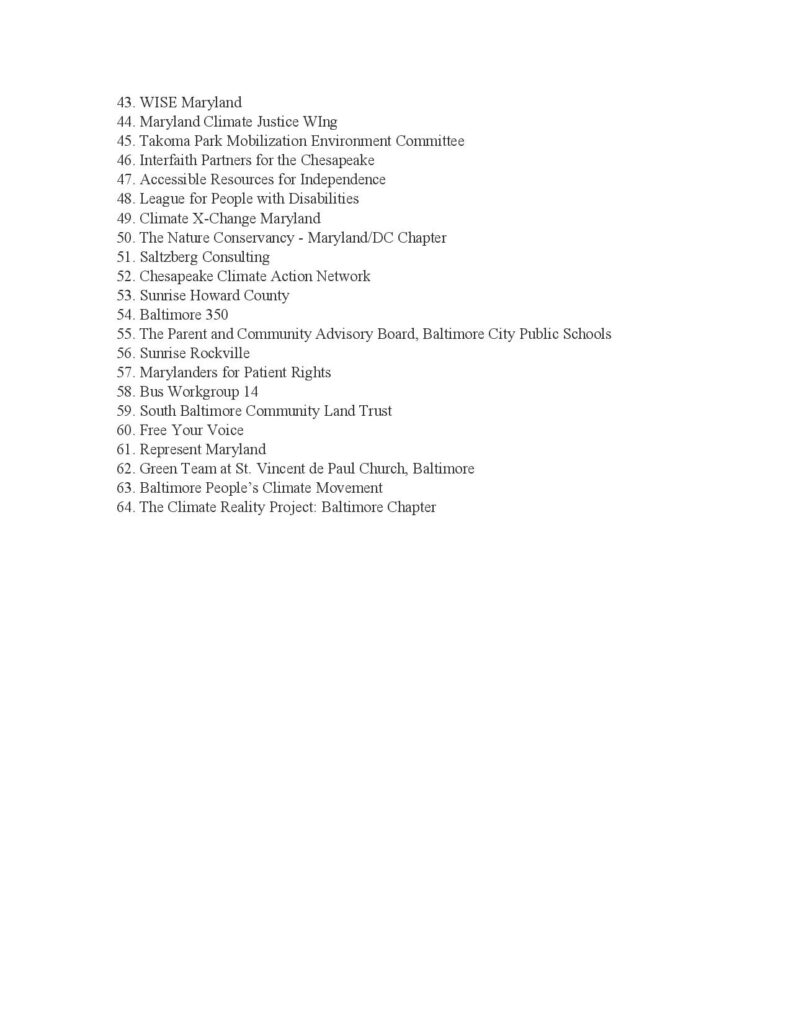
350 Montgomery County
Audubon Naturalist Society – Woodend, Chevy Chase, MD
Baltimore Tree Trust
Beaverdam Creek Watershed Watch Group
Cedar Lane Unitarian Universalist Church Environmental Justice Ministry
Central Maryland Transportation Alliance
Chesapeake Bay Foundation
Chesapeake Physicians for Social Responsibility
Citizens Against Beltway Expansion [CABE]
Cleanwater Linganore Inc
Climate Parents of Prince George’s County
Coalition for Smarter Growth
Conservation Montgomery
DontWiden270.org
DoTheMostGood Montgomery County
Forest Glen Citizens Association
Friends of Sligo Creek
Greenbelt Advocates for Environmental and Social Justice
Greenbelt Climate Action Network
Indian Spring Citizens Association
Indivisible Howard County
League of Women Voters of Maryland
Maryland Campaign for Environmental Human Rights
Maryland Legislative Coalition
National Parks Conservation Association
Neighbors of the Northwest Branch
North Hills of Sligo Creek Civic Association (NHSCCA)
Our Revolution Maryland
Parkwood
Preservation Maryland
Prince George’s County (MD) Peace & Justice Coalition
Rapid Shift
Regents Square Condominium (Rockville)
Rock Creek Conservancy
Rogue Tulips Consulting & Association Management
Sierra Club, Maryland Chapter
Takoma Park Mobilization
The Ocean Foundation
University Park Community Solar LLC
Washington Area Bicyclist Association
Wicomici Environmental Trust, Ltd.
West Montgomery County Citizens Association (WMCCA)
Woodside Forest Civic Association
cc: Linda Strozyk DeVuono, Office of the Attorney General, LDeVuono@mdot.maryland.gov
Active Transportation Webinar: Virginia Legislative Update
Click here to watch our Active Transportation Webinar on updates from the 2020 Virginia Legislative session. The event was cosponsored by Fairfax Alliance for Better Bicycling, the City of Fairfax, Fairfax County, and George Mason University’s Department of Parking and Transportation.
CSG Comments on the Draft Regional Transit Plan for Central Maryland
Thursday, June 18th, 2020
Maryland Transit Administration & Regional Transit Plan Commission
6 St. Paul St.
Baltimore, MD 21202-1614
Re: Comments from Thirty Organizations on the Draft Regional Transit Plan for Central Maryland
Dear Maryland Transit Administrator Kevin Quinn and the Regional Transit Plan Commission,
Thank you for your leadership in the process to create a Regional Transit Plan that is vital to residents in the region. Public transit will always be a necessary service that keeps health care and other vital systems running both during a global pandemic and in the absence of one. The COVID-19 crisis has further reinforced that we need to make structural changes to our public transit system to address inequities and ensure that everyone has access to the important places in their communities. The Regional Transit Plan can address these deficiencies and can also serve as a critical tool to employ in the economic recovery of the region by both creating jobs and allowing people to get to jobs. Every $1 billion invested in transit supports and creates over 50,000 jobs. While the Draft Regional Transit Plan’s overarching goals are well-chosen, the plan should be improved to significantly address inequities that disproportionately impact people of color, people with disabilities and other marginalized communities and to set a higher bar to improve access, reliability, and protect our environment.
We, undersigned groups encourage you to strengthen this important plan by enacting the following measures:
- Improve access to frequent transit connected to employment centers for marginalized communities and reduce the number of disconnected communities. Everyone deserves to be able to travel to the places where they live, work, and play. Everyday, communities of color have disproportionately less access to critical destinations due to redlining and structural racism. The neighborhoods in Baltimore with the highest percentage of people traveling more than 45 minutes to get to work and also taking transit are predominantly Black communities. The plan should provide strategies and targets to substantially increase access to frequent transit service for communities of color and other marginalized communities to connect to employment centers. The plan should also reduce the census blocks with disconnected communities–communities where there is over 5% unemployment and over 20% of workers are commuting over 45 minutes to get to work.
- Improve the reliability and accessibility of transit for people with disabilities. Our public transit system must work for everyone. People with disabilities are disproportionately impacted by inadequate transit. The plan should significantly increase On Time Performance of Paratrasit and upgrade the percentage of stops and stations that are ADA accessible at a much faster pace than 25% every 10 years. The plan should also include strategies that provide users with better notification systems of vehicle arrival times and provide an analysis of the number of vehicles needed. It is important that the plan include measures to increase the number of wheelchair accessible vehicles and provide special funding for transit services for health care.
- All bus replacements should be for zero emission buses starting in 2024. We need to travel in ways that keep us and our planet healthy. Most of our buses run on diesel fuel that spew out pollution that makes us sick and exacerbates climate disruption. The plan should include a target and strategies that lead to the full transition to a zero-emission transit fleet by requiring that in 2024, all bus replacements be for zero emission buses. Each zero-emission bus reduces pollution as much as taking 27 cars off the road. This goal is achievable, needed to protect public health, and consistent with the goals of comparable jurisdictions. New York City is transitioning 100% of their fleet to electric by 2040.
- Provide faster service to reduce people’s commute times. If people are spending less time traveling each day, they can spend more time with their loved ones. If people can get from point A to B faster on public transit, they will use it more. Currently, people can reach fewer than 1 in 10 jobs in the Greater Baltimore region in less than 45 minutes on transit. While the draft plan recognizes that faster service is important, it does not offer concrete targets. The plan should set targets to substantially reduce peoples’ commute times.
- Provide concrete strategies to pay for the plan. Investing in public transit benefits communities across the region. If we want to see the benefits in the plan, we need to fund them. The plan should develop concrete strategies for identifying federal, state, and local funding and leveraging funding to meet the needs of the plan, with an emphasis on funding strategies in the next 5 years.
- The plan should have consistent short-and long-term goals for improving transit and details of what transit improvements will occur in early priority corridors. The plan should provide 5-year and 25-year targets for each objective: providing faster, more reliable service; growing ridership; increasing access to jobs and opportunities; improving the customer experience; being more equitable; and preparing for the future. MTA should include assessments on how strategies under these objectives will slow the growth of vehicle miles traveled (VMT) in the region and explain how the corresponding decline in greenhouse gas emissions aligns with the Administration’s Greenhouse Gas Reduction Act Plan. The draft plan does not offer consistent metrics; instead it uses different baselines and target years for different indicators. MTA should provide a baseline of current conditions so the public can understand how the conditions are being improved and so that improvements can be reliably monitored and measured. The plan should also outline what transit improvements will occur in early priority corridors identified in the plan and outline the corridors that MTA will study.
Thank you for your consideration of these proposed improvements. Please note the improvements outlined in this letter are by no means exhaustive but outline some of the key measures that should be improved.
Sincerely,
Niamh McQuillan, Co-Lead, 350 Baltimore and Climate Reality Project Baltimore
Klaus Philipsen, FAIA, ArchPlan
Liz Cornish, Executive Director, Bikemore
Nanci Wilkinson, Chair, Environmental Justice Ministry, Cedar Lane Unitarian Universalist Church
Steven Hershkowitz, Maryland Director, Chesapeake Climate Action Network
Gwen L. DuBois MD, MPH President, Chesapeake Physicians for Social Responsibility
Emily Ranson, Maryland Director, Clean Water Action
Jane Lyons, Maryland Advocacy Manager, Coalition for Smarter Growth
Floyd Hartley, Chair, CARS (Consumers for Accessible Ride Services)
Donald M. Goldberg, Executive Director, Climate Law & Policy Project
Eric Norton, Director of Policy & Programs, Central Maryland Transportation Alliance
Robin Murphy, Executive Director, Disability Rights Maryland
Lore Rosenthal, Program Coordinator, Greenbelt Climate Action Network
Liz Feighner, Hoco Climate Action
Richard Deutschmann, Climate Action Team Lead, IndivisibleHoCoMD
Joe Uehlein, President, Labor Network For Sustainability
Richard Willson & Lois Hybl, Co-presidents, League of Women Voters of Maryland
Henry Bogdan, Policy Director, Maryland Nonprofits
Rachel London, Esq., Executive Director, Maryland Developmental Disabilities Council
Kim Coble, Executive Director, Maryland League of Conservation Voters
Cecilia Plante, Co-Chair, Maryland Legislative Coalition
Josh Tulkin, Director, Maryland Sierra Club
Ronza Othman, President, National Federation of the Blind of Maryland
Timothy Judson, Executive Director, Nuclear Information and Resource Service
Cheryl Barnds, Rapid Shift
Mark Southerland, Ph.D.Legislative Director, Safe Skies Maryland
Diana Younts, Takoma Park Mobilization Environment Committee
Tafadzwa (Taffy) Gwitira, Founder and farmer, Tele Farm
Jimmy Rouse, Co-Founder, Transit Choices
W. Phil Webster, Unitarian Universalist Legislative Ministry of Maryland
CSG Testimony Re: Subdivision Staging Policy
June 5, 2020
Montgomery Planning Board
8787 Georgia Ave
Silver Spring, MD 20910
2020-2024 Subdivision Staging Policy (Item 7)
Testimony for June 11, 2020
Jane Lyons, Maryland Advocacy Manager
Chair Anderson and Planning Commissioners, thank you for the opportunity to testify. This testimony is on behalf of the Coalition for Smarter Growth, the leading organization in the DC region advocating for more walkable, inclusive, transit-oriented communities. Please see below for our comments on the 2020-2024 Subdivision Staging Policy (SSP) working draft. Generally, we urge you to support policies that encourage sustainable growth patterns and maintaining a high-quality school system.
Schools & Taxes:
1. We strongly support the elimination of automatic housing moratoria throughout most of the county. The staff recommendation to create School Impact Areas correctly takes into consideration the distinct development contexts of different areas and how those contexts impact school enrollment growth.
The current moratorium policy assumes that the majority of new student generation comes from new development. However, we now know from the data that stopping development does not actually solve school overcrowding – less than 30 percent of school enrollment growth can be attributed to new development. Most new students come from young families moving into existing single-family homes – not from new apartment buildings.
The working draft also correctly identifies the other negative impacts of the current housing moratorium policy, including worsening housing affordability, hindering economic development, and preventing sustainable growth patterns. Rather than locating in a transit-oriented neighborhood, households and businesses alike are pushed into less desirable areas for growth. We should do all we can to encourage new housing in major transit and job hubs, not ban it – especially during a recession.
2. We support reducing the school impact tax to 100 percent of the cost of a seat, maintaining the current rate at 120 percent in the Agricultural Reserve, and further lowering the rate to 60 percent in Activity Centers. This recommendation correctly recognizes that impact taxes are a tool to either incentivize or disincentivize economic development. In some cases, it may be worth lowering impact taxes in order to expand the overall, long-term tax base and promote growth in the places we want to see it. Although, we’d like to note that some of the identified Activity Centers in outer areas lack transit and are overly large.
Montgomery County has one of the highest school impact taxes in the region. Even at this comparatively high rate, school impact fees only funded approximately 8 percent of the Montgomery County Public Schools (MCPS) capital budget in both FY19 and FY20. For FY21, impact taxes are only 6 percent of the MCPS capital budget, while recordation taxes fund nearly 24 percent of the budget. In short, reducing the school impact tax for areas where we desire growth will not make or break the MCPS capital budget, but impact taxes do play a significant role in whether new home projects pencil out. Even if a project can move forward at the existing tax rate, the increased cost is ultimately passed onto buyers through higher housing prices.
3. We are concerned by the proposed Utilization Premium Payments.
We should not charge developers for impacts not caused by their project. If a school is already overcrowded, it is because of past student enrollment growth and points to a larger funding failure within the county to raise and allocate enough resources to adequately fund schools’ capital needs. A future project will add to the overutilization, which is why future projects should contribute to the school impact fee pool to fund the seats of any students that project generates.
This recommendation will not build schools, just as the past School Facility Fees provided marginal funding at best – Utilization Premium Payments will only deter economic development. However, we would support increasing the school impact tax from 60 percent to 100 percent for projects located in Activity Centers with overcrowded schools.
4. We support progressive increases to the recordation tax.
While we do not think the Utilization Premium Payments have a strong nexus, the recordation tax does. Since over 70 percent of new students come from neighborhood turnover and recordation taxes account for nearly a quarter of the MCPS capital budget, it makes sense to target home purchases to fund school capacity projects.
We especially support an increase that is progressive, thus raising prices more on homes over $1.5 million, with an expansion of the first-time homebuyer exemption. Staff estimates that these changes would have raised roughly $20 million more for school construction in FY19. Nevertheless, if increasing the recordation tax is not feasible, we recommend instead adjusting the distribution of the revenue to increase the share going to schools and affordable housing.
5. We oppose ending the impact tax exemption for downtown Silver Spring.
As previously stated, impact taxes are a tool to either incentivize or disincentivize economic development, and it’s important to consider the short-term tradeoffs for longer term benefits. The Silver Spring impact tax exemption is a perfect example of this: between 2006 and 2016, the exemption only cost the county $5.8 million. Although Silver Spring is the only Enterprise Zone to successfully graduate from the program, its future success is far from guaranteed, especially in the current difficult economic environment.
A few things that weren’t mentioned: The working draft does not reference the capacity relief that boundary changes would bring system-wide, reducing the need for some expensive capital projects. Utilization is one of the three factors being examined by the current boundary analysis. We also urge the staff to make note of the effect that flexible school siting and creative project financing techniques could bring on the MCPS capital budget.
We recognize that these recommendations fall under the jurisdiction of MCPS and the Board of Education, not the SSP. Still, we believe those ideas warrant mentioning. Furthermore, it is apparent that there needs to
be a better dialogue between MCPS, the Board of Education, Planning Board, and the County Council. Schools issues are greatly interconnected with housing, health, transportation, and more, and should be treated as such by the county’s various institutions.
Transportation:
We appreciate and strongly support the move to better incorporate Vision Zero into the Subdivision Staging Policy, as well as the recommendation to increase intersection delay standards along Purple Line and BRT corridors. This small adjustment would save lives and support walkability around these future transit nodes.
We understand the objective to look at policy area transportation impacts for Master Plans, but are unsure why this should require a mandate within the SSP. If this recommendation moves forward, we believe that there should be higher standards than the baseline requirements to help us work towards our mode share, climate, and congestion goals. For example, we should set more equal standards for average time per trip. 19 minutes for auto trips and 52 minutes for transit encapsulates the transit inequities ingrained into our land use and transportation planning. We must do better.
Thank you for your consideration.