Author: Elena Sorokina
RELEASE: DC is a significantly safer place to walk than the metro region as a whole, according to a new report
Smart Growth America
Coalition for Smarter Growth (DC/MD/VA)
Partnership for Smarter Growth (Richmond)
FOR IMMEDIATE RELEASE
January 10, 2017
CONTACT
Stewart Schwartz, Coalition for Smarter Growth
(703) 599-6437
stewart@smartergrowth.net
Alexandra Dodds, Smart Growth America
(202) 971-3927
adodds@smartgrowthamerica.org
Andrew Moore, Partnership for Smarter Growth
(804) 283-6819
amoore@psgrichmond.org
Dangerous by Design
- New rankings show District of Columbia a significantly safer place to walk than metro region as a whole, but also finds big disparities in fatality rates within the city’s population
- Washington DC region and Hampton Roads region rank safer than Richmond and Baltimore regions
- Higher rates of pedestrian fatalities found among people of color, elderly, lower income and uninsured
<< Smart Growth America and National Complete Streets Coalition to hold a webinar at 1 pm today. >>
Washington, DC – Nationwide between 2005 and 2014, a total of 46,149 people were struck and killed by drivers while walking. That averages out to about 13 people per day. In the Washington DC region during the same period, 814 people were killed, an average of nearly one every four days.
Each one of those people was a child, parent, friend, classmate, or neighbor. People of color, the elderly, and those from low-income areas experience a disproportionate rate of fatalities. “We have a long way to go to achieve ‘Vision Zero’ in our communities – zero deaths and serious injuries – among road users,” said Stewart Schwartz, Executive to Director of the Coalition for Smarter Growth, which works in DC, Maryland, and Virginia.
Dangerous by Design 2016, a new report released today by Smart Growth America and the National Complete Streets Coalition ranks the 104 largest metro areas in the country as well as every state by a “Pedestrian Danger Index,” or PDI, ranking from greatest risk (1) to the least risk (104 for the regions). PDI is a calculation of the share of local commuters who walk to work (the best available measure of how many people are likely to be out walking each day) and the most recent data on pedestrian deaths.
Comparing four regions in our urban crescent
Ranking the regions in the urban crescent between Baltimore and Hampton Roads, the Washington metropolitan area ranks 69th out of 104 metro areas, and Hampton Roads 77th (better than DC region), while Richmond and Baltimore lag, ranking 44th and 55th respectively. The Richmond region, however, showed a 14 point reduction in its PDI between 2014 and 2016. “There has been an increasing focus on walking and bicycling in the Richmond region, more people living in our walkable downtown, and major public education outreach by our partners at Bike Walk RVA,” said Andrew Moore, President of the Partnership for Smarter Growth in Richmond.
DC ranks the best locally for people walking, with a PDI of 15.4, compared to the PDI for the metropolitan statistical area as a whole of 43.5. Virginia’s PDI is 41.4, but Maryland with a PDI of 77.8 lags regionally and below the national average.
“The national report shows only incremental progress in reducing the Pedestrian Danger Index in the DC and Baltimore regions, some progress in Hampton Roads (reduction of 6.5 points) and the aforementioned progress in the Richmond region (reduction of 14 points),” said Schwartz. “Of concern is the uptick in the District of Columbia’s PDI (nearly 1 point). At a time when jurisdictions across our region and nationwide are adopting ‘Vision Zero’ policies that recognize any traffic death is one too many, it’s alarming that we haven’t made more progress over the past few years. We know that better street design, slower speeds, and better reporting and enforcement make a huge impact on how safe it is to walk in a given place.”
Cities and suburbs
“With narrower streets and slower speeds, dense, walkable cities like DC tend to have safety rates better than suburbs with high-speed arterials,” said Schwartz, “That’s what we confirmed when we did a regional version of this national report back in 2008.” (Dangerous by Design 2016 doesn’t include comparative statistics for cities and adjacent suburbs).
“Wide, high-speed arterial roads in the suburbs are particularly dangerous, but can be made safer with fewer and narrower lanes, medians, signalized crossings, better sidewalks, fewer curb cuts, and protected bicycle lanes,” Schwartz continued. “State and local departments of transportation need to make safer street and arterial design a top priority.”
Social disparities
People of color and older adults are overrepresented among pedestrian deaths locally and nationwide. In the District of Columbia, African-American residents account for 48.7% of the population but more than 64.7% of pedestrian fatalities and Hispanic Americans account for 9.9% of the population but more than 13.7% of the pedestrian fatalities. All told, people of color represent 78.4% of the pedestrian fatalities in DC. “It’s imperative that Mayor Bowser and her administration step up their efforts to change street design and other safety measures if we are going to achieve Vision Zero in the city,” said Cheryl Cort, Policy Director for the Coalition for Smarter Growth.
Pedestrian fatality rates are also disproportionately high for African Americans in Maryland (29.0% of the population but 38.3% of fatalities), and Virginia (18.9% of the population but 30.6% of fatalities). Even after controlling for the relative amounts of walking among these populations, risks continue to be higher for some people of color—indicating that these people most likely face disproportionately unsafe conditions for walking.
Older adults also face greater risks. DC residents 65 and older represent 11.3% of the city’s population but 21.8% of the city’s pedestrian fatalities. “There are so many ways to make our streets and neighborhoods safer for older adults to navigate,” said Cort, author of CSG’s report, Moving an Age-Friendly DC: Transportation for All Ages. “Leaders can make our region safer for walking through measures like keeping sidewalks and crosswalks in good repair, bump-outs, and protected bicycle lanes, and making sure transit is accessible and usable.”
In addition, Dangerous by Design 2016 finds that PDI is correlated with median household income as well as rates of uninsured individuals. Low-income metro areas are predictably more dangerous than higher-income ones: as median household incomes drop, PDIs rise. Similar trends bear out with rates of uninsured individuals: as rates of uninsured individuals rise, so do PDIs, meaning that the people who can least afford to be injured often live in the most dangerous places for walking.
Read the full Dangerous by Design 2016 report, released today by Smart Growth America, at smartgrowthamerica.org/dangerous-by-design.
About the organizations:
Coalition for Smarter Growth is the leading organization in the Washington DC region dedicated to making the case for smart growth. Its mission is to promote walkable, inclusive, and transit-oriented communities, and the land use and transportation policies and investments needed to make those communities flourish. Learn more at smartergrowth.net.
Partnership for Smarter Growth educates and engages the communities in the Richmond region to work together to improve quality of life by guiding where and how the region grows. It connects residents in the nine jurisdiction region and focuses on land use planning, urban design, transit, and safer streets for walking and bicycling. Learn more at psgrichmond.org.
Smart Growth America is the only national organization dedicated to researching, advocating for, and leading coalitions to bring better development to more communities nationwide. From providing more sidewalks to ensuring more homes are built near public transportation or that productive farms remain a part of our communities, smart growth helps make sure people across the nation can live in great neighborhoods. For additional information, visit smartgrowthamerica.org.
The report is released in collaboration with AARP, the American Society of Landscape Architects, and Nelson\Nygaard Consulting Associates. See the full report for all partner organization information.
###
Councilmember Proposes DC Take Over Running Metrobuses-And Making Them Free
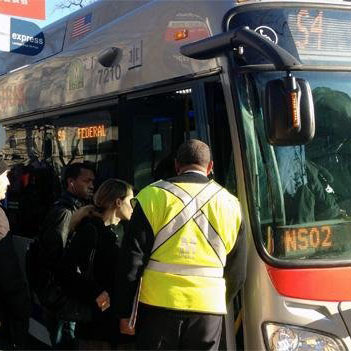
WASHINGTON – (WMAL) In a bold vision that would shake up the region’s transportation scene, D.C. Councilmember David Grosso is proposing the District take over operations of Metrobuses that run only within D.C., and to increase funding in order to eliminate fares.
“Instead of paying WMATA to operate these routes for our residents, let’s do it ourselves. We can task DDOT with running or contracting out the service, as we do with the Circulator. We could even brand them with the Circulator’s now-ubiquitous red and black,” Grosso writes on the urban planning website Greater Greater Washington. “Let’s take those millions of dollars we pay annually to WMATA, invest additional funds, and provide the type of transportation system that residents can rely on, one that is an attractive alternative to Metrorail.”
Grosso says it would give WMATA one less thing to worry about as they work to fix the rail side of operations, and would allow for additional investment that Maryland and Virginia may balk at otherwise. In making the buses free to ride, Grosso says it would also increase ridership, reduce the strain on Metrorail, speed up the boarding process, and reduce confrontations between drivers and passengers.
“To be clear, the city would not turn a profit under this scheme; we never have from our public transportation (or roads and highway projects for that matter),” Grosso writes. “But that’s not the point. What we’d get is something much greater.”
Some worry the proposal could further solidify philosophical differences between Maryland, the District, and Virginia.
“I’ve got mixed feelings,” Coalition for Smarter Growth Executive Director Stewart Schwartz tells WMAL. “There could be negative consequences in further fragmenting our regional bus networks. I worry it could distract from the regional conversation and regional commitment we need to have for the funding Metro needs.”
D.C. has been a leading advocate in increasing funding for Metro. Mayor Muriel Bowser has publicly called for the establishment of a new tax region-wide to serve as a dedicated funding source for Metro. The Governors of Maryland and Virginia have advocated for a more cautious approach, waiting to see if Metro can improve its operations and finances first before committing to more money.
Schwartz says the region’s ability to compete on a global level hinges on cooperation across borders around D.C.
“The more we can keep ourselves tied together through our transit system, and even other utility systems, and the more we can work together through regional bodies, the better for our region’s economic competitiveness.”
STATEMENT on DC Court of Appeals McMillan ruling
FOR IMMEDIATE RELEASE
December 8, 2016
CONTACT
Cheryl Cort, Policy Director
(202) 251-7516
Coalition for Smarter Growth STATEMENT on DC Court of Appeals ruling on McMillan Sand Filtration Site redevelopment
Today, the DC Court of Appeals halted movement on the McMillan Sand Filtration Site redevelopment, vacating the Zoning Commission’s ruling on the planned unit development (PUD). Following the Court of Appeals ruling, Coalition for Smarter Growth Policy Director Cheryl Cort issued the following statement:
“The Appeals Court ruling is a disappointing setback to delivering the city’s largest new park for all of us to enjoy. The ruling also delays much-needed housing and affordable housing, a new grocery store, and the historic restoration of aging structures.
Whatever the next steps to win a mixed-use McMillan development, the Court’s interpretation of the District’s Comprehensive Plan underscores just how important it is for residents to get involved with the ongoing Comprehensive Plan amendment process to clarify the plan as our city’s vision for guiding growth.”
About the Coalition for Smarter Growth
The Coalition for Smarter Growth is the leading organization in the Washington DC region dedicated to making the case for smart growth. Its mission is to promote walkable, inclusive, and transit-oriented communities, and the land use and transportation policies and investments needed to make those communities flourish. Learn more at smartergrowth.net.
McMillan redevelopment blocked by D.C. Court of Appeals
The D.C. Court of Appeals vacated the Zoning Commission’s approval of the McMillan Sand Filtration site redevelopment only one day after the groundbreaking, as reported by UrbanTurf. The court’s decision found that the D.C. Zoning Commission did not adequately address how the redevelopment would impact the nearby neighborhoods.
The ruling made by the D.C. Court of Appeals reads:
“In the first order, the Zoning Commission approved Vision McMillan Partner’s application for a planned unit development (PUD) on the site. In the other two orders, the Mayor’s Agent for Historic Preservation approved permits allowing [Vision McMillan Partners] to demolish certain structures on the site and to subdivide the site. Petitioner Friends of McMillan Park (FOMP) challenges these orders. Specifically, FOMP argues that the project is inconsistent with the District’s Comprehensive Plan and that the Commission failed to adequately explain its conclusions.”
In a statement, the non-profit organization, Friends of McMillan Park, described the ruling as “a great victory for our long efforts.” Friends of McMillan Park has stated that their hope for the property is to only construct a park.
Kirby Vining, treasurer of Friends of McMillan Park, told DCist, “The court is the first time that we’ve had an objective look at what the city is actually doing with this land.”
Despite the win for Friends of McMillan Park, the court doesn’t totally agree with the non-profit. According to DCist, the court believes that in certain cases high-density development could be justified for the 25-acre site..
The delivery for the redevelopment was slated for 2018. Plans involved 531 apartments and a 52,000-square-foot Harris Teeter from Jair Lynch as well as 146 townhouses from EYA. Plans also included an eight-acre park, 17,500-square-foot community center, and roughly 1 million square feet towards medical office space from Trammell Crow.
UPDATE: The Coalition for Smarter Growth Policy Director Cheryl Cort issued the following statement:
“The Appeals Court ruling is a disappointing setback to delivering the city’s largest new park for all of us to enjoy. The ruling also delays much-needed housing and affordable housing, a new grocery store, and the historic restoration of aging structures.
Whatever the next steps to win a mixed-use McMillan development, the Court’s interpretation of the District’s Comprehensive Plan underscores just how important it is for residents to get involved with the ongoing Comprehensive Plan amendment process to clarify the plan as our city’s vision for guiding growth.”
Wiedefeld Marks One Year As Head of Metro as Rifts Over Long-Term Problems Persist
WASHINGTON — (WMAL) It was one year ago today that Paul Wiedefeld took over possibly the least-coveted job in the transportation world in starting to chart a path forward for the floundering Metro system. Many D.C.-area leaders and transportation experts agree Wiedefeld has given the system some hope, but there is still much to be done both in the short and long term, and many sharp disagreements about the direction still to be ironed out.
“He has been willing to make the tough decisions,” Virginia Congressman Gerry Connolly told WMAL. “Which many of his predecessors, frankly, did not do.”
Chief among those tough decisions was the unprecedented move to close the system for an entire day on March 16. The region was given little more than a few hours notice that the system would be shuttered for 24 hours that Wednesday to do an emergency inspection of jumper cables.
“That showed his ability to make tough decisions and stand by them,” Coalition for Smarter Growth Executive Director Stewart Schwartz told WMAL. “It really established his role as a leader.”
Those same sentiments were expressed when Wiedefeld put together the 10-month track rehabilitation plan known as Safe Track, designed to compress three years’ worth of work into a much shorter time span. It was also seen in some in-the-weeds issues like workforce development. Wiedefeld announced the firing of 20 managers in May, and layoffs to the tune of 500 positions in July in an attempt to turn around the oft-criticized culture of the system.
Some say Wiedefeld’s effort to turn around operations and safety is inspiring other area leaders to finally start tackling the long-term issues that are out of Wiedefeld’s hands, like overhauling how Metro gets its money, and increasing its subsidies to further the system’s improvement.
“We appreciate Paul’s sense of urgency and focus on what needs to be done,” Greater Washington Board of Trade President Jim Dinegar said. “How we’re going to pay for it, how it’s going to be governed and all the rest is a work in progress, but I believe there is a growing sense of urgency.”
That urgency is appreciated by Metro Board Chairman Jack Evans, who again warned his colleagues of the dire straits ahead.
“We are faced with these staggering costs here,” Evans said during a D.C. Council breakfast Tuesday. “We are looking at $160 million in the next two years in operating costs, and $492 million in capital costs, increases that we have to put into Metro, or not. And the ‘or not’ is, the system’s just going to stop running.”
Evans proceeded to rail against jurisdictions in Maryland and Virginia that he says have been dragging their feet on giving Metro what it needs.
“Loudoun County is the richest county in America. Fairfax County is the second-richest county in America. Arlington County is the sixth-richest county in America, and Montgomery County is the eighth-richest county in America,” Evans said. “These are the jurisdictions who can’t afford to pay for Metro.”
Evans’ comments do little to help a system where cross-jurisdictional cooperation is key, Connolly said.
“You can’t be Chairman of Metro and trash your compact partners,” Connolly said. “I have a Republican General Assembly in Richmond I have to sell (an increase in funding) to. And Jack Evans, every time he opens his mouth, makes that job harder.”
Evans made waves two weeks ago when he questioned Maryland Governor Larry Hogan’s motivations in refusing to give Metro extra money, insinuating the Republican cares little for constituents in Montgomery and Prince George’s Counties since it is a heavily Democratic area. Hogan’s office dismissed those claims, and a spokeswoman questioned Evans’ fitness for the job.
“The system needs strong, balanced, and rational leadership,” the spokeswoman said, “and if this chairman can’t provide it, then it’s time to find someone who can.”
There are four proposals to save Metro. Which might prevail?
There are no fewer than four distinct plans being floated to save Metro. Business leaders and elected officials urge a crusade to repair the transit system by restructuring its board, giving it reliable funding or handing it over to the federal government. They proclaim bravely that failure is not an option.
In fact, experience with similar restructuring efforts suggests that failure is the probable outcome. The same political and economic divisions that have stymied restructuring for the past 40 years persist today.
If the region is to finally fix Metro’s structural weaknesses, analysts say, then force must be exerted on the top elected officials in the District, Maryland and Virginia to get them to act.
One such stimulus for change would be a unified coalition of business leaders, transit advocates and civic organizations. Government and business groups, including the Metropolitan Washington Council of Governments (COG), the Greater Washington Board of Trade and the Federal City Council hope to assemble such a bloc.
It’s especially important that prominent chief executives join the effort, supporters say. Top executives of large companies have the clout needed to persuade legislators in Richmond and Annapolis to ensure dependable revenue for Metro, and possibly transform its board and other governing structures.
“It has to be key industry leaders, CEOs, stepping up and saying, ‘We can’t afford to live in limbo here,’ ” said Bob Buchanan, president of the 2030 Group, a regional business organization. “The status quo continues to be an embarrassment as Metro twists slowly in the wind, and piecemeal efforts aren’t going to do it.”
But many CEOs of major companies in the area are busy with national or global issues rather than local ones, or they prefer to avoid potential political controversies.
Another potential change agent — but less desirable — is Congress. It could appoint a control board or other body to take over Metro — temporarily or permanently — and push through needed changes to save the system.
Metro board Chairman Jack Evans, who also is a D.C. Council member, is among those who has endorsed such plans.
That prospect has lost much of its allure with Republican victories in the recent national election. Much of the GOP prefers to devote transportation dollars to roads, and the party platform approved in July urged phasing out federal transit spending altogether.
“There needs to be a strategic pause in discussion of a control board,” said a senior official in the administration of D.C. Mayor Muriel E. Bowser (D), who asked not to be named to speak candidly about a sensitive political issue.
The question to be decided in the coming months is whether the region can overcome its internal differences and coalesce around a common plan. Otherwise, federal intervention becomes more likely.
Two major obstacles loom. First, it will be difficult to get Virginia’s support for increased taxes for Metro, as advocated by the District and Montgomery County. Northern Virginia Democrats said it would probably be necessary for their state to find a different source of fresh revenue, such as highway tolls.
“This all really hinges on Virginia,” said COG Chairman Roger Berliner, who also is a Democratic Montgomery County Council member representing Potomac-Bethesda. “I know we will win in the District. I believe we can win in Maryland.”
A division also has emerged over whether it is necessary to transform Metro’s board and governing structure at the same time that reliable funding is sought.
On one side, Virginia and the Federal City Council say it’s vital to rewrite the Metro compact, the founding document that outlines how Metro is governed and funded. U.S. Reps. John Delaney (D-Md.) and Barbara Comstock (R-Va.) also have proposed revising the compact, albeit to a lesser extent, by requiring Metro board members to have expertise in transit or another relevant discipline.
“There’s no doubt there needs to be governance restructuring,” Virginia Transportation Secretary Aubrey Layne said. “It needs a visioning process so we can look at both public and private entities [as guides] and ask, ‘What’s the best structure to run Metro?’ ”
By contrast, the District, the COG and the Board of Trade have sought to avoid a discussion of amending the compact. Although they are open to it if a consensus could be reached, they say they fear that a battle would undercut the higher priority of obtaining a dedicated funding source.
“It runs the risk of being a distraction from the core issues with the system,” the senior District official said. “The riders don’t care who governs Metro. They just want a safe system that gets them to where they need to go.”
There is little time to waste. Officials have said they need a common funding plan by summer. That would allow for a lobbying campaign before the Virginia and Maryland legislative sessions open in early 2018.
Metro’s budget pressures have led some players to think of moving more quickly. The Board of Trade may propose legislation in the Richmond and Annapolis sessions beginning in January to allow the suburban counties to tax themselves to raise money for Metro.
“It probably needs to move faster than originally anticipated,” James C. Dinegar, president of the Board of Trade, said.
Here’s a summary of the four plans:
●Put funding first. The COG and the Board of Trade have been working since spring on a plan to seek a reliable funding stream in exchange for setting performance benchmarks for Metro on safety, reliability and customer satisfaction.
Metro is the only major transit system in the nation that doesn’t obtain a significant amount of its revenue from a tax or other dedicated source.
The proposal got a major boost last month when Bowser publicly urged adoption of a regional sales tax of at least half a penny to fund Metro.
Maryland Gov. Larry Hogan (R), a strong opponent of higher taxes, initially was cool to the idea. But he later signaled he could go along if Montgomery and Prince George’s wanted to tax themselves to support Metro, as long as the rest of the state wasn’t affected.
Montgomery County Executive Isiah Leggett (D) has supported a regionwide sales tax for Metro for two years. Prince George’s County Executive Rushern L. Baker III (D) sought to place responsibility on Annapolis. His spokesman noted that the state, rather than the counties, has funded Metro in the recent past, and has “unique authority” to explore sources such as a sales tax.
A major hurdle is Virginia. The Republican-controlled General Assembly opposes tax increases to help Metro. Even Northern Virginia Democrats said they can’t ask their constituents to pay more in sales or property taxes to support transportation.
At the same time, two top Virginia Democrats, Gov. Terry McAuliffe (D) and Fairfax Board of Supervisors Chairman Sharon Bulova (D), agree that Metro eventually will need some kind of dedicated funding — even if it’s in some form other than a tax.
“That’s something we’ll all be scratching our heads over,” Bulova said.
●Rewrite the compact. The Federal City Council, arguing that dedicated funding alone isn’t enough to save the agency, introduced a proposal this month to radically overhaul Metro’s governance by rewriting the agency’s compact.
The council wants to reduce the size of the 16-member Metro board, among other things, to make it more efficient. It also wants to weaken union protections by dropping the requirement that outside arbitrators decide labor contract disputes. Such mandatory arbitration has had the effect of driving up labor costs.
The proposal to reopen the compact enjoys wide support in the business community, but transit advocates are skeptical.
“You could end up in a complete quagmire, stalemate, unable to come to an agreement on the union issues, on funding formulas,” said Stewart Schwartz, executive director of the Coalition for Smarter Growth.
●Let the feds take over. Evans, the Metro chairman, has been so frustrated with the board that he called for federal appointees to take control of the agency, either temporarily or permanently.
He has acknowledged that such a scenario is unlikely. He hoped in part to call attention to the structural problem in which board members have split loyalties between their duties to Metro and to the jurisdictions that appoint them.
The Federal City Council urged Congress use the threat of a federal control board as an incentive to force the District, Virginia and Maryland to agree on changes.
Some welcomed that idea as providing necessary leverage. Others said that it risked handing over Metro to people with no stake in the region.
“Congress can’t even pass a budget on time, and we’re going to ask them to make the trains run on time?” said Ronit A. Dancis, president of the Action Committee for Transit, which advocates for improved public transit. “I’m not comfortable with a federal takeover even being a threat.”
Comstock and others said that revising the compact is critical to supporting Metro General Manager Paul J. Wiedefeld, who has generally won praise for aggressive changes in his first year in the job.
“We need a new structure with the compact so Paul J. Wiedefeld can do the job that he’s been hired to do,” Comstock said.
Delaney said it’s hard to push through genuine changes because Metro is suffering a gradual decline without a dramatic, one-time crisis requiring immediate action.
“It can kind of limp along for a while, and that’s why you don’t see something being done right away,” Delaney said. “It’s death by a thousand cuts.”
Photo credit: Bonnie Jo Mount/Washington Post
What board members and the public liked (or didn’t) about the 2016 CLRP Amendment
A review of more than 450 written public comments and more than an hour of in-person public comment and board discussion preceded a final vote by the TPB on November 16 to amend the region’s Constrained Long-Range Transportation Plan (CLRP). Regularly updating the plan is one of the TPB’s primary responsibilities as the federally designated metropolitan planning organization for the region.
This year’s CLRP amendment added five major new projects, including new Express Lanes on I-395, an 11-mile extension of Virginia Railway Express (VRE) commuter rail, new bus-only lanes on 16th Street in the District of Columbia, and an expansion of the District’s dedicated bicycle-lane network. The amendment also made changes to four major projects already in the plan and included several other smaller additions and changes.
MORE: See all of the major additions and changes in the 2016 CLRP Amendment
5 key CLRP-related actions at the Nov. 16 TPB meeting
The TPB took five formal actions to finalize this year’s CLRP amendment. The actions together pave the way for the TPB to submit the amendment and an update of the region’s six-year Transportation Improvement Program (TIP) for federal review and approval.
- ACTION #1: Accepted public comments and staff and agency responses to comments.The board reviewed and accepted the more than 450 written comments received during a 30-day comment period that ended November 12. The board also reviewed and accepted a set of “responses” developed by staff and sponsoring agencies explaining how the issues raised have been or will be addressed or directing commenters to other appropriate avenues to share their input. Listen to the full presentation and discussion.
- ACTION #2: Approved the results of the Air Quality Conformity Analysis. The federally required analysis demonstrated that future vehicle-related emissions of certain smog-forming pollutants will fall sharply in coming years under the plan and remain below approved regional limits. Most of the reductions will be thanks to tighter federal controls on vehicle technology and fuel formulation. Board member Dave Snyder (Falls Church) reminded the board that the region needs to remain committed to achieving further reductions through measures like transportation demand management, since tougher new air quality standards are expected in coming years. Listen to the discussion and vote.
- ACTION #3: Adopted the 2016 CLRP Amendment. The amendment included five major new projects, changes to four major projects already in the plan, and dozens of other smaller additions and changes. The amendment also reaffirms the hundreds of regionally significant highway, transit, and bicycle and pedestrian projects already in the plan. Four of the 28 board members present voted against the amendment, saying the plan does too little to improve the region’s transportation future. Listen to the discussion and vote or read more analysis below.
- ACTION #4: Approved the FY 2017-2022 Transportation Improvement Program (TIP).The TIP identifies amounts and sources of funding for hundreds of projects programmed for planning, engineering, or construction over the next six years. The TPB updates the TIP every two years, usually in conjunction with an update to the long-range plan. Listen to the presentation and vote.
- ACTION #5: Approved a certification of the metropolitan transportation planning process. When it approves the TIP, the TPB must also certify that the metropolitan transportation planning process it carries out meets all relevant federal requirements. Some board members expressed some reservations about the certification but ultimately voted to approve it. Listen to the presentation and vote.
A mix of criticism and praise emerged in the final discussion of the 2016 CLRP Amendment
Extensive public comment and board discussion preceded the TPB’s final votes related to the 2016 CLRP Amendment. Staff summarized and presented the more than 450 written comments submitted during a formal 30-day public comment period. Four people presented in-person comments at the beginning of the meeting. And several board members spoke up to express concerns, ask questions, or to explain their support for this year’s amendment.
In the end, the board approved the 2016 CLRP Amendment with broad support, saying that the projects in this year’s amendment were worthwhile and needed. But there was also a sense that the TPB should work toward developing a plan that will more positively impact future travel behavior and travel conditions in the region.
Public comments focused on two main projects but many addressed a range of other issues
In all, the TPB received more than 450 written comments from individuals, businesses, organizations, and governmental representatives during the 30-day comment period that ended November 12. Most focused on two of the proposed additions in this year’s CLRP amendment:
- I-395 Express Lanes: More than 300 comments addressed the proposed addition of express toll lanes on I-395 in Northern Virginia. All but a few expressed support for the projects, for reasons including improved travel time for all users, the use of private rather than public funding, and that the tolls from the lanes will provide a revenue stream for transit improvements in the corridor. A couple of comments expressed concern about the potential adverse impacts of the lanes on lower-income travelers, while others said that no toll revenue should be used for transit services in the corridor.
- DC dedicated bicycle-lane network: About 160 comments addressed the District’s plan to expand its dedicated bicycle-lane network by removing travel lanes for automobile traffic on certain road segments throughout the city. Specifically, the comments opposed the addition of bicycle lanes on a portion of 6th Street NW, citing impacts on parking for several nearby churches as well as traffic implications for major downtown event venues. Representatives from the United House of Prayer, one of the churches affected by the 6th Street proposal, provided in-person comments at the TPB’s October meeting highlighting their congregation’s concerns. DDOT officials said the agency would work with church leaders to determine the best routing for the new bike lanes.
MORE: Full summary of all comments received on the 2016 CLRP Amendment
The November 16 meeting also featured in-person public comment from representatives of four area organizations. Kevin McNulty (Northern Virginia Chamber of Commerce) and Brandon Shaw (Prince William County Chamber of Commerce) both spoke in favor of the projects slated for inclusion in the 2016 CLRP Amendment, citing the impact the projects will have on the region’s economy. Nancy Smith (Northern Virginia Transportation Alliance) applauded the key road projects in Virginia but said that the region needs a more strategic approach to identifying worthwhile projects that will have a truly regional impact.
Stewart Schwartz (Coalition for Smarter Growth) applauded the transit investments slated to be included in the plan but told board members that transportation investment will only get the region so far in solving its transportation problems. He said that more efficient growth patterns and land-use will be necessary to address regional transportation challenges.
Board member Linda Smyth pressed VDOT on allowing commercial trucks to use I-66 Express Lanes
Last year’s CLRP amendment included the addition of a Virginia Department of Transportation (VDOT) plan to add new express toll lanes to I-66 inside and outside the Capital Beltway. The agency has since said that the private concessionaire that will build and operate the lanes has proposed allowing commercial trucks to use the lanes on the portion of the facility outside the Beltway.
At the November 16 meeting, board member Linda Smyth (Fairfax County) reiterated her ongoing concerns about the air quality, noise, and traffic impacts of allowing commercial truck traffic on the new lanes and pressed VDOT for an analysis of potential impacts.
“I understand what VDOT is saying here, except their analysis is not complete. The environmental analysis should include the impacts on neighborhoods and air quality,” Smyth said. “What they’re looking at essentially is the through-movements of trucks on the express lanes, not where they get off on the ramps and what neighborhoods they then drive through. And that should be part of the analysis.”
VDOT’s Rene’e Hamilton told Smyth that the state will study the effects as part of a reevaluation of the environmental analysis of the project.
“We are going to go through a reevaluation and look at those interchanges and potentially the impacts to neighborhoods around there,” Hamilton said. “We will go back in and look at air, noise, and all the traffic related to any changes,” she said.
Hamilton also explained that the results of that analysis would be taken through a public review and comment process, including bringing it back to the TPB, before VDOT makes a final decision.
“I will look forward to a very comprehensive analysis,” Smyth responded.
Four board members voted against CLRP approval, saying the plan falls short
“I understand the importance of why we do this work, keeping the system going. But I do think it’s important that at least some of us register our frustration that we do not have a CLRP that actually reduces congestion and improves performance by whatever related standards we determine are appropriate.”
That was the sentiment of board member Peter Schwartz (Fauquier County), who along with three other board members voted against adoption of the 2016 CLRP Amendment.
Schwartz, along with two of the other opponents, Marc Elrich (Montgomery County) and Neil Harris (Gaithersburg), cited the CLRP’s failure to improve travel conditions in the region despite tens of billions of dollars in capacity-expanding highway and transit projects.
“Some of us need to say more concretely that we don’t think this is where we really need to be,” Elrich said.
Metro’s Shyam Kannan was responsible for the fourth “nay” vote, saying that the transit agency could not support any amendment to the plan that did not include sufficient funding for Metro’s capital needs, including both reinvestment in existing infrastructure and key expansion projects.
The CLRP amendment ultimately passed with broad support—24 of 28 board members who were present voted in favor of the amendment.
Some board members publicly voiced their intention to cast a “yea” vote, including Jay Fisette (Arlington County), who said that the CLRP amendment process had given localities the chance to work with VDOT to refine the I-395 Express Lanes project.
“This project now includes as a base condition a minimum of $15 million annually for multimodal improvements in the corridor to promote transit use and moving more people and fewer vehicles. That was nowhere a part of the plan earlier,” Fisette said.
Board member Martin Nohe (Prince William County) also voiced his support, bringing a dose of reality to the discussion. Nohe said he agreed with the comments that the region needs a better long-range plan, but that the CLRP isn’t that plan.
“I believe we do need a bigger, multijurisdictional, regional plan that says, ‘Here is what we can do if we had the money,’” he said. “But the fact is, [the CLRP] is what we can do with the money that we have, and therefore I think we should go do it.”
Also publicly voicing their support were board members Cathy Hudgins (Fairfax County), Jonathan Way (City of Manassas), R. Earl Lewis, Jr. (MDOT), and TPB Chairman Tim Lovain (Alexandria).
Next steps for the CLRP
The 2016 CLRP Amendment as adopted will now be submitted for federal review and approval. The TPB will forgo a 2017 plan amendment and instead focus on the next major four-year update of the plan as required by federal law. The update will include revised estimates of available revenue and is expected to include a new “unconstrained” element to highlight projects for which funding has not yet been identified but that area leaders might want to rally support around to find new funding.
Other takeaways from the Nov. 16 TPB meeting…
- The TPB’s Citizens Advisory Committee (CAC) endorsed Vision Zero. After a briefing on regional traffic safety data at its November 10 meeting, the committee formally endorsed Vision Zero, an effort to eliminate traffic-related bicycle and pedestrian deaths in the region. Read the full CAC report.
- Recruitment is underway for new CAC members for 2017. Applications to join the CAC for its 2017 term are due December 9. The three incoming TPB officers for 2017 will appoint nine new members to the committee, three from each state-level jurisdiction. Learn more and apply.
- Chairman Tim Lovain recapped the Nov. 2 traffic incident management conference.The conference brought practitioners and regional leaders together to discuss ways to further improve the region’s already robust traffic incident management practices. Read more about the conference.
- The TPB’s Long-Range Plan Task Force presented its Phase 1 report. The group is looking at the region’s unmet funding needs and is hoping to identify a limited set of projects with the greatest potential to improve the future performance of the region’s transportation system. The Task Force met just before the November meeting and expects to meet again soon in the new year. Read the full Phase 1 report.
- COG is leading work on a Metro funding study and establishing a new Metro safety oversight agency. COG Executive Director Chuck Bean updated the board on ongoing work to quantify unmet funding needs for Metro and to facilitate the establishment of the new tristate Metro Safety Commission (MSC). Listen to Bean’s full report.
Picture credit: Elvert Barnes/Flickr
Click here to read the original story.