On February 4th, 2021, CSG cosponsored a Transit Equity Day Lunch and Learn Panel Discussion with the Sierra Club Virginia chapter. If you missed the event, or are looking for event materials, you can view the video of the event here and see the slide deck here.
Category: Better Public Transit
RELEASE: Historic Climate Win at Transportation Planning Board
Press Release
For immediate release:
December 16, 2020
Contact:
Stewart Schwartz, CSG, 703-599-6437
Historic climate vote took place today at Metropolitan Washington’s Transportation Planning Board (TPB)
Elected officials agree to prioritize transportation projects and policies to reduce greenhouse gas emissions
Today, at the launch of the process to create the Washington DC region’s next multi-billion dollar regional transportation plan, Visualize2045, elected officials on the Transportation Planning Board (TPB) voted to “[require] (emphasis added) its member agencies to prioritize investments on projects, programs, and policies to reduce greenhouse gas emissions, prioritize the aspirational strategies, and achieve COG’s land use and equity goals as they submit their input for inclusion in the TPB’s [Long-Range Transportation Plan and Transportation Improvement Program].” The TPB also agreed to prioritize the aspirational initiatives they adopted in early 2018 including linking jobs and housing, a regional bus rapid transit network, Metro, demand management, bike/walk access to transit, and the capital region trail network.
“This is a historic vote. For the first time, regional elected officials committed to prioritizing transportation projects, programs, and plans to reduce greenhouse gas emissions through the region’s transportation plan,” said Stewart Schwartz, Executive Director of the Coalition for Smarter Growth (CSG). “They also agreed on the need to reduce vehicle miles traveled to achieve the greenhouse gas emissions reductions we need.”
During the debate, representatives of Prince William and Loudoun counties raised concerns about the challenges of reducing VMT in outer suburbs, and sought to soften the resolution from “requires” to “urges.” Their motion failed, and the vote on the full package of amendments passed 22 to 1 with 7 abstentions and 6 members absent. A full list of elected officials’ votes can be found below.
“In response to the concerns of the outer suburbs,” Schwartz said, “we believe that the outer suburbs can help tackle transportation emission, through better land use including walkable, mixed-use ’15-minute’ neighborhoods, commuter rail, and bus.”
The TPB’s action follows the commitment by the Council of Governments to reduce the region’s total greenhouse gas emissions 50% below 2005 levels by 2030.
“Our analysis shows that adoption of electric vehicles is essential, but the timeline is uncertain, and we’ll have to do more – which means reducing how much we have to drive, through better land use – walkable, transit-oriented communities; addressing the east-west jobs imbalance; and investing more in transit, walking and biking infrastructure,” said Bill Pugh, Senior Policy Fellow for CSG. Bill’s analysis for CSG is laid out in his recent post in Greater Greater Washington, and in a draft paper – Cutting Transportation Emissions by 2030 and Beyond: Smart Land Use and Travel are Essential submitted to the Transportation Planning Board by CSG.
THE VOTES:
Here is how Transportation Planning Board members voted on amendments to strengthen commitments to reducing vehicle miles traveled and greenhouse gas emissions (the full Technical Solicitation document can be found at a link here and amendments debated today can be found at Agenda Item 9; official vote tally should be confirmed with TPB staff).
Motion by Loudoun County Supervisor Kristen Umstattd, seconded by Manassas Park Vice-Mayor Pamela Sebesky to “urge” rather than “require” that jurisdictions prioritize projects, programs, and policies to reduce greenhouse gas emissions.
“Through this technical solicitation input process the TPB urges/requires its member agencies to prioritize investments on projects, programs, and policies to reduce greenhouse gas emissions, prioritize the aspirational strategies, and achieve COG’s land use and equity goals as they submit their input for inclusion in the TPB’s [Long-Range Transportation Plan and Transportation Improvement Program].”
Motion failed with 16 no, 14 yes (with 6 members absent)
Voting yes (for “urges”)
1. DDOT represented by Mark Rawlings
2. MDOT represented by Asst Secretary Jeffrey Hirsch
3. Charles County – Jason Groth (staff)
4. City of Frederick Alderman Kelly Russell (TPB 2020 Chair)
5. City of Laurel – represented by staff Phil Goddard (?)
6. Virginia Department of Transportation
7. Fairfax County Supervisor Walter Alcorn
8. Fairfax County Supervisor James Walkinshaw
9. Loudoun County Supervisor Kristen Umstattd
10. Loudoun County staff representative Bob Brown
11. City of Manassas Vice-Mayor Pamela Sebesky
12. City of Manassas Park Mayor Jeanette Rishell
13. Prince William County Chair Ann Wheeler
14. Prince William County Board Member Victor Angry
Voting no (favoring “requires”)
1. DC Office of Planning – Kristin Caulkins
2. DC Councilmember Charles Allen
3. College Park Councilmember Denise Mitchell
4. Frederick County Alderman Kai Hagen
5. City of Greenbelt – Mayor Emmett Jordan
6. Montgomery County Executive – represented by Gary Erenrich
7. Montgomery County Councilmember Evan Glass
8. Prince George’s Councilmember Deni Tavares
9. City of Rockville Mayor Bridget Newton
10. City of Takoma Park Councilmember Kacey Kostiuk
11. Maryland Delegate Carol Krimm
12. City of Alexandria Councilmember Canek Aguirre
13. Arlington County Board member Christian Dorsey
14. City of Fairfax Mayor David Meyer
15. City of Falls Church Councilmember David Snyder
16. WMATA represented by Shyam Kannan
Absent:
1. DC Councilmember Phil Mendelson
2. DC Councilmember Brandon Todd
3. City of Bowie
4. City of Gaithersburg
5. Prince George’s County Executive represented by Victor Weissberg (Dept of Transportation)
6. Fauquier County
Motion to adopt all six amendments (found at Agenda item 9) first proposed by Falls Church Councilmember David Snyder with final drafting by TPB staff including amendment B with “requires.” Motion made by Mayor Bridget Newton of the City of Rockville and seconded by Councilmember Charles Allen of DC.
Motion passed with 22 yes, 1 no, 7 abstentions (with 6 members absent)
Yes (for the amendments on VMT and greenhouse gas emissions)
1. DC Office of Planning – Kristin Caulkins
2. DC Councilmember Charles Allen
3. MDOT represented by Asst Secretary Jeffrey Hirsch
4. College Park Councilmember Denise Mitchell
5. Frederick County Alderman Kai Hagen
6. City of Frederick Alderman Kelly Russell (TPB 2020 Chair)
7. City of Greenbelt – Mayor Emmett Jordan
8. City of Laurel – represented by staff Phil Goddard (?)
9. Montgomery County Executive – represented by Gary Erenrich
10. Montgomery County Councilmember Evan Glass
11. Prince George’s County Executive represented by Victor Weissberg (Dept of Transportation)
12. Prince George’s Councilmember Deni Tavares
13. City of Rockville Mayor Bridget Newton
14. City of Takoma Park Councilmember Kacey Kostiuk
15. Maryland Delegate Carol Krimm
16. City of Alexandria Councilmember Canek Aguirre
17. Arlington County – Dan Malouff for Board member Christian Dorsey
18. City of Fairfax Mayor David Meyer
19. City of Falls Church Councilmember David Snyder
20. Fairfax County Board Member Walter Alcorn
21. Fairfax County Board Member James Walkinshaw
22. WMATA represented by Shyam Kannan
No
1. Virginia Department of Transportation
Abstentions
1. DDOT represented by Mark Rawlings
2. Loudoun County Supervisor Kristen Umstattd
3. Loudoun County staff representative Bob Brown
4. City of Manassas Vice-Mayor Pamela Sebesky
5. City of Manassas Park Mayor Jeanette Rishell
6. Prince William County Chair Ann Wheeler
7. Prince William County Board Member Victor Angry
Absent:
1. DC Councilmember Phil Mendelson
2. DC Councilmember Brandon Todd
3. City of Bowie
4. City of Gaithersburg
5. Fauquier County
6. Charles County
###
The Coalition for Smarter Growth advocates for walkable, bikeable, inclusive, and transit-oriented communities as the most sustainable and equitable way for the Washington, DC region to grow and provide opportunities for all.
RELEASE: Campaign for better buses in Mont. Co. launches at noon, 25+ orgs support
Today, over 25 organizations will launch a campaign advocating for better bus service in Montgomery County.


MEDIA ADVISORY: 20+ organizations to announce campaign to reimagine bus service in Montgomery County
Over 20 organizations will hold an event to launch a campaign for better Ride On and Metrobus service in Montgomery County.
RELEASE: “Devastating. Leaders must step up to save WMATA.”
PRESS STATEMENT
December 1, 2020
Contact:
Stewart Schwartz, Executive Director
703-599-6437 (cell)
Proposed cuts to WMATA would be devastating
Leaders must step up!
“The reality of proposed cuts to our Metrorail and Metrobus service in the absence of a rescue package is now clear. It would be simply devastating – to our workers, our economy, our transportation network.
Congress needs to step up and this includes every Republican. We are one nation, one economy, with a huge share of our economy dependent on our cities and metropolitan regions.
If the cuts were to take place they would gut a system the DC region built over four decades and upon which our essential workers and economy depends. It would undermine decades of real estate investment, prompt flight of our next generation workforce, and have a disproportionate impact on the essential workers upon whom our food and health and services systems depend.
We shouldn’t let our two Governors and local elected officials off the hook either. We cannot afford to continue wasteful road expansion and sprawl, massive toll roads that benefit few, and boondoggles like the Maglev when we can’t afford to maintain and operate what we’ve already built. We must be shifting funding from road expansion to save the transit system that is the backbone of our region’s economy.
‘Fix-it-first’: maintain, rehabilitate, and operate our existing infrastructure and locate new development in walkable communities with both jobs and frequent transit.”
###
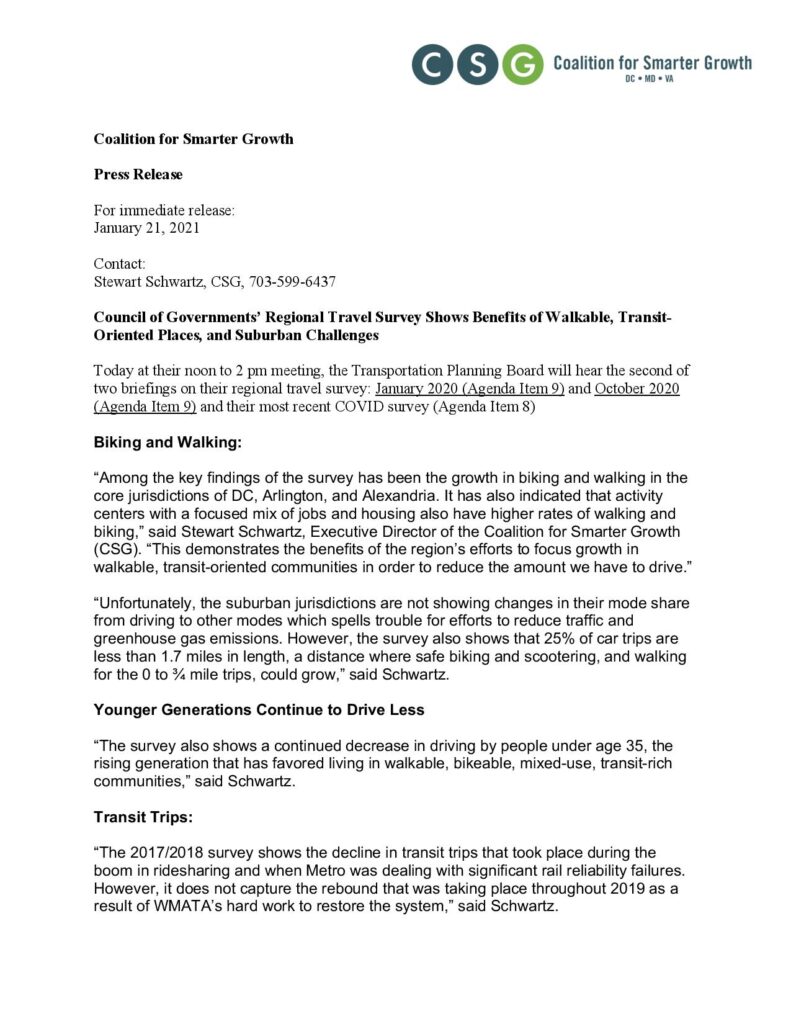
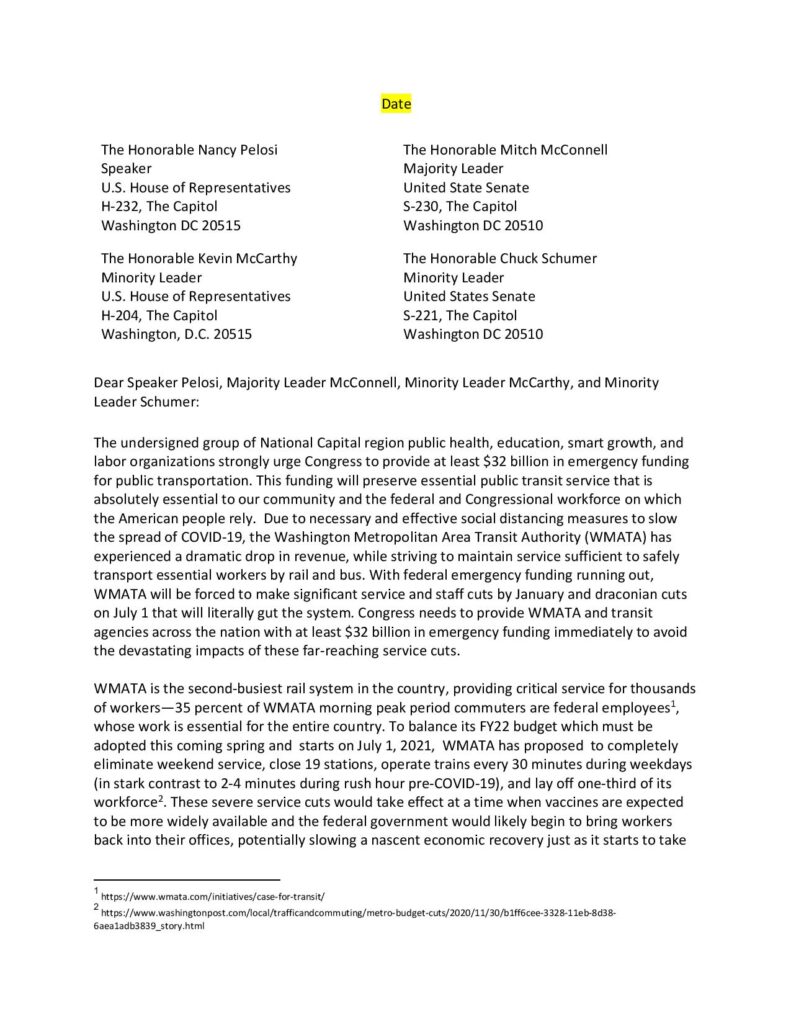
MetroNow Emergency Transit Funding Sign-on Letter
Dear Members of the Congressional Delegation for Maryland, the District of Columbia and Virginia:
Transit is a lifeline for essential workers and critical to our economic health and well-being. The CARES Act, passed in March of this year, provided a stop gap to help transit agencies survive dramatic losses in revenue streams, unprecedented drops in ridership, and fund new and enhanced cleaning protocols, but the funding is running out. Transit agencies nationally need $32 billion in emergency operating funds to avoid damaging service and jobs cuts and minimize economic hardship.
The vast majority of WMATA funding comes from capital contributions, jurisdictional subsidies, and farebox revenues from riders. Since COVID-related restrictions were enacted in March, farebox revenues have evaporated. Bus fares were waived around the Capital Region to minimize interaction between rider and driver, and Metrorail, which kept fares intact, has averaged only about 10% of the pre-COVID ridership since March. In Maryland, the Transportation Trust Fund relies largely on motor fuel taxes, titling and registration fees, federal aid, sales tax, transit fares, and port and airport fees, all of which have taken a hit during the pandemic, with corresponding impacts to the Maryland Transit Administration (MTA). Meanwhile, as jurisdictions face the worst fiscal crisis in living memory, they are stripping budgets to the bones, leaving no room to alleviate losses in farebox revenue through additional jurisdictional subsidies.
When the CARES Act funding runs out, transit agencies will be forced to cut transit service and furlough or lay off workers or redistribute capital funds, intended for repairs and expansion, to operating budgets. Both options will seriously harm the viability, safety, and reliability of transit service in the short and long term, but more importantly, it will harm the riders, businesses, and regional economies and workers that depend on transit. Anticipating the lack of federal aid, WMATA and the Maryland Transit Administration have already warned of service and workforce cuts to address their COVID-19 revenue impacts. Cuts to transit will harm the region, weaken the economic recovery, slash capital expenditures and the jobs they support, and worsen inequality.
The economy cannot recover without transit. If Congress fails to act this month to fund $32 billion in emergency operating funds, it will deepen the economic pain already felt by millions throughout the country. In this time of uncertainty, grief, and loss, Congress must put aside their differences and work together to fund transit or this region will emerge weaker on the other side of the virus.
The undersigned business groups, transit agencies, unions and elected officials urge you to commit this critically needed funding for transit. Our riders, our economy, and our region depend on it.