Category: CSG in the News

Public Gets First Input On Transportation Bill Projects

nvtaMembers of the public from Loudoun, Arlington, Fairfax and Prince William counties got their first chance to speak to the full board of the Northern Virginia Transportation Authority Thursday night in a public hearing discussing the projects that could receive funding from the General Assembly’s transportation bill that passed earlier this year.

Twenty-two people, including legislators, representatives of local advocacy groups and individuals giving their opinions, went before the board, and dozens more reviewed the almost 50 projects the NVTA is considering. The NVTA’s priority is finalizing a list of projects that will receive funding for FY14, when there is expected to be $190 million available.

NVTA Chairman Martin Nohe, the Coles District Supervisor in Prince William County, gave a 30-minute presentation before anyone spoke, explaining what the NVTA is and how board members plan to implement the funding. $1.6 billion is expect to come to Northern Virginia over the next six years from HB2313, 70 percent of which will be dispersed by the NVTA and 30 percent going directly to each locality: the four counties and the cities of Manassas, Manassas Park, Falls Church and Alexandria.

The money is intended, essentially, to relieve the high levels of congestion that have plagued the area for years, and only figure to get worse. The main bone of contention among those who spoke was the best way to go about doing that.

“There’s a lack of quantitative information right now to evaluate projects with different modes and different types,” Del. Jim LeMunyon (R-67) who was the first to speak, said. “For every million dollars we spend, how many hours are we putting back into the lives of Northern Virginians? We need to know that.”

Residents in Prince William and Loudoun counties almost unanimously applauded the NVTA’s to fund the widening of several segments of Rt. 28 in Loudoun, Fairfax and Prince William counties.

The projects proposed for FY14 funding are “hot spot” improvements between Sterling Boulevard and the Dulles Toll Road in Loudoun, expanding from two lanes to a four-lane divided roadway from Linton Hall to Fitzwater Drive in Prince William, and widening from three to four lanes southbound between the Dulles Toll Road and Rt. 50 and northbound from McLearen Road to the Dulles Toll Road in Fairfax County.

“I’m here to commend your decision to include the Rt. 28 hot spot improvements,” Jeff Fairfield, speaking on behalf of the Rt. 28 Tax District Landowners Advisory Board, said. “These improvements will alleviate congestion. There’s been a tremendous improvement on removing traffic lights, yet we now experience congestion due to a lack of lane capacity.”

“Rt. 28 relief is needed now,” Gary O’Brien of Manassas said. “There are currently several disconnected projects. What it needs is more transportation capacity, right through the system. Try to consolidate the little plans into a larger system.”

Arlington County Supervisor Chris Zimmerman, the chairman of the Project Implementation working group, said the list of projects proposed for funding was built from existing transportation plans, such as the NVTA’s TransAction 2040, and are closest to “shovel-ready.”

“Our aim has been to, No. 1, follow the law” Zimmerman said. “We began by reviewing what the statutes require of us. In developing criteria, that was first and foremost. It has been our intention to use objective criteria and quantifiable criteria to the greatest degree possible. That is what we have been trying to accomplish.

“Many of the projects, by their nature, will take multiple years to do and have multiple parts. It’s a very complex network; there isn’t a silver bullet. It will take a lot of fixing in different places.”

Many Prince William County residents spoke against potential funding of the Bi-County Parkway, a controversial transportation project stretching from I-95 to Rt. 50 in Loudoun, but the project is not among those included for FY14 funding or on the Six-Year Plan.

Perhaps the most scrutinized debate will be how many funds are devoted to transit projects, pedestrian or bicycle projects, and how much will simply be devoted to increasing capacity on the roads network.

“In a great metropolitan area, you cannot ‘get the red out,’” Stewart Schwartz, the executive director of the Coalition for Smarter Growth, said about relieving intense traffic jams. “We have to account for induced traffic. For the peak-hour commute, there’s nothing better than high-capacity transit. I urge you to resist a return to the old approach, which didn’t work, and focused on a transit-oriented, walkable bikeable future that we need to have.”

The NVTA will hold another public hearing July 24 before deciding upon the final FY14 list at 6 p.m. Wednesday, July 24, at Fairfax City Hall. The public comment period before the Project Implementation’s next working group will close next week. The form, and submittal information, can be found here.

Photo courtesy of Leesburg Today.

Click here to read the original story>>

Six-Year Improvement Program: a Blueprint for Failure

bacon


With the adoption of the new Six-Year Improvement Program, the details of Governor Bob McDonnell’s transportation priorities plan are coming into clearer focus. There are some worthy elements to the plan but glaring deficiencies guarantee that Virginia will see minimal benefit from the billions of dollars dedicated to new construction.

On the positive side of the ledger, it is heartening to see that Virginia will get serious about meeting its statutory maintenance obligations. The Virginia Department of Transportation (VDOT) will spend an estimated $2.3 billion over the next six years to rehabilitate aging bridges. Roughly one in eleven bridges in the state is rated “structurally deficient.” (See “Bad Bridges” for details). VDOT also will dedicate 25% of its formula revenues to repairing deteriorating pavement on state interstates and primary roads. (It’s not clear from published reports, however, whether this work will address the aging sub-structure of these roads, which account for much of the deterioration.)

Second, VDOT will apply 5% of formula revenue to “smart roadway” projects, which will utilize sensors, video, wireless communication, artificial intelligence and other advanced technologies to do a better job of synchronizing traffic signals, clearing accidents and communicating information to drivers. If executed properly, these investments can increase the capacity of existing traffic arteries at significantly lower cost than constructing more lanes.

On the other hand…. Stewart Schwartz, executive director for the Coalition for Smarter Growth, sums up the negatives in a press release issued yesterday after the Commonwealth Transportation Board meeting:

“We are shocked by the lack of discussion of the spending priorities in the Six-Year Plan, by the failure to tie the program to specific policy goals, and the assumption that simply adding road capacity will solve our transportation problems.  The plan includes a number of wasteful mega-projects that have been strongly criticized as unnecessary including Route 460 ($1.4 billion), the Coalfields Expressway ($2.8 billion), Charlottesville Bypass ($244 million), N-S Corridor ($1 billion plus), and a long range $11.4 billion plan for I-81.

The CTB doesn’t understand the benefits of more efficient land use – of cities, towns, and compact transit-oriented development –  along with transportation demand management programs (carpooling, telecommuting etc), that reduce driving demand.  They don’t understand changing demographics and market demand that have led to big declines in vehicle miles traveled.  The plan includes just 9% of the total for transit even though 69% of the state population lives in the Urban Crescent.

In short, we believe this program will be remembered for squandering billions of tax dollars while making Virginia’s patterns of development less efficient, more oil dependent and less competitive.”

I couldn’t have said it better. My only point of difference with Stewart is that I have no faith that the extra $500 million allocated to rail and public transportation (bringing the total to $2.9 billion) will be spent any more effectively than the money dedicated to roads. When funding decisions are based upon politics rather than objective Return on Investment analysis, the potential exists for rail and public transit projects to be every bit as wasteful as road projects.

Virginia’s decision-making process for allocating transportation dollars is a mess. It is bureaucratic, cumbersome and lengthy. Once projects make it into the pipeline, they rarely get re-evaluated in the light of changing travel trends or market conditions. The CTB exercises no independent review over the priorities handed down by the McDonnell administration. Functioning as regional advocates and conduits of information to the administration, CTB representatives do their most important  work behind the scenes. By the time projects are formally reviewed during CTB meetings, the decisions have already been made. Additionally, there are major transparency issues associated with Public Private Partnership mega-projects. The need for confidentiality when the state negotiates with private-sector partners conflicts with the need for public disclosure before the final deal has been struck.

The McDonnell administration has made no effort whatsoever to address these process issues. It has made no effort to re-evaluate projects in the funding pipeline in the light of new demographic, travel and development trends. And it has made no effort to better align transportation planning and land-use planning. The entire approach has been marked by spending as much money as possible to build as many projects as possible. Bottom line: The McDonnell administration has borrowed billions of dollars and raised our taxes in order to pour more money into a broken system.

Photo courtesy of James Bacon.

Click here to read the original story>>

VDOT to increase spending on deficient bridges

richmond

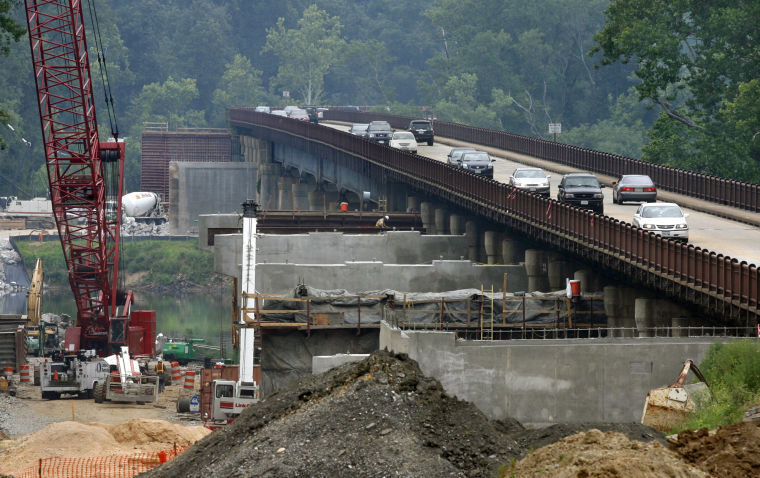
VDOT will spend nearly $2.3 billion to upgrade the state’s bridges over the next six years.

“We’re going to spend $564 million in additional state money on bridge reconstruction and rehabilitation,” said state Transportation Secretary Sean T. Connaughton. “This isn’t just about infrastructure. This is about ensuring the public safety.”

The goal is to make sure the percentage of structurally deficient bridges remains less than 8 percent of the state’s nearly 21,000 bridges and culverts.

“There’s a large backlog of bridge maintenance projects that we’re now going to be able to get to,” Connaughton said at the Commonwealth Transportation Board meeting Wednesday in Richmond.

This year, 7.5 percent of Virginia bridges were rated structurally deficient, the Virginia Department of Transportation said.

Nationally, 11 percent of 607,000 road bridges were considered in poor repair, according to figures from the Federal Highway Administration. The average U.S. bridge is 42 years old.

VDOT says that bridges slated to be replaced as structurally deficient in the Richmond region include those carrying Interstate 64 over Airport Drive in Henrico County, Interstate 195 over the Powhite Parkway in Richmond, U.S. 1 over railroad tracks at Bellwood in Chesterfield County, and state Route 13 over Sallee Creek in Powhatan County.

The funds for accelerated bridge work are part of the state’s $17.6 billion allocation for transportation programs for the fiscal year that begins July 1 and continues through the fiscal year that ends June 2019.

The six-year transportation program, including new funding sources for Northern Virginia and Hampton Roads, is $6.2 billion larger than last year’s approved plan, a 54 percent increase. The state Transportation Board approved the new six-year program Wednesday.

The funding increase largely springs from revenue the General Assembly provided this year, the first significant infusion of money into the state’s cash-strapped transportation system since 1986.

Not everyone was pleased with the spending plan.

“This program will be remembered for squandering billions of tax dollars while making Virginia’s patterns of development less efficient, more oil dependent and less competitive,” said Stewart Schwartz, executive director of the Coalition for Smarter Growth.

The plan includes a number of “wasteful mega-projects that have been strongly criticized as unnecessary,” Schwartz said, citing $1.4 billion for the new U.S. 460; $244 million for the Charlottesville Bypass project; the $1 billion-plus North-South Corridor highway in Northern Virginia; and the $2.8 billion Coalfields Expressway in Southwest Virginia.

“We are shocked by the lack of discussion of the spending priorities in the six-year plan, by the failure to tie the program to specific policy goals, and the assumption that simply adding road capacity will solve our transportation problems,” Schwartz said.

The May 23 collapse of an Interstate 5 bridge in Mount Vernon, Wash., has drawn national attention on the issue of bridge safety. In the I-5 incident, a 160-foot span of the four-lane bridge collapsed into the Skagit River after a tractor-trailer with an oversized semitrailer struck the span’s overhead truss structure.

To eliminate the nation’s deficient bridge backlog by 2028, the U.S. needs to invest $20.5 billion annually, though only $12.8 billion is being spent currently, the American Society of Civil Engineers said in its 2013 Report Card for America’s Infrastructure.

According to the American Association of State Highway and Transportation Officials, being classified as structurally deficient does not mean a bridge is unsafe.

If a Virginia bridge’s structural rating sinks too low, state highway officials post a lower weight limit on it and increase its frequency of inspections. In the worst case, VDOT closes bridges in poor condition.

Photo courtesy of P. Kevin Morley.

Click here to read the original story>>

Va. transportation board approves study that includes Bi-County Parkway

RICHMOND — A state transportation board Wednesday advanced plans for a controversial project to build a parkway connecting Prince William and Loudoun counties.

The Commonwealth Transportation Board, in a 15 to 1 vote, endorsed a master-plan study that looked at potential improvements along the state’s North-South Corridor, a 45-mile route connecting the two Northern Virginia counties.

The vote was denounced by opponents of the Bi-County Parkway, who said board’s decision is a sign that the state is moving forward with the 10-mile road, which would skirt Civil War sites to connect I-66 in Prince William with Route 50 in Loudoun.

Board member W. Sheppard Miller III, of Virginia Beach, voted against moving forward, saying the board’s resolution did not adequately rule out toll roads, which he opposes.

A total of 15 people appeared before the board to comment, and several of them urged Virginia Department of Transportation (VDOT) officials to delay the adoption of the corridor study, saying that the state has not been transparent about its plans.

“This impacts tens of thousands who are unaware,” said Tom Thompson, who lives near the site of the proposed parkway.

Gary Garczynski, who lives in Woodbridge and represents the board’s Northern Virginia district, said the vote was a small step in a years-long process for the parkway.

“It’s not a foregone conclusion, and I regret to say that a lot of people think it is,” Garczynski said. “From my perspective, that’s just not true. We have a long way to go.”

The North-South corridor is one of 12 designated regions in which state transportation funding priorities are established. The improvements, including the Bi-County Parkway, are designed to improve traffic flow, spur economic development and provide better access to Dulles International Airport, supporters say.

Del. Timothy D. Hugo, a Republican Party leader who represents parts of Fairfax and Prince William counties, was among those who attended the meeting to object to the proposed road.

The board has “created a firestorm. . . . The rationale provided by VDOT [for the parkway] changes every time,” Hugo said. “These people deserve a straight answer.”

Residents say they worry about increased traffic and the fact that the parkway would run through a protected rural area with a rich Civil War history.

The board’s vote Wednesday came after a month’s delay. Concerns were raised by Rep. Frank R. Wolf (R-Va.), who wrote a letter to Gov. Robert F. McDonnell (R), to say that the state’s process lacked transparency and that more public input was needed. Six Republican state legislators, led by Hugo, have announced that they oppose the road and the state’s handling of the process.

Stewart Schwartz, president of the Coalition for Smarter Growth, has questioned whether a plan for north-south improvements is necessary.

“You started with a conclusion and went backwards,” he said of the adopted study. ““We will look back and realize that we have gained no ground and squandered billions.”

Community stories show the shift to a walkable lifestyle

38 percent. That’s the growing percentage of District households that are car-free. Countless others are car-lite, relying mostly on transit, walking, and biking.

Too often we lose sight of this fact in local debates on issues like parking, transit improvements, redevelopment, and so on.


 Asdrubal - Mt. Pleasant Julia & Marcus - Columbia Heights Wanda - Hillbrook
Rebecca & Alistair - Petworth Dan - Dupont Circle Emilia - Woodley Park Dennis - Downtown Ward 7
Mouse over or click an image to read an individual story.

Basic lifestyle and mobility decisions are fundamentally changing for large segments of DC’s population. Nonetheless, a significant number of District policies and discussions still assume that most residents will own a car and use it for many, if not all, of their daily needs.

The consequences of this misunderstanding impact all of us, ranging from higher housing costs, increased traffic thanks to unintentional subsidy of car ownership, and diverting resources from improving other transportation options.

In the end, what all of that means is a less walkable, less inclusive District.

To raise awareness of this misunderstanding, the Coalition for Smarter Growth has collected first-hand accounts from neighbors across DC, examining the various modes of transportation they use in their everyday lives.


Click for interactive map.


We hope this project will help policy makers and skeptical (but open-minded) residents understand that the District won’t face parking and driving Armageddon if we respond to changing lifestyle choices by getting rid of unnecessary parking mandates for new buildings, or by giving buses more priority on roads to make transit more reliable and convenient.

The District won’t face that Armageddon because so many existing residents and new residents simply don’t drive very much. Tastes and lifestyle choices are in the midst of a dramatic change, and despite what some hyperbolic opponents of transportation havesaid, a majority of our new residents are very likely to be car-free or car-lite and looking to stay that way.

The Mosley Family - Mt. Pleasant Neha - Capitol View Mo - Columbia Heights The Hampton Family - Columbia Heights
Jeffrey - Chevy Chase Abigail - Glover Park Gavin - Adams Morgan Zach - Ft. Totten
Mouse over or click an image to read an individual story.

Abstract statistics and shouting matches about who is right aren’t what walkable living is all about. Instead, it’s just regular people throughout the city who are leading this quiet but growing sea-change, that’s making much of our 20th century transportation formulas less relevant to how we get around today:

  • Longtime resident Wanda in Hillbrook notes how many of her neighbors walk to the stores along Minnesota Avenue, and pleads for more investment in pedestrian and bike infrastructure in her neighborhood.
  • Rebecca in Petworth happily relies on Metro to drop her toddler off at daycare in L’Enfant Plaza, and walks to the grocery store to do her family’s shopping.
  • In Mt. Vernon Square, Keith says that on the rare occasions when he can’t walk to where he’s going, Car2Go, Bikeshare, or transit is there to fill the gap.

If you have time, please use our story collection form on the Walkable Living Stories campaign webpage to share your own story, and consider tweeting or sharing your favorite story on Facebook.

If you have other ideas to help explain this changing lifestyle preference to policy makers, neighbors, or the press, leave them for us in the comments section, or share them with the Coalition for Smarter Growth directly at action@smartergrowth.net.

Click here to read the original story>>

My walkable living story

Almost 4 in 10 DC households are car-free, and even more are car-light. That’s not because DC is full of car-hating zealots; it’s because life is simply more convenient that way, when the conditions are right.

When 5 minutes of walking, along a pleasant and safe sidewalk, can get you to most of your daily needs, and cycling or high-frequency transit can get to the rest, driving is more of pain than convenience. Especially when you factor in battling for parking and road rage, not to mention cost.

So when the Coalition for Smarter Growth started putting together Walkable Living Stories, about how and why so many DC residents go car-free or car-light, I wanted to participate. Here’s my story:

dan csg

“My wife and I hate sitting in traffic and wanted to never have to do it again. So we opted out! When we selected our apartment, we intentionally picked one in the densest part of DC. Within two blocks of our apartment we have a grocery store, convenience mart, dry-cleaner, hardware store, and several cafes. So almost all our daily errands are on foot, or Capital Bikeshare. My commute is on the 16th St. bus line, where buses come every few minutes (more often than Metro trains!), so we never have to wait long. And we never have to look for parking, because we don’t need any! Our apartment costs more than one in the suburbs would, but we don’t have a car payment, nor an insurance payment, nor any gasoline bills. We do occasionally rent cars for out-of-town trips, but that’s much less hassle and cost than car ownership.”

For more about CSG’s Walkable Living Stories project, visit their website, or see today’s big GGW post.

Click here to read the original story in BeyondDC >>
Click here to read the original story in The Washington Post>>

Is Washington D.C. a Walkable and Bikeable City? These People Say It Is

Ginnie from the Walkable Living Stories campaign.

What a way to kick off summer, with the Coalition for Smarter Growth launch today of Walkable Living Stories.

The campaign shares the stories of dozens of Washington D.C. residents who have chosen a walkable lifestyle. When you get to the site, you find yourself clicking on the interactive map to see where the 38 percent of the car-free or car-lite district households reside and how they do it.

You can click on your community, an individual storyteller, or a neighborhood that interests you. You may even click on someone you know (Editor: Such as Dan Malouff from Dupont Circle, who works with us at Arlington County Commuter Services and is a blogger for Greater Greater Washington). You will, at the least, find that the people are easily recognizable and relatable. They may be your co-worker, friend, neighbor, fellow cyclist, walker, or someone you see daily on the metro on your way to yoga.

I clicked on Ginnie, head librarian at D.C. Public Libraries. She says that Capital Bikeshare has changed her life and uses it to get to work, even on rainy days. Ginny has made sharing (checking out books from the library) part of her work life, so it made perfect sense for her to extend the sharing lifestyle (bikesharing) to her personal life?

And, don’t we already live in a shareable world? Sharing has definitely made my life easier, more fun, healthier, and more affordable. We can already appreciate the benefits of sharing with free wi-fi hot spots, potlucks, clothing swaps, gamification, Facebook, Twitter, Wikipedia …

It’s human nature to share, and how great it is for the Coalition for Smarter Growth to expose us all to the ways that D.C. residents creatively and enthusiastically pursue this lifestyle.

Let’s hope this campaign makes the District (and the region) more walkable.

Submit your own story here.

Click here to read the original story>>

Walking tour explores Fort Totten’s present and future

Development at Fort Totten has been slow despite access to 3 Metro lines, its close proximity to both downtown DC and Silver Spring, its access to the Metropolitan Branch Trail, its green space and its affordability. But as demand increases for housing in the District, this previously-overlooked neighborhood could become a hot spot.


Photo by tracktwentynine on Flickr.Last Saturday, the Coalition for Smarter Growth concluded their spring walking tour series with “Fort Totten: More than a Transfer Point,” a look at future residential, retail and commercial development near the Fort Totten Metro station. Residents and visitors joined representatives from WMATA, DDOT and the Office of Planning on a tour of the area bounded by South Dakota Avenue, Riggs Road, and First Place NE.

Today, vacant properties and industrial sites surround the station and form a barrier between it and the surrounding area. Redeveloping them could improve connections to the Metro and make Fort Totten a more vibrant community.

There is a significant amount of new residential, retail and commercial development planned within walking distance of the Metro station. But Saturday’s tour began with the only completed project, The Aventine at Fort Totten. Built by Clark Realty Group in 2007, the 3-building, garden-style apartment complex consists of over 300 rental units as well as ground-floor retail space.


The Aventine at Fort Totten, the newest apartment complex in Fort Totten. All photos by the author unless otherwise noted.Visitors were ambivalent about the success of the Aventine due to its small amount of retail space and lack of connectivity to surrounding neighborhoods. While residents noted that it created more options to live close to Metro, representatives of the Lamond Riggs and North Michigan Park civic associations agreed the development differed from the original vision for the project.

They called it an example of the need to continually engage real estate developers and local government agencies to ensure that new development is of a high quality and responsive to the local context. Throughout the tour, residents said that future development proposals should adhere to DC’s urban design guidelines, improve pedestrian access and have a plan to mitigate parking concerns.

Between South Dakota Avenue and the Metro station, the Cafritz Foundation will redevelop the old Riggs Plaza apartments to build ArtPlace at Fort Totten. When finished, the 16-acre project will contain 305,000 square feet of retail, 929 apartments, and 217,000 square feet of cultural and art spaces, including a children’s museum. Deborah Crain, neighborhood planning coordinator for Ward 5, noted that ArtPlace will include rental units set aside for seniors and displaced Riggs Plaza residents.


An ad for ArtPlace at Fort Totten at its future home.As one of the largest landowners near the Fort Totten Station, WMATA has a huge stake in future development around the station. They own approximately 3 acres of land immediately west of the station along First Place NE that is currently used as surface parking lot for commuters. Stan Wall, Director of Real Estate at WMATA, discussed the great potential for development on the current parking lot mentioned that the agency will solicit proposals for development of the area in the near future.


Parking lot at Fort Totten station.Anna Chamberlain, a DDOT transportation planner, talked about how streetscape improvements could calm traffic, making streets around the Metro station more pedestrian- and bike-friendly. DDOT is also working to improve connections to the Metro, as some areas lack clearly defined walking paths. The agency will begin designing a path connecting the Metro to the Metropolitan Branch Trail within the next few months.


New sidewalks and street trees on Riggs Road.The final stop on the tour was Fort Totten Square, a joint effort by the JBG Companies and Lowe Enterprises to build 350 apartments above a Walmart and structured parking at South Dakota Avenue and Riggs Road. DDOT has completely rebuilt the adjacent intersection to make it safer for pedestrians and more suitable for an urban environment, replacing freeway-style ramps with sidewalks, benches, crosswalks and improved lighting.

Jaimie Weinbaum, development manager at JBG, says they’re committed to working with the city and residents to make Fort Totten Square an asset to the community. They’ve promised to place Capital Bikeshare stations there and would like to have dedicated space for Car2go as well.

With help from the private sector and public agencies like DDOT and WMATA, Fort Totten could become a model for transit-oriented development, but much of the new construction won’t happen for a long time. Until then, residents eagerly await the changes and continue to work with other stakeholders toward creating a vision that will benefit everyone.

Photos courtesy of Greater Greater Washington

Click here to read the original article >>

Redeveloping McMillan is the only way to save it

At a recent public hearing, neighbors of McMillan Sand Filtration Site renewed calls to make it a park. But the only way that can happen is by developing part of it as a neighborhood, and it’s up to the DC Council to make it happen.


Rendering of the future McMillan Park.

Residents filled a June 6 public hearing held by the Office of the Deputy Mayor for Planning and Economic Development to oppose plans to sell the derelict 25-acre site to Vision McMillan Partners, who will build homes, shops, offices and a park there. But others, including Councilmember Kenyan McDuffieand groups like the Coalition for Smarter Growth say it’s the best way to bring McMillan back to life.

It would be prohibitively expensive just to make McMillan a park. Since the underground cells are made of unreinforced concrete, they would have to be demolished and rebuilt just to make them safe to enter. Allowing some private development will give the neighborhood new amenities while paying to keep the best of what’s already there.

Plan preserves historic structures while creating new park

VMP’s plan preserves all 24 of the plant’s above-ground structures, including the vine-covered sand silos visible from North Capitol Street, along with 2 of the below-ground filtration cells. 2/3 of the site will remain open space, while the southern third will become an 8-acre public park with a pool, recreation center, and a community center with meeting rooms and an art gallery. VMP promises that this will be “one of the largest and best-designed public park spaces in the District.”


Proposed site plan of McMillan redevelopment.

The historic buildings will become part of a new neighborhood with about 800 apartments and townhomes, half of which will be set aside for families making between 50 and 80% of the area’s median income. There will also be street-level, neighborhood-serving retail anchored by a 50,000-square-foot, full-service grocery store. Along Michigan Avenue, there will be taller office buildings with a medical focus, taking advantage of proximity to Washington Hospital Center across the street.

To make this happen, however, the DC Council must decide this fall whether to declare the land as surplus and “dispose” of it. They can do this either by selling it to VMP or granting it as-is to VMP under existing zoning, which wouldn’t allow major redevelopment to occur. They could also divide the property and sell off the parts to different owners and under different zoning. They can do all of this in a single set of hearings and votes, and they should to ensure that this process happens as quickly and fairly as possible.


This rendering shows how new and old buildings will coexist at McMillan.

Throughout the summer and fall, the council will hold separate public hearings on whether to surplus McMillan and the details of VMP’s plan. Meanwhile, the DC Historic Preservation Review Board is reviewing VMP’s plan to redevelop the site with housing, shops, offices and an 8-acre park and will hold hearings about it this month and in September. They’ve already offered comments about the proposal and will make their recommendations before the end of the year.

Plan will improve stormwater collection, traffic

Groups like Friends of McMillan Park and the DC Chapter of the Sierra Club argued that McMillan is already a public space and should become a public park. However, one DMPED official I spoke to after the hearing said that the city can’t afford to do the work necessary to make the site safe for public occupancy. If the District retains ownership, the site would most likely remain decrepit and fenced off indefinitely.


All 24 of the site’s historic above-ground structures will be preserved.

Opponents maintain that the site’s underground cells are needed to retain stormwater, mitigating the effects of frequent floods in Bloomingdale, which is downstream from McMillan. But DC Water already plans to replace two of the cells with water storage tanks, which will remain after redevelopment. Meanwhile, VMP has also promised to incorporate stormwater retention and buffers into the buildings and landscaping on the site, reducing stormwater runoff.

Another top complaint was traffic. Residents feel that the neighborhood’s roads are already quite congested, especially at rush hour, and could not handle the extra trips generated by a major office, retail and residential center on the McMillan site. There is no question that the Washington Hospital Center, the city’s largest non-government employer, needs better public transportation service, as it is not located near a Metro station.


Buildings will step down moving south from Michigan Avenue.

VMP plans to build a bus turnaround for shuttles between McMillan and the Brookland Metrorail station, which would operate until a planned streetcar line along Michigan Avenue is built. Moreover, North Capitol Street has been designated a Bus Priority Corridor, meaning that the city intends to make changes to the street design and traffic flows to permit faster and more frequent bus service. The development would also open new through streets across the McMillan site, improving traffic flow and connections within the larger neighborhood.

Ward 5 needs parks, but it needs housing too

Some opponents say that new development should happen elsewhere in Ward 5, like on vacant and abandoned lots along North Capitol Street or Rhode Island Avenue. While not enough resources have been dedicated to encouraging more infill development, there’s no reason why that can’t happen in combination with the redevelopment of McMillan.


Rendering of the completed McMillan Park.

It is true that Ward 5 needs more and higher-quality parks, recreation facilities, and community centers. But the surrounding neighborhoods and the city as a whole are growing and are need more affordable housing, as well as more diverse shopping and entertainment opportunities within walking or biking distance or a short transit ride.

VMP’s current plan reflects the input of community members gathered over the course of several design charrettes that were open to the public. It satisfies the need for several types of amenities in this part of the city in a balanced way. It combines buildings that are in keeping with the surrounding neighborhoods with a large park, and preserves some of the historic filtration cells and all of the silos and brick regulator houses.

We have an opportunity to transform a decrepit former public works site that has been fenced off for over 70 years into a citywide destination: a vibrant and attractive new place to live, work, shop and play that serves many of the needs of residents in this part of DC while incorporating many reminders of its unique history. The Council shouldn’t waste any time taking advantage of it, as an opportunity like this won’t come again soon.

If you’d like to tell DMPED and the Council to surplus McMillan and allow VMP’s plan to happen, you can contact them here. Comments must be received by June 20.

All images courtesy of VMP.

Click here to read the original story>>

Prince George’s tries to make TOD easier

Prince George’s County wants to encourage growth in the right places by speeding up the approval process for transit-oriented development. The county council unanimously passed a bill last week that just might do it.

061313 pgtod

Developers have often said they don’t want to do business in Prince George’s because of its lengthy and unpredictable development review process. Bill CB 20 creates a fast-track development review process for projects within ½ mile of the county’s 15 Metro stations and the Bowie MARC station.

Projects are eligible for the speedier process if the Planning Board finds they meet best practices for urban design, like mixing housing with retail and making engaging streetscapes.

The bill aims to increase transit ridership, reduce auto dependency, and encourage walking for more trips. It’s one of several recommendations county planners say could draw more investment to the county’s Metro station areas.

Concerned about attracting unwanted commercial uses, the bill contains a long list of uses that are not eligible for the expedited review, including adult entertainment, liquor stores, pawn shops, strip malls, and drive-throughs.

An earlier version of the bill would have eliminated most requirements for public meetings or site plan review. This could have potentially rushed low-quality projects to approval without giving the Planning Board and the public enough time to review proposed projects.

Not surprisingly, many people opposed it, and the County Council tabled the bill last year before putting together a roundtable to discuss ways to improve incentives for transit-oriented development. The current bill combines 2 overlapping versions councilmembers Eric Olson and Mel Franklin submitted earlier this year.

The bill’s most important feature is streamlining the review process. It prevents the County Council from arbitrarily dragging out the process, a power they’ve abused in the past that creates uncertainty and discourages developers from working in the county. Developers say that the unpredictability of approvals in Prince George’s County often makes it not worth the time and money spent there.

While the current bill shortens the review process, it still gives the Planning Board and members of the public enough time to offer feedback. If the Planning Board approves a proposal, the County Council has a few days to decide whether or not to review it as well. Project applicants or residents can also use this time to appeal the board’s decision.

Bill CB 20 is just one of many actions Prince George’s County has taken to encourage investment at Metro stations. Recently, county officials have also reduced the impact fees developers pay to support schools and public safety. Economic analysts say excessive fees discourage investment altogether, meaning the county won’t even receive the fees it seeks to collect.

Another element of ensuring development goes at Prince George’s Metro stations is having a good countywide plan. There is a town meeting this Saturday, 10 am-1 pm at the University of Maryland, to work on a plan for the county’s growth over the next 20+ years. You can help push for a plan that works in concert with this legislation to encourage TOD at Metro station sites.

Photo Courtesy of Elvert Barnes on flickr.

Click here to read the original story>>