

DC Comprehensive Plan Fact Sheet
Category: Resources
CSG testimony supporting Montgomery County CIP amendments
January 30, 2020
Montgomery County Council Office
Council Office Building
100 Maryland Ave.
Rockville, MD 20850
FY 21 Capital Budget and FY 21-26 CIP (Support with Amendments)
Testimony for February 5th, 2020
Jane Lyons, Maryland Advocacy Manager
President Katz and Councilmembers, thank you for the opportunity to speak today. I am here on behalf of the Coalition for Smarter Growth, which supports the FY 21-26 CIP with several critical amendments. We are pleased with the support the County Executive’s CIP gives to bicycle and pedestrian safety, the Bethesda station south entrance, and bus stop improvements. These projects are a necessity if we want to end unnecessary tragedies on our streets.
Missing projects: Given that, I’ll begin with what we believe is missing: funding for the northern entrance for the White Flint Metro station, the Capital Crescent Trail tunnel in Bethesda, and a multi-use path along Dale Drive. These projects will support economic development and increase both Metro and Purple Line ridership. They also both specifically address safety along MD 355, one of the most dangerous and deadly roads in the county, where two people have already been killed in 2020.
Bus Rapid Transit: Regarding BRT, we are happy that this CIP includes funding for preliminary engineering of BRT on MD 355, Veirs Mill Rd, New Hampshire Ave, and the North Bethesda Transitway. However, given our economic development and climate crises, these projects cannot wait and should be advanced to start even sooner. Likewise, it is disappointing that there is no money included in the CIP for BRT construction. This is especially disappointing when every road project includes costs for both preliminary engineering and construction. Not one BRT project has a construction timeline. I hope the Council will prioritize BRT by actively planning for its implementation.
Specifically, I hope you will accelerate the preliminary engineering timeline for MD 355 – four years is much longer than needed – and schedule planning for New Hampshire Ave and North Bethesda Transitway to begin much earlier than FY22 and FY24, respectively. At this rate, we can expect that service wouldn’t begin on these lines until at least 2026. Can our economy or climate wait that long? Can transit-dependent residents in Gaithersburg or Germantown wait that long for high quality transit, especially in light of the Corridor Cities Transitway cancellation?
MCDOT has proposed that MD 355 BRT service be broken into three routes since the full 22 mile route is too long for an ideal level of frequency. This effectively breaks up construction and service commencement into three phases. I recommend that the Council select a design alternative (Alternative B); then when preliminary engineering and design for the first phase is complete, construction could begin on that phase while the second phase undergoes preliminary engineering and design, and so on.
Finally, we firmly believe that Route 29 BRT will not set a good example without dedicated lanes south of Tech Road. MCDOT’s median lane study was supposed to be released last fall. This report should be shared with the Council immediately so that any construction funding can be included in the CIP.
Ride On improvements: Given slow progress, most BRT service in the county won’t be operational for five to ten years. We recommend that MCDOT take the success of Ride On extRa and expand express bus service to the other future BRT corridors. Ride On extRa Route 101 increased ridership by 11 percent and reduced travel times by 25 percent. MCDOT should also officially name priority service corridors, similar to WMATA’s Priority Corridor Network, which has helped WMATA to quickly improve service in phases.
As mentioned, we are pleased with the continued upgrade of Ride On’s 5,400 bus stops. The CIP details a GIS bus stop inventory and condition assessment, criteria for improvements, and prioritization. To the best of our knowledge, that information is not easily available to the public. We request that MCDOT publicly post that information, especially their criteria for improvements and prioritization.
Additionally, we urge the county to prioritize electric vehicle replacement. Most replacements for the Ride On fleet are set to be hybrids; however, the proposed CIP still details that 80 of the 153 vehicles will be diesel.
Affordable housing: We are grateful to the County Executive for creating the new Affordable Housing Opportunity Fund to help acquire properties in areas with growing rents. This fund supports the recommendations we crafted as members of the Purple Line Corridor Coalition Housing Action Team. We hope the County Executive and DHCA will continue to work with affordable housing developers to craft a program that best fits their financing needs.
School capital projects: Finally, we want to support funding for school capital projects, especially those that will relieve clusters in moratorium. However, we should note that the incentive created by the moratorium to fund capacity projects leaves out the vital capital needs of schools that are falling apart but aren’t overcapacity. Through the SSP update process, we hope to revisit the moratorium, and replace it with a policy that better serves the needs of both schools and housing.
Given the challenge of a shrinking capital budget and so many urgent projects, it’s time for the Council to start considering new funding sources. We will not meet our economic development, climate, and equity goals without significant investments the infrastructure that allows us to thrive. Thank you for your time.
CSG testimony in support of changes to the Maryland Metro/Transit Funding Act (HB 0086)
January 24, 2020
Appropriations Committee
House Office Building, Room 121
Annapolis, MD 21401
HB0086 – Transportation – Maryland Metro/Transit Funding Act – Alterations (Support)
Testimony for January 28, 2020
Jane Lyons, Maryland Advocacy Manager
Thank you, Madam Chair, Mr. Vice Chair, and members of the Appropriations Committee. This testimony is on behalf of the Coalition for Smarter Growth, the leading organization in the D.C. region advocating for walkable, inclusive, transit-oriented communities. We are strongly in favor of HB 86, which makes necessary alterations to the Maryland Metro/Transit Funding Act.
This bill will repeal the requirement that the Secretary of Transportation withhold a portion of the Washington Metropolitan Area Transportation Authority’s (WMATA’s) operating grant if WMATA’s operating expenditures increase by more than three percent over the prior fiscal year. The current three percent cap is arbitrary and limits WMATA’s ability to provide the level of service its Maryland customers require to get to and from work and other destinations.
WMATA’s own reports have shown that the best way to increase ridership, and thus increase farebox revenue, is to increase service. The WMATA Board has also recently endorsed the bold Bus Transformation Project, which seeks to make bus the mode of choice in the DC region. These service improvements cannot happen without the necessary funding and support from the State of Maryland.
Right now, WMATA’s current budget proposal seeks to increase suburban fares and cut vital bus routes in Montgomery and Prince George’s Counties, which will either require local providers to fill in the gap or, more likely, people will lose the bus service that they depend on to get where they need to go. These fare increases and cuts will disproportionately hurt low-income residents.
The WMATA Board, on which the Maryland Secretary of Transportation sits, is the proper body for deciding by what percentage WMATA’s operating expenditures should increase from year to year. If Maryland doesn’t want operating expenses to increase by more than three percent, the state can veto WMATA’s budget. Removing the legislative requirement of three percent gives more flexibility to Maryland’s decision makers. Three percent is entirely arbitrary and limits the system’s performance in a time of slow economic growth, high traffic congestion, and a climate crisis.
We are also supportive of the updated requirements to the Maryland Transit Administration (MTA) regarding the development of the Central Maryland Regional Transit Plan. A strong transportation network is key to connecting the DC region to the jobs and opportunities throughout central Maryland, and the plan for that network won’t be strong without regular consultation with those who are most familiar with its challenges.
This legislation makes vital updates to the Maryland Metro/Transit Funding Act. Given the state’s traffic, high cost of living, and the urgent need to reduce vehicle miles traveled and greenhouse gas emissions, we should be pouring more resources into our transit services and making those services the best they can be. The contrast between how Maryland speeds ahead with destructive, 12-lane, multi-billion toll road projects while we fight over funding our transit services couldn’t be starker.
Therefore, we ask you to vote in favor of HB 86. Thank you for your consideration.

CSG Comments on DC Comp Plan Amendments
January 10, 2020
Director Andrew Trueblood
DC Office of Planning
1100 4th Street, SW, Suite 650 East
Washington, DC 20024
Via: plandc@dc.gov
RE: Coalition for Smarter Growth Comments on DC Comp Plan October 2019 Draft
ENCL: Detailed CSG comments on the Comprehensive Plan October 2019 draft
Dear Director Trueblood:
Please accept these comments on behalf of the Coalition for Smarter Growth, the leading organization in the Washington, DC region dedicated to making the case for smart growth. Our mission is to promote walkable, inclusive, and transit-oriented communities, and the land use and transportation policies and investments needed to make those communities flourish.
Summary statement: We wish to express our support for the Comprehensive Plan amendments, including the map amendments. We believe that these changes are a major step forward for the District, as it seeks to fulfill its new mandate from the Framework Element to build a more inclusive, equitable, and sustainable city.
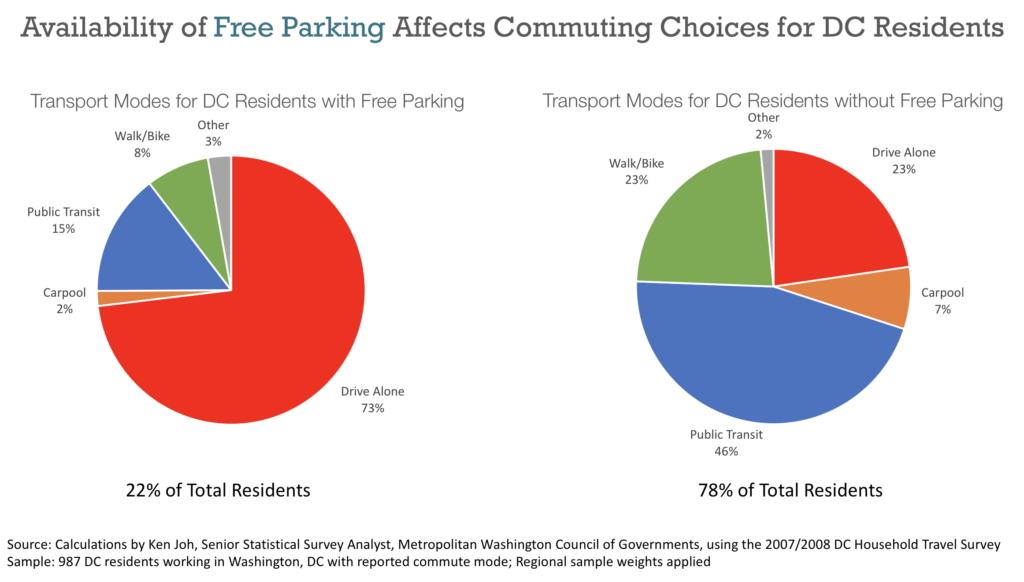
We strongly support the housing goals to increase housing opportunities throughout the city and provide more affordable homes, especially in parts of the city where there are few today. We commend the refocusing of defensive language to “enhancing” and “respecting” neighborhoods while ensuring they help address our housing needs. We also support the continued focus on transit-oriented development. We recommend going further in rethinking the role of vehicle parking in our future as parking requirements are a government anachronism in a rapidly changing transportation and environmental context. We recommend eliminating government regulations for minimum parking requirements and focusing on improving multimodal access and transportation demand management.
A mix of housing types with access to better transit will build a stronger city and better neighborhoods for all. It is also a legal obligation under the Fair Housing Act to affirmatively further fair housing. We applaud the District’s specific production goals to create 36,000 homes, with 12,000 of them affordable by 2025, and we support the allocation of these production goals by planning area. We agree that this is a helpful approach to building a truly equitable city and directly addressing the need to undo a legacy of racial discrimination and segregation.
We support the Future Land Use Map (FLUM) changes in general. A highlight are FLUM changes for new housing capacity in Rock Creek West, the area with the smallest share of affordable housing, at just one percent today. The next two areas lagging in affordable housing opportunities are Capitol Hill and Near Northwest. We urge the District to designate more housing capacity in these areas to achieve the
minimum 15 percent affordable homes in each planning area. We value quality affordable homes to meet the needs of DC households in all planning areas, but we especially urge the city to use land use policy to help lagging areas catch up to their affordable housing production goals of 15 percent.
DC’s many compact, walkable, transit-served neighborhoods make it the most sustainable place to live in the region. We should make it easier for more people, of all incomes to live in the city, which offers lower transportation costs, and helps reduce regional vehicle miles traveled and greenhouse gas emissions. The Comprehensive Plan and the District’s increased housing production goals play a major role in facilitating our region’s increased sustainability and social equity. The District faces many challenges, but our most pressing need as we manage the benefits of rising prosperity is to ensure that our low-income residents, especially people of color, have access to safe and affordable housing and transportation, along with quality nearby schools and services. Therefore, we commend the District’s efforts to ensure equitable access to quality housing and neighborhoods across the city.
We have enclosed our detailed comments on the Comprehensive Plan and maps. These comments are supplemented by our joint statement with affordable housing groups submitted on December 16, 2019. In addition, we want to associate ourselves with the comments of Ward 3 Vision and the 21st Century School Fund.
Thank you for the good work of the Office of Planning and sister agencies in putting together this excellent draft. We look forward to supporting the quick adoption of the new plan.
Sincerely,
Cheryl Cort, Policy Director
CSG testimony opposing I-270/495 expansion
January 8, 2020
Maryland Board of Public Works
Maryland State House
100 State Circle
Annapolis, MD 21401
Maryland Department of Transportation Item 23-GM (Oppose)
Testimony for January 8, 2020
Jane Lyons, Maryland Advocacy Manager
Governor Hogan and Board members, thank you for the opportunity to speak today. I am here on behalf of the Coalition for Smarter Growth, the leading organization in the D.C. region advocating for walkable, inclusive, transit-oriented communities. I am also a founding member of the Maryland Advocates for Sustainable Transportation coalition, which includes over 20 organizations and continues to grow.
Financial and process concerns:
The multi-billion dollar, decades-long decision being made today is being rushed. It is premature and lacks adequate environmental, alternatives, and financial analyses. You have begun with the conclusion – to build private toll lanes – rather than with an objective analysis of alternatives. Critical information has not been shared with the public and other local, state, and federal agencies. This is not how any state should be making multi-billion dollar decisions.
This project has significant financial uncertainty and risks. Prior to advancing this project and prior to solicitation, you must share the proposed financial terms and risks, including the state’s responsibility to compensate developers and lenders. Prior to taking action, you must request truly independent financial and traffic analyses. The public deserves to know how much they are expected to pay, both in tolls and potentially in taxes.
Environmental and traffic mitigation concerns:
We are also concerned about environmental impacts and traffic mitigation. We appreciate the attention given to the American Legion Bridge. However, private toll lanes may not be the answer. To date, MDOT has failed to study a true, comprehensive transit, demand management, and transit-oriented land use alternative to expanding I-495 and I-270, and in the case of the American Legion Bridge, Maryland and Virginia should study Purple Line and Metrorail options.
Maryland has 26 Metro stations, many of which are not being used to their full potential. Incentivizing residential and commercial development at Maryland’s Metro, Purple Line, and certain MARC stations would do more to reduce driving, long-distance commuting, and traffic than further widening highways. Because of induced demand, newly widened highways in metropolitan areas fill up again in as few as five years, but transit-oriented development provides long-term traffic mitigation.
Furthermore, the retained alternatives are in direct opposition to state climate and economic development goals. Your focus on moving cars in the west side of the region and your failure to study a transit-oriented development solution leaves Prince George’s, eastern Montgomery, and Baltimore behind. Investing in TOD and jobs in the Prince George’s to Baltimore transit corridors would not only do more to address traffic, it would provide critically needed, more balanced, economic development. Amazon’s HQ2 selection makes clear the high value modern employers place on access to high quality public transit.
To this, the scope of any transit improvements offered to counties in the P3 agreement needs to be clarified before today’s approval. A single BRT line is not enough to offset the harm of adding miles of new highway lanes.
For these reasons, we urge the Board to delay further action and steps towards a P3 agreement, and ultimately adopt a more effective and sustainable transit-oriented approach. At a minimum, this project requires a comprehensive alternatives and impact analysis, clarification of the state’s financial obligations, independent financial and traffic analyses, and a better deal for transit.
Thank you for your time.