
Category: Reports

ADU D.C. Homeowner’s Manual
How to Build an Accessory Apartment or Second Dwelling in the District of Columbia
The ADU D.C. Homeowner’s Manual is a product of the year-long ADU DC initiative launched in the spring of 2019. This effort was made possible with the support of founding funder Citi, and led by the United Planning Organization (UPO), along with its partner, the Coalition for Smarter Growth.

For more information on how to build an ADU, view the full resource folder here. Also, join our online forum on DC ADUs here.
Maryland Managed Lanes DEIS Traffic Review
We joined forces with the Maryland chapter of the Sierra Club and numerous other civic and neighborhood associations to fund a review of the draft environmental impact survey for the proposed expansion of I-495/I-270. Read the findings below.
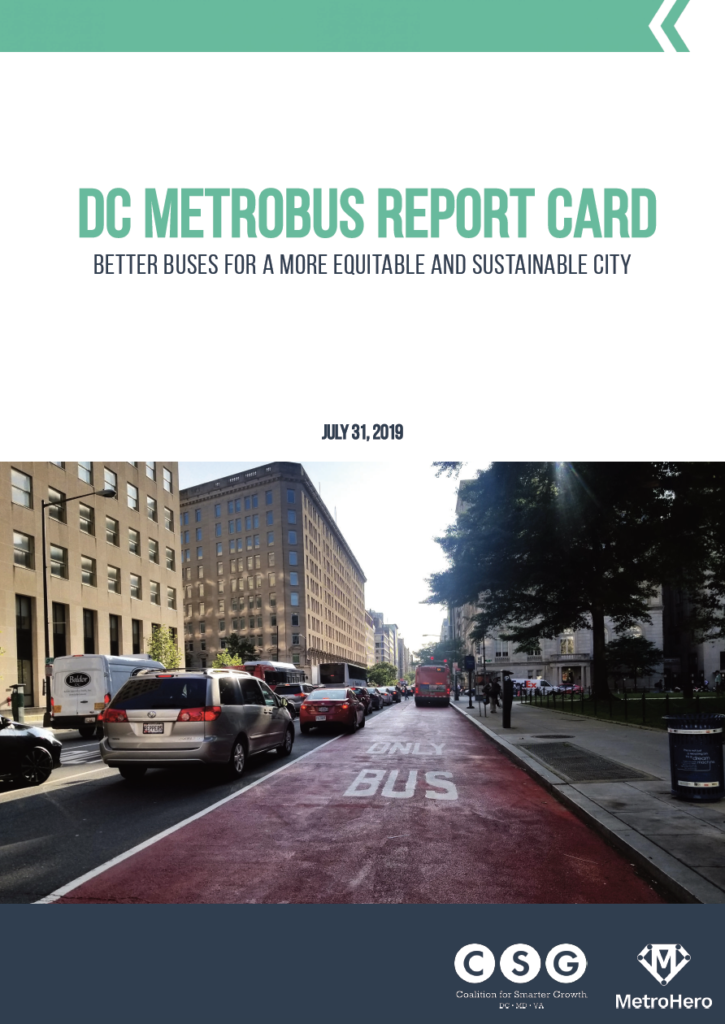
RELEASE: DC Bus Service gets a “D” on its Report Card


Press Release
FOR IMMEDIATE RELEASE
July 10, 2019
CONTACT
Cheryl Cort, Coalition for Smarter Growth
202-675-0016
cheryl@smartergrowth.net
DC Bus Service gets a “D” on its Report Card
Groups highlight how DC buses can be faster and more reliable
D.C. – Today, Coalition for Smarter Growth and MetroHero released a first-ever performance-based DC Bus Report Card. Developed from real-time data collected in May 2019 by MetroHero, the report shows DC’s major bus routes suffer from poor reliability and sluggish speeds, factors that are likely major contributors to the system’s declining ridership. The analysis of the report card can be found here.
“Our analysis shows the challenges Metrobus riders encounter on a daily basis. On the city’s priority corridors with high-ridership routes, we found service to be generally unreliable and unpredictable, with speeds slower than 10 mph,” said Jennifer Hill, Ph.D., Lead Researcher at MetroHero.
“The slow speeds and lack of on-time reliability are contributing factors in declining ridership. But we know how to turn this around: give buses priority on the streets, speed up boarding, balance bus stop spacing, and provide customer-focused service,” said Cheryl Cort, Policy Director for the Coalition for Smarter Growth.
MetroHero analyzed bus performance for 34 routes in DC’s highest ridership corridors in May 2019, focusing on three key factors: adherence to designated headways, adherence to scheduled arrival times, and average travel speed. Bus speeds on these routes averaged just 9.5 mph over the entire month, confirming other data showing that Metrobus speeds across the entire system have been getting slower every year.
“We hope that this report will be a useful tool to inform decision-makers about where DC’s buses need the most help and what solutions will have the greatest impact for riders,” said Hill.
DC and Metro are stepping up to implement improvements to bus service. DC recently implemented pilot bus lanes on H and I Streets downtown, and is planning to run bus lanes on 16th Street and K Street in the near future. The city has also implemented traffic signal priority and queue jumps on several corridors.
On an average weekday, Metrobuses transport over 200,000 riders around the District of Columbia to and from work, school, doctor appointments, grocery stores, entertainment, and more. Buses offer transit service far beyond the reach of Metrorail.
“This is an important moment for DC’s bus service. Buses are the most efficient use of limited public street space for moving people, and critical if the city is to grow without choking on traffic. We are encouraged by recent city actions, but urge the Bowser administration to make moving buses truly a top priority on our city’s streets,” said Cort.
About the Coalition for Smarter Growth
The Coalition for Smarter Growth is the leading organization in the Washington DC region dedicated to making the case for smart growth. Our mission is to promote walkable, inclusive, and transit-oriented communities, and the land use and transportation policies and investments needed to make those communities flourish. Learn more at smartergrowth.net.
About MetroHero
MetroHero (www.dcmetrohero.com), which began as a simple app designed to visualize real-time train positions in the D.C. Metrorail system, has been monitoring and providing performance metrics on WMATA’s trains for over three years. The app has gained popularity with many area commuters, averaging roughly 15,000 unique users every month, largely due to its unique real-time visualizations of the current state of the Metrorail system, from train delays and service outages to user-driven reports of inconveniences such as station crowding and broken intercoms. In September 2018, the MetroHero team extended a number of their train performance tracking algorithms to the Metrobus system, which they used to gather performance data for the report card.
###
CSG in the News: A Controversial Solution To D.C.’s Housing Crisis: Help The Middle Class
From WAMU: A Controversial Solution To D.C.’s Housing Crisis: Help The Middle Class, by Ally Schweitzer
The idea? Invest in housing for the middle class.
…Why has the mayor’s proposed workforce housing fund sparked controversy?
Mainly because there’s deep skepticism that middle-income people should be a priority when D.C. residents on the bottom of the economic ladder are much worse off.

The top 20 occupations in D.C. by employment totals, 2017. (Includes D.C. residents and commuters.) From a Coalition for Smarter Growth analysis of Bureau of Labor Statistics data.
First, the Coalition for Smarter Growth has criticized the city’s definition of “workforce,” saying it’s out of step with reality. According to a report published by the urbanist think tank, eight out of the city’s top 20 professions pay an annual median wage of less than $49,000, or 60 percent of AMI. For example, nearly 16,000 city workers are employed as janitors or cleaners — jobs that pay an annual median wage of $29,000, per CSG’s analysis. Meanwhile, teachers, social workers, and first responders don’t crack the top 20.”
Read CSG’s report and recommendations here.