Category: CSG in the News

House transportation bill to face Senate Democrats

RICHMOND — The path forward on a long-term plan to fund transportation projects in Virginia will have to move through skeptical Senate Democrats, though it was still unclear Wednesday what a final package might look like.

A version of Gov. Robert F. McDonnell’s proposal survived the House of Delegates but the state Senate rejected its own version of the bill on Tuesday after Democrats balked at the ideas of swapping the gas tax for a higher state sales tax and of paying for transportation using general fund revenues.

Sen. A. Donald McEachin (D-Henrico) said Wednesday that Democrats were still looking for a substantive plan that would generate closer to $1 billion a year for the state, steer clear of the general fund and not rely on would-be revenues from the passage of federal legislation related to the collection of Internet sales taxes. That legislation, they have said, has stalled in Congress.

“I think that’s the signal we sent last night,” said McEachin, who dismissed accusations that Democrats were unwilling to bargain. “We’re still willing to roll up our sleeves and do some hard work.”

On Tuesday, the Senate sent its legislation to the Finance Committee, effectively killing it and raising doubts about the prospects for the House measure on its way to the Senate. The House-approved bill is now the only surviving version of the governor’s package, and the Senate could amend or kill it.

“I’m very disappointed,” McDonnell (R) said in an interview Tuesday night. “I think the Democrats have a lot of answering to do tonight. They’re going to have to tell us what they’re willing to do. This is a party that says no to everything but higher taxes. I think the Democrats are way out of touch and they need to start being reasonable.”

While Senate Democrats were in lockstep Tuesday, four House Democrats voted in favor of their chamber’s transportation proposal: Rosalyn R. Dance (Petersburg), Luke E. Torian (Prince William), Roslyn C. Tyler (Sussex) and Onzlee Ware (Roanoke City). They cited regional concerns among their reasons for breaking with their party to support the bill.

Sen. Janet D. Howell (D-Fairfax), who voted against the Senate version of the plan, said her Republican colleagues did not offer a plan with adequate funding for public transit projects.

“I’m looking for . . . a plan I can sell to my constituents,” Howell said. “I haven’t seen that yet.”

Northern Virginia Transportation Alliance President Bob Chase said the House bill is “very much a work in progress.”

“The emphasis in the House has been to get something out,” said Chase, an early supporter of McDonnell’s plan. “I think it’s been crafted . . . in a way to try to show as many legislators as possible that there’s something in the bill that they ought to like. Where the bill stands now doesn’t necessarily preclude anything from being considered in conference.”

Stewart Schwartz, executive director of the Coalition for Smarter Growth, said the House’s version of the governor’s plan is “still a very flawed bill.”

“Eliminating the gas tax makes no economic or transportation sense,” Schwartz said Tuesday. “If it reduces gas prices like the governor projects, it is likely to increase the amount of driving, decrease transit use and increase congestion, especially in the two most urban regions of the state. There is nothing in this to guarantee that local jurisdictions across the state will get the local funding hey need. There’s no way to make this plan better at this point.”

Schwartz also wasn’t optimistic about the plan’s chances for improvement in a conference committee, which he predicted would be “disastrous” for Northern Virginia and Hampton Roads.

“Once it goes to a closed-door committee . . . dominated by the governor’s party, you are unlikely to get a bill that would address the many concerns that the metro regions have identified. The worst thing would be to have such a flawed plan move forward.”

Read the original article here >>

Coalition for Smarter Growth joins fight for transit dollars in Montgomery County

D.C.-based nonprofit the Coalition for Smarter Growth has joined the cause for transportation dollars to build the Purple Line and Bus Rapid Transit system, both of which supporters say would ease congestion in Bethesda, BethesdaNow.com reported.

The nonprofit, which until now has dealt largely with Northern Virginia transportation and sprawl issues, has turned its attention to Montgomery County and will host an event on Feb. 13 at the Silver Spring Civic Building focused on the area.

Read the original article at Washington Business Journal >>

The Next Generation of Transit: the Key to Montgomery’s Green Future

Join us for the Coalition for Smarter Growth’s panel discussion on the need to “invest in transit to improve our quality of life, protect our open spaces, and do our part in stopping climate change,” on Wednesday. February 13th from 6-8 pm at the Silver Spring Civic Building.

The Planning Department will be part of the panel, discussing the update to our Master Plan of Highways, which will move that functional plan beyond roadways to address bus rapid transit, bicycle-pedestrian priority areas, and MARC service.

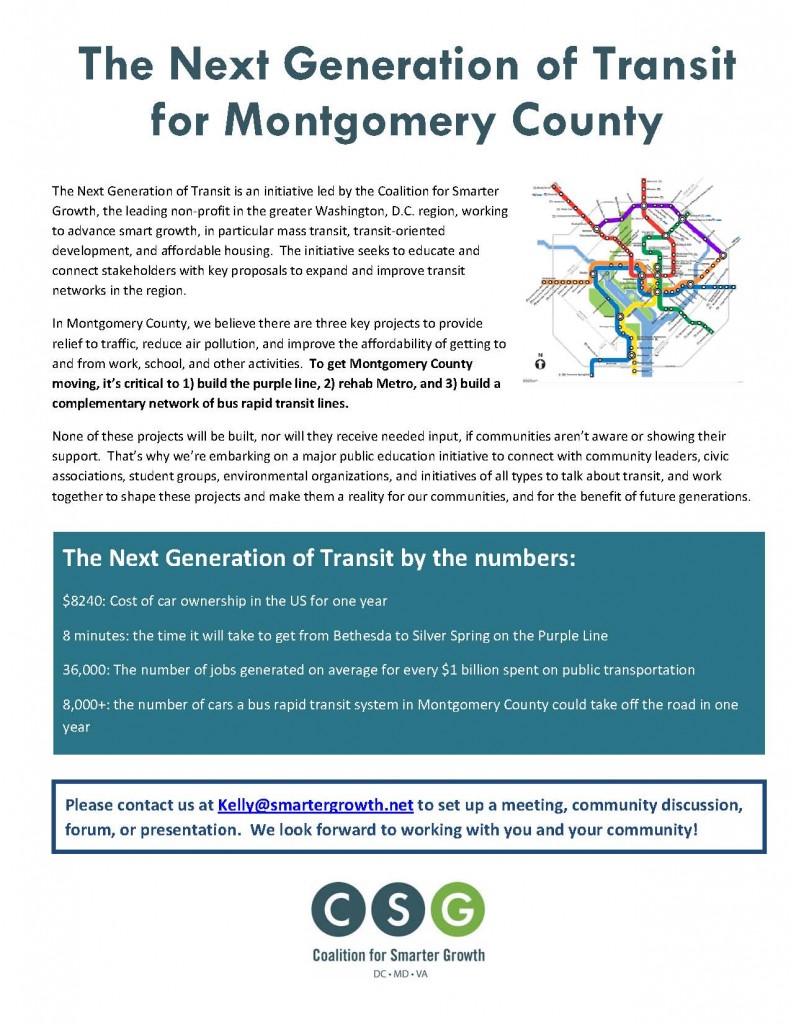
The Coalition shares some interesting data about bus rapid transit:

NextGenTransit-flier_Page_1

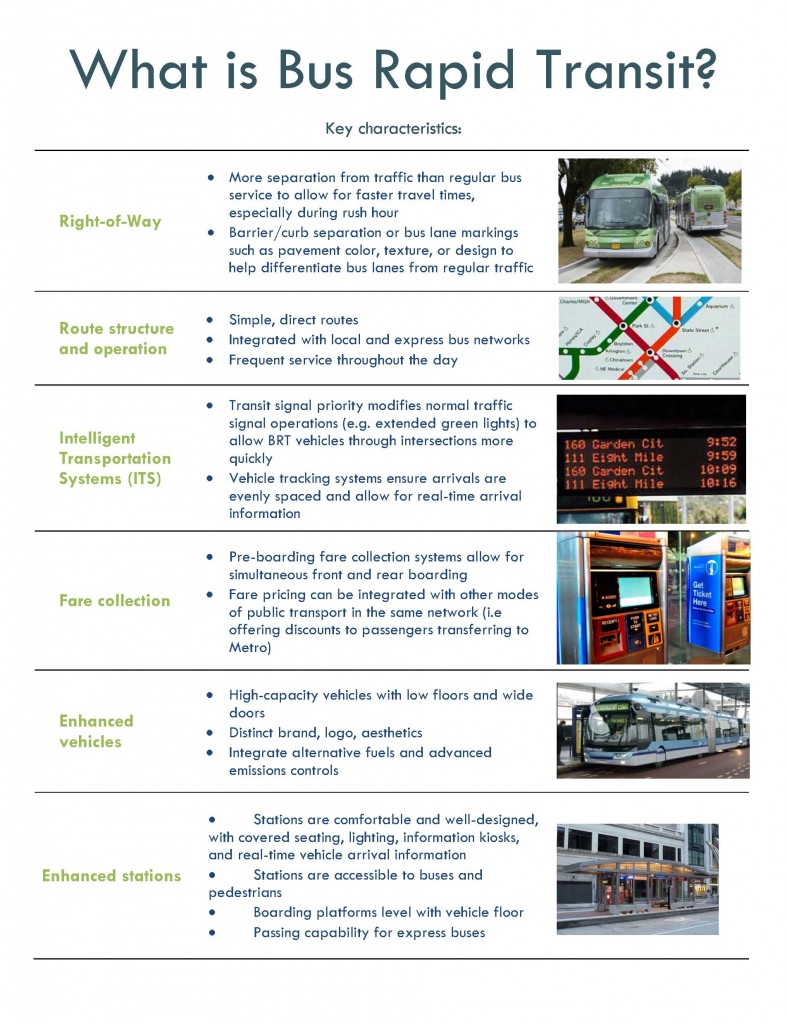
and provides a good description of bus rapdi transit (it’s not what you might expect from buses!):

NextGenTransit-flier_Page_2

Photos courtesy of The Straight Line
Read the original article here >>

Group Argues New Transit Options Key To Growth In Bethesda, Montgomery

A new group is joining the cause for transportation dollars to build the Purple Line light rail and Bus Rapid Transit system, both of which supporters say would ease congestion in Bethesda.

The Coalition for Smarter Growth, a D.C.-based nonprofit that until now has dealt largely with North Virginia transportation and sprawl issues, has turned its attention to Montgomery County and will host an event focused on the area next week in Silver Spring.

“The Next Generation of Transit: The Key to Montgomery’s Green Future” is scheduled for 6 p.m. to 8 p.m. on Feb. 13 at the Silver Spring Civic Building and will feature County Councilman Roger Berliner (D-Bethesda-Potomac), Smart Growth America CEO Geoff Anderson, Montgomery County Planner Larry Cole and Purple Line project manager Mike Madden.

The Coalition for Smarter Growth helped host a happy hour on White Flint development last week. It will focus its message next week on what the group argues are the environmental benefits of transit projects:

Montgomery County residents care about the environment. The county has been a leader in progressive planning from its award-winning Agricultural Reserve and extensive stream valley parks, to affordable housing and the revitalization of Silver Spring.

Now, Montgomery County is at a crossroads.  The county is expected to add over 200,000 new residents and over 100,000 new jobs in the next 20 years. Traffic and pollution will only grow worse if we don’t give people better options for moving around. Over 34% of greenhouse gas emissions in Montgomery County come from transportation.  Linking transit and transit-oriented communities can make a major contribution to fighting climate change and reducing air pollution.

But among our transit projects, the Purple Line may fail for lack of funding, WMATA needs to continue restoring its aging infrastructure, and the county needs more rapid transit connecting more places. We need to act now as a community and support a three-part transit agenda linking the Purple Line, Metro and the proposed Rapid Transit System. Investing in transit alternatives will be critical for doing our part to solve climate change, improve our air quality, support sustainable development and create good green jobs.

Join us with Geoff Anderson of Smart Growth America and Roger Berliner of the Montgomery County Council to discuss transit and smart growth solutions to climate change. We’ll also get the latest updates on Montgomery transit projects and strategize with us about how we can do our part through investing in transit.

For more information, visit the event website.

Flickr photo by ACTransit.org

Read the original article on BethesdaNow.com >>

Where will Prince George’s hospital go?

Smart growth advocates have applauded Prince George’s County Executive Rushern L. Baker III’s commitment to support new projects near the county’s 15 Metro stations, but as the county executive considers the best place to put a new $650 million regional hospital, he is making them nervous. Baker plans to hold a forum Feb. 28 at the Prince George’s Sports & Learning Complex to begin vetting four possible sites for the hospital. Two of them, the shuttered Landover Mall and the newly built Woodmore Town Centre, are nearly three miles from a Metro station in locations that require pedestrians to cross a Capital Beltway interchange. To the pro-transit crowd that has backed Baker as he presses the federal government on the importance of locating agencies near Metro stations, choosing either site would be a mistake.

A few steps can fix Inclusionary Zoning

DC’s Inclusionary Zoning (IZ) affordable housing program has suffered from serious administrative problems in its start-up phase. As a policy, however, it is still sound, and is the right policy for DC’s future.


Photo from 2910 Georgia Ave.A handful of IZ units are on the market, along with over 900 units in the pipeline. There are also 1,000 units that came through the Zoning Commission’s Planned Unit Development (PUDs) process since 2000, using the same policy standards as IZ.

Unfortunately, 2 early IZ units sat on the market for more than a year, and the developer has sued the city to get out of the IZ requirement. This doesn’t reflect a fundamental flaw in IZ; rather, it arises from understaffing at the DC government and rigid local and federal regulations. There’s not much time to fix the sputtering implementation of this important affordable housing policy tool.

IZ brings many benefits

IZ sets aside 8-10% of new housing construction for households earning 50-80% of Area Median Income (a 50% AMI household of 3 earns $49,250 per year, a 80% AMI household earns $78,221 per year). IZ is worth fixing because we have plenty of evidence that this kind of program can produce results beyond what other housing programs can. IZ provides affordable housing in mixed-income and wealthier neighborhoods throughout a jurisdiction rather than concentrating it in a few neighborhoods.

This benefit of economic integration has been documented. Low-income children in programs like IZ perform better in school than their peers, because they live in low-poverty neighborhoods and attend local low-poverty schools. Another other advantage of IZ is that it does not require a direct subsidy from the government to construct the affordable unit, but rather lets the developer to build extra market-rate units, and uses that value to pay for the below-market ones.

Other than a nominal administrative cost, IZ is a very cost-effective way to sustain the city’s production of new moderately-priced homes. There are many successful similar programs throughout the country, including Montgomery County’s long-running IZ program, Moderately-Priced Dwelling Units (MPDUs).

DC IZ also has a sister program which creates affordable dwelling units through PUDs and public land deals. (Confusingly, these are often called ADUs, which is the same acronym, but not the same thing, as Accessory Dwelling Units, market-rate basement or garage units inside someone’s house). This program does not appear to have problems filling units at the same income levels. That success shows that IZ can also overcome its challenges with some concerted attention.

Three problems have stalled IZ

Three debilitating problems with the program’s administration can be fairly easily corrected and get it back on track: severe understaffing, rigid regulations, and rigid FHA lending rules.

Severe understaffing: Only 1-2 people administer the program inside DC’s Department of Housing and Community Development (DHCD). Without a few more staff people, IZ and the sister affordable dwelling units (ADUs) cannot be administered effectively. The Mayor and DC Council need to provide a few more staff positions to manage these programs.

An alternative to administering the program entirely inside the DC government would be to give responsibility for the for-sale units to a nonprofit experienced in managing permanently affordable homeownership programs. CityFirst Homes is already doing a similar job with the District’s first major housing land trust. Evidence suggests that more hands-on assistance from a non-profit like CityFirst Homes can drastically cut foreclosure rates and yield more successful homeowners.

The other component that requires sustained support is the housing counseling agencies who educate applicants and help them through the process. Ensuring the city’s budget provides for this is another key ingredient to success. In all, these administrative costs amount to a modest budget item and are a fraction of what it costs to subsidize new affordable housing construction.

Rigid IZ regulations: DHCD manages a process for connecting a person who qualifies for affordable housing to available units. This involves a centralized application and lotteries. Details of that process have proven too rigid to accommodate the realities of matching housing seekers and available units.

The city is in the process of revising the regulations to give the program necessary flexibility. This revision should be in effect in a few months.

An alternative to the current lottery system would be to let the developers market the units to qualified households, and simply have the District housing agency certify the applicants as qualified and provide general oversight. This is already the process for the PUD and public land “ADUs.”

With sufficient support from housing counseling agencies, residents in search of an affordable home should be able to get enough help to conduct that search, especially with the city’s useful website, dchousingsearch.org.

Rigid FHA lending rules: The Federal Housing Administration has emerged as the predominant mortgage backer in the post-2008 affordable homeownership world. Nationwide, most local housing programs have encountered a critical conflict with FHA rules where local programs (like IZ and ADUs) often require that the affordability provisions survive foreclosure. FHA does not allow for this.

The only way to deal with FHA mortgage lending standards that conflict with local program requirements is to change the program to conform to FHA’s standards, and get FHA to sign off on the changes. DC is acting to change its standards to comply with FHA. The timeline for receiving FHA’s approval is uncertain but the city hopes it will happen shortly, we hope in the next month or so.

If a unit goes into foreclosure and then sells on the market, the city would lose its investment in an affordable home. There are other safeguards the city could put in place that do not conflict with FHA. They would at least allow the city to recover the value of the affordability of the unit, should a foreclosure occur and the unit sell on the market.

With these three administrative fixes in place, DC should be ready to smoothly operate a program to place the right applicant in the right unit as 900 more IZ units come online.

Mend it, don’t end it

IZ’s growing pains have led to some calls to more fundamentally modify or scrap the IZ program. We should consider and debate these suggestions only once DC fixes the immediate problems and the program administration is running smoothly.

Some opponents continue to question the policy itself, but experience across the country points to IZ as a valuable and effective tool to create moderately-priced housing in strong markets with virtually no direct cost other than a small budget for staffing the program.

Photo courtesy of 2910 Georgia Ave.

Read the original article on Greater Greater Washington. >>

Plans in place for White Flint Mall

About 100 advocates for turning White Flint into a transit-oriented urban area crowded into a back room at Seasons 52 one evening earlier this week to talk about making Rockville Pike “hip.” The location was appropriate. The restaurant is in a block of newer buildings near the White Flint Metro stop that also includes an Arhaus Furniture store and a Whole Foods Market. The block is linked together by landscaped streets and sidewalks.

Across Rockville Pike is White Flint Mall. Built in the 1970s, its empty stores and surface parking lots are exactly what many people at the Jan. 29 networking event want to replace. Advocates for urban development built around public transportation say White Flint can be a model for similar growth elsewhere in Montgomery County and in the nation as a whole. To accomplish that, groups that sprang up around the sector plan process a few years ago are redoubling their efforts and drumming up support to make sure their vision is carried out.

A Very Happy Hour!

Nearly one-hundred people came out to talk about the future of White Flint at a happy hour Tuesday evening co-hosted by the Friends of White Flint and the Coalition for Smarter Growth at Seasons 52 on Rockville Pike.

Lindsay Hoffman, from Friends of White Flint, and Kelly Blynn, from Coalition for Smarter Growth, greet the crowd.

Lindsay Hoffman, from Friends of White Flint, and Kelly Blynn, from Coalition for Smarter Growth, greet the crowd.

The turnout exceeded our expectations.

The turnout exceeded our expectations!

County Councilmembers Hans Riemer and Roger Berliner offered a few words about the potential of White Flint as envisioned in the White Flint Sector Plan, which the council passed in 2010. “We are on the verge of a golden age in Montgomery County and it’s projects like this that are bringing that life,” Riemer was quoted as saying by Bethesda Now.

Councilmember Roger Berliner (D - District 1)

Councilmember Roger Berliner (D – District 1)

Councilmember Hans Riemer (D - At Large)

Councilmember Hans Riemer (D – At Large)

Studies show that changing demographics combined with a renewed interest in urban living have resulted in a greater demand for compact, walkable neighborhoods like what’s envisioned in the sector plan. North Bethesda Market, where Seasons 52 is located, shows where White Flint will go in the future, with high-rise apartments set over shops and restaurants around a central plaza.

Councilmember Berliner said that projects like it are integral to attracting young, educated residents to the county. “Montgomery County’s future in my judgement does in large part depend on being able to attract this kind of crowd, a young, energetic crowd,” he said.

White Flint Implementation Coordinator Dee Metz answers questions

White Flint Implementation Coordinator Dee Metz answers questions

The Friends of White Flint and the Coalition for Smarter Growth both plan to hold more happy hours and other events in the area. Stay tuned for announcements of future events!

Photos courtesy of Dan Reed.

Read the original article on Friends of White Flint. >>

Friends Of White Flint Hosts “Kick-Off” Happy Hour

Smart Growth advocates and supporters of dense, transit-based redevelopment of White Flint gathered in North Bethesda yesterday to mingle and discuss the large-scale changes coming to Rockville Pike in the next few decades. The nonprofit Friends of White Flint, which describes its mission as implementing the 2010 White Flint Sector Plan, co-hosted a happy hour at Seasons 52 in North Bethesda Market with the Coalition for Smarter Growth. In the crowd were neighbors, transit activists, developers, County Council members Roger Berliner (D-Bethesda-Potomac) and Hans Riemer (D-At large) and others from outside the White Flint area interested in the various projects that are estimated to bring 14,000 housing units and 13 million square feet of redevelopment around the White Flint Metro station.

Strategies Detailed to Remedy DC’s Affordable-Housing Crisis

Lack of affordable housing is an unintended consequence of a region’s success, and can certainly be seen in the Washington D.C. metro area.

As the public demand for walkable neighborhoods has increased, low- to moderate-income residents are being priced out of those neighborhoods. And unfortunately, the public policy regarding housing affordability in the United States remains “drive until you qualify.”

Thus began Chris Leinberger of the Brookings Institution at a recent seminar entitled “Walkable Neighborhoods: How to Make Them for Everyone,” sponsored by the Coalition for Smarter Growth.

The seminar also featured Ed Lazere of the DC Fiscal Policy Institute and David Bowers of Enterprise Community Partners, who brought their own unique spins on the affordable-housing problem in D.C.

Lazere illuminated some startling statistics regarding housing affordability (D.C. lost half of its low-cost apartment rental units from 2000 to 2010). Bowers added the human element with stories of how housing affordability has affected some actual D.C. residents (illustrating his concept that “data without stories are just numbers”).

Leinberger pointed out that Hollywood does more market research than any other U.S. industry, crediting the popularity of television shows such as Seinfeld and Sex and the City supplanting that of, say, Leave it to Beaver, as reflecting the national consumer demand for walkable neighborhoods away from suburban forms of development which remained in demand until the mid-1990s.

The result of this increased demand has naturally been an increase in land values in walkable communities, specifically in D.C.’s 139 designated activity centers. This, coupled with the lesser issue of increased construction costs associated with the development of walkable neighborhoods, according to Leinberger, has led to gentrification.

Bowers pointed to D.C.’s U Street and H Street corridors as the city’s two most recent neighborhoods to undergo gentrification which, Leinberger stated, was either good or bad, depending on where you sit.

The side effect of gentrification, of course, is pricing out D.C.’s low- and moderate-income residents from these neighborhoods, often displacing long-time residents in the process. And where are they to go? Bowers pointed out that 20 percent of D.C. residents spend half of every take-home dollar on housing already. “They are drowning,” Bowers said.

The main solution to housing affordability in walkable urban places, Leinberger stated, is simply to create more walkable urban places. This is a recognition that housing affordability in in-demand neighborhoods is, by definition, a supply/demand problem.

Leinberger enumerated additional remedies, of which the following is a subset:

  1. Offering standard tax credit and vouchers from the local government in lieu of increased tax revenues from other parts of the walkable urban district;
  2. Participating in federal government programs associated with the U.S. Department of Housing and Urban Development’s Choice Neighborhoods, the next generation of the department’s Hope VI programs;
  3. Instituting inclusionary zoning to require affordable units within a district with higher walkable urban infrastructure investment;
  4. Implementing fee capture upon resale of any market-rate unit within a district with such infrastructure investments;
  5. Allowing ancillary units in for-sale housing (i.e., “granny flats”) to expand the housing supply; and
  6. Encouraging employers to locate in transit-oriented developments in order to increase tax revenues in those districts.

These remedies are not just theoretical, but have been implemented in jurisdictions nationwide. Likewise, they are made possible based on increased profitability that does indeed occur in walkable neighborhoods.

Chris Leinberger dropped a staggering statistic regarding how much D.C. land values have increased in the past decade. On one particular site in Capitol Riverfront, he noted that the land value was probably at around $5 per square foot a decade ago. That same land was recently sold to Toll Brothers at a cost of $825 per square foot. “That increase is stunning,” he added.

In addition, in Arlington County, Virginia, the eight significant walkable neighborhoods occupying 10 percent of the county’s land today generates 55 percent of the county’s revenue, up from 20 percent just a few short decades ago. The county now captures part of this value growth by requiring that developers apportion a percentage of their residential units as affordable housing, or make a contribution to the county’s affordable housing fund.

While there is no one silver-bullet remedy, jurisdictions can, with perseverance, creativity, and hopefully a sense of urgency, address the “unintended consequence of success” that housing affordability poses as they create the walkable communities preferred by consumers of all socioeconomic backgrounds.

Click here to read the original article from Mobility Lab. 

Photo courtesy of  Paul Goddin.