
View pdf version here: 2019.07.16 Testimony for Potomac Yard Metro Water Permit

Press Release
For immediate release: July 25, 2019
Contact: Stewart Schwartz, 703-599-6437
Coalition calls on DC area leaders to transform the bus
Washington DC: Bus services in the DC region carry 621,000 riders per day, almost as many as Metrorail. Yet, bus service is in trouble as buses are slowed by road congestion, competition from services like Uber and Lyft (which are adding to that congestion), and are seeing declining ridership. These are key concerns highlighted in the WMATA Bus Transformation Study being briefed to the WMATA board today. The Coalition for Smarter Growth (CSG) served on the study Executive Committee with leading business executives, a union representative and two other non-profit leaders. The study also included strategic and technical advisory committees comprised of government staff and advocates.
“CSG recently teamed with MetroHero on our own study of DC bus performance and confirmed the concerns in the Bus Transformation Study – buses were moving slower and becoming less reliable, scoring a ‘D’ on in our analysis,” said Cheryl Cort, Policy Director for the Coalition for Smarter Growth.
“The public is strongly supportive of better bus service,” said Stewart Schwartz, CSG’s Executive Director. “The most recent survey by the Bus Transformation Study of 2905 area residents and riders found that people overwhelming want to see dedicated bus lanes, more frequent service, free transfers from bus to rail, and more affordable fares.”
“We’ve always known what makes bus service effective – fast, frequent, reliable service, with affordable fares, good user information and safe, comfortable conditions at bus stops and on buses,” said Cheryl Cort. “The recommendations in our DC Bus Report Card, in the Bus Transformation Study, and the Greater Washington Partnership’s bus study, and WMATA’s 2018 study, all point to these same priorities.”
Recent press has highlighted some of the negative reactions by local and state jurisdictions to ideas in the Bus Transformation Study regarding potentially shifting some more local routes and service to the jurisdictions from WMATA. The jurisdictions, many of which have established their own bus systems over the years, expressed concerns about taking on the routes and the potential costs. However, they also generally supported the service improvement recommendations in the report.
“We urge the jurisdictions and WMATA not to get tied up in a fight over who runs which routes. Riders and potential riders want them to focus on service – how to make the buses faster, frequent, more reliable, easier to use, and more affordable for lower income residents,” said Schwartz. “Rather than arguing over who should run what, we need leadership that makes bus transformation a top regional priority.”
“We cannot address our region’s traffic challenges, improve access to jobs, or fight climate change, unless we make bus the mode of choice across wide swaths of our region. Rail and bus transit must be tied to compact, walkable, mixed-use, mixed-income development as much as possible if we are to address these challenges,” said Cort.
The study has six main elements with 27 recommendations. Three main customer facing elements are:
The Coalition for Smarter Growth will be partnering with other advocacy organizations and business leaders in urging local leaders to follow-up release of the Bus Transformation report with concrete actions to dramatically improve bus service.
___________
The Coalition for Smarter Growth is the leading organization in the Washington DC region dedicated to making the case for smart growth. Our mission is to promote walkable, inclusive, and transit-oriented communities, and the land use and transportation policies and investments needed to make those communities flourish.
###
View PDF here: 2019.07.16 CSG testimony opposing Westphaila Ctr DSP changes_FNL
July 16, 2019
The Hon. Elizabeth M. Hewlett, Chairman
Prince George’s County Planning Board,
14741 Governor Oden Bowie Drive
Upper Marlboro, MD 20772
Re: Deny the proposed Item #9. DSP-19008 WESTPHALIA CENTER (SNAPPER), and Item #10. DDS-657 WESTPHALIA CENTER (SNAPPER)
Dear Chair Hewlett and members of the Board:
Please accept these comments on behalf of the Coalition for Smarter Growth. The Coalition for Smarter Growth is the leading organization in the Washington, D.C. region dedicated to making the case for smart growth. Our mission is to promote walkable, inclusive, and transit-oriented communities, and the land use and transportation policies and investments needed to make those communities flourish.
We are writing to request the Board to deny the proposed Detailed Site Plan (DSP) for Westphalia Center (Snapper). This proposed DSP is clearly not complaint with the Westphalia Sector Plan or the Plan Prince George’s 2035 Approved General Plan. The proposed industrial land use for the site will not fulfill the intent of these plans, which specify that uses should create a mixed-use, walkable town center.
The staff report states that the DSP supports the purposes of the M-X-T zone:
[(2)] To implement recommendations in the approved General Plan, Master Plans, and Sector Plans, by creating compact, mixed-use, walkable communities enhanced by a mix of residential, commercial, recreational, open space, employment, and institutional uses;
Phase I included residential uses only, and this DSP is for a merchandise logistics center, which will add a major employment use that is walkable to the remainder of the town center. As one of the phases of a larger mixed-use development, this DSP will help to create a compact, mixed-use, and walkable neighborhood, including a mix of residential, commercial, recreational, open space, employment, and institutional uses as anticipated in the approved CSP-07004-02.
It strains credulity to assert that a 19-acre monolithic warehouse building, measuring 1,198 feet by 558 feet, surrounded by 1,800 surface parking spaces is contributing to a compact, walkable, mixed-use town center. The staff suggests that the current forested site, adjacent to a residential use could be accessed on foot. However, no pedestrian pathway from the residential development to the proposed building is indicated in the plans. There is no illustration of how a pedestrian would walk across the woodland buffer and the expansive surface parking lot to a door of the large building. In addition, the main truck route to and from the loading docks – with 18-wheel trucks day and night — would cut between the warehouse and existing residential community at Westphalia. This is a mammoth warehouse and distribution center – it is not a component of a mixed-use, walkable, urban community in any way.
The staff report notes that:
On June 18, 2019, the District Council adopted and enacted Prince George’s County Council Bills CB-018-2019 and CB-019-2019; CB-018-2019 for the purpose of adding a definition of a merchandise logistics center and amending the definition of regional urban community in the Zoning Ordinance; and CB-019-2019 for the purpose of amending the regulations of the M-X-T Zone.
This substantial change to the M-X-T zone is contrary to the intent of the M-X-T zone to create mixed-use, walkable, urban communities which would match the success of similar communities in other jurisdictions across the region, and as noted above, is contrary to the intent of both the Westphalia Sector Plan and the county’s 2035 General Plan.
The key to the county’s economic development, particularly in higher paying jobs, is to support and promote walkable, mixed-use, urban centers. Once the county committed to Westphalia as a mixed-use center, a vision promised to the current residents of the first phase, the county must stick with that commitment. Changing the M-X-T zone to allow warehouses and distribution centers will undermine the value of both existing and future mixed-use centers, because no developer, small business, or residential buyer could count on their investment retaining its value. While the County Council may have amended definitions for the M-X-T zone, the DSP must still conform to town center characteristics described and defined in the Westphalia Plan and the General Plan.
We recognize the need for industrial and distribution jobs, but there are other locations available for the proposed distribution center that would have less impact an existing residential and mixed-use community. One such location is the identically-sized, 80-acre old Landover Mall site at the Capital Beltway interchange with MD 202, which we understand is for sale.
We urge the Board to reject the current proposal. We ask the Board to encourage such uses in more appropriate locations to utilize existing transportation infrastructure and to promote uses more in line with the County’s long-term development goals. Thank you for your consideration.
Sincerely,
Cheryl Cort
Policy Director
July 16, 2019
Re: Supplemental appropriation and amendment to FY20 Capital Budget and FY19-24 CIP – $3,000,000 for Bus Rapid Transit: MD 355 (Support), and Supplemental appropriation and amendment to FY20 Capital Budget and FY19-24 CIP – $1,000,000 for Bus Rapid Transit: Veirs Mill Corridor (Support)
By Jane Lyons, Maryland Advocacy Manager
President Navarro and Councilmembers, thank you for the opportunity to speak today. I am here on behalf of the Coalition for Smarter Growth, the leading organization in the D.C. region advocating for walkable, inclusive, transit-oriented communities. We support a robust bus rapid transit system on MD 355 and in the Veirs Mill corridor.
For MD 355, we urge the Council to recommend Alternative B, dedicated median BRT lanes, and to incorporate Alternative C, dedicated curb BRT lanes, in the southernmost segment in Bethesda. Median bus lanes are the gold standard for BRT, producing the highest ridership, frequency, and reliability. These are the characteristics that will make BRT a choice mode for current transit riders and attract new riders.
Given the high ridership projections, economic development potential, and the long-standing support from community groups and business leaders, we believe that Segment 2 (White Flint/Twinbrook) should be included in the first construction phase, followed quickly by the segments north of Shady Grove. Prioritizing White Flint and Twinbrook will serve the most riders, as well as help spur anticipated investment and business development greatly needed by the county that will not occur without significant transit upgrades.
However, Alternative B does not offer dedicated BRT lanes south of Tuckerman Lane to the Bethesda Metro station (Segment 1). We prefer all-day dedicated curb lanes in both directions for this section but would accept the Alternative C recommendation for a peak direction only lane – as an initial phase. High-quality bus transit access to the job centers located along this corridor is critical. Any segment with dedicated curb lanes will require regular enforcement to ensure that cars do not use the lanes and slow down BRT service.
Regarding the alignment of northernmost segment through Clarksburg, we recommend the Snowden Farm Parkway alignment since it is the only option that does not require a road extension or widening, has the most potential for transit-oriented development, and is the only option that offers access to a grocery store.
In addition to favoring median BRT lanes, we strongly encourage and prefer the conversion of existing travel lanes to BRT to save time and right-of way-acquisition costs. We also concur with the Planning Board recommendation to initiate further service planning and network redesign for effective integration of BRT and local service. Effectively integrating BRT with local service will help to maximize ridership, accessibility, and affordability.
The county should also plan for improved bicycle and pedestrian infrastructure near BRT stations. Pending construction of the BRT, the county must continue to invest in streetscape enhancements, off-peak street parking, safer pedestrian crossings, and sidewalk and bikeway improvements along MD 355. These are urgent and necessary in order to meet mobility, Vision Zero, emission reduction, and economic development goals.
Finally, we strongly urge that preliminary engineering advance concurrently for both the entire Veirs Mill BRT project and MD 355 BRT. The Veirs Mill corridor has the highest ridership of any bus route in the state of Maryland, and current transit service does not meet the high demand. There is an equity and social mobility issue at stake – nearly 10 percent of the corridor lives below the poverty line, 22 percent do not speak English proficiently, and half of households have one or fewer cars. Veirs Mill BRT is an important step towards bridging the east-west economic divide, and should not be delayed any longer.
In fact, given the urgency to change course and fight climate change, the county and state should place both the entire 355 and Veirs Mill BRT projects on a fast track.
Thank you for your time.
July 12, 2019
Montgomery County Council
Council Office Building
100 Maryland Ave
Rockville, MD 20850
Bill 18-19 — Landlord Tenant Relations — Relation Expenses (Support) and Bill 20-19 — Landlord Tenant Relations — Licensing of Rental Housing — Fee Exemption (Support)
Testimony for July 16, 2019
Jane Lyons, Maryland Advocacy Manager
President Navarro and Councilmembers, thank you for the opportunity to speak today. I am here to urge your support for two bills, both of which advance the Coalition for Smarter Growth’s mission of creating more inclusive, livable communities.
First, Bill 18-19 requires that if a tenant’s housing is condemned as unfit for human habitation, a landlord must make a relocation payment to the tenant and provide a tenant with right of first refusal. Given the current housing crisis, low-income tenants often have few choices but to locate in housing that is substandard but affordable. When that housing is condemned due to poor conditions for which the tenant is not responsible, the tenant must then face the expensive task of moving, possibly to a more expensive home.
Further, the right of first refusal provision ensures that tenants have the option to return to their homes after repairs. To truly have mixed-income, inclusive communities, we must protect renters, especially those at the highest risk of displacement due to health and safety violations. This is common sense legislation that would make Montgomery County a more welcoming place for low-income renters.
Next, Bill 20-19 is linked to a familiar issue: accessory dwelling units. CSG and partner organizations that care about providing a diverse and affordable supply of housing have highlighted the numerous benefits of ADUs. One of the greatest benefits is allowing individuals with disabilities to live closer to caretakers or relatives – whether that be parents, siblings, children, or extended family. Similarly, individuals with disabilities can also benefit from the lower rents often offered for ADUs.
One of the biggest barriers to providing ADUs as a housing option for disabled individuals is the cost of licensing and constructing an ADU. Exempting the license fee for ADUs occupied by disabled individuals will help lower the overall cost of providing an ADU. In addition, we hope that the Council will pursue opportunities to assist homeowners, especially low-income homeowners, with ADU financing. Financing assistance can include partnering with banks, providing interest-free loans, and creating a financing guide.
This is a population that stands to benefit the most from ADUs; therefore, I urge you to help incentivize ADUs as a housing solution for individuals with disabilities, while also enabling greater integration into neighborhoods and community life.
Thank you for your time.
We support a robust bus rapid transit system on MD 355 and urge the Planning Board to recommend a combination of Alternatives B and C.
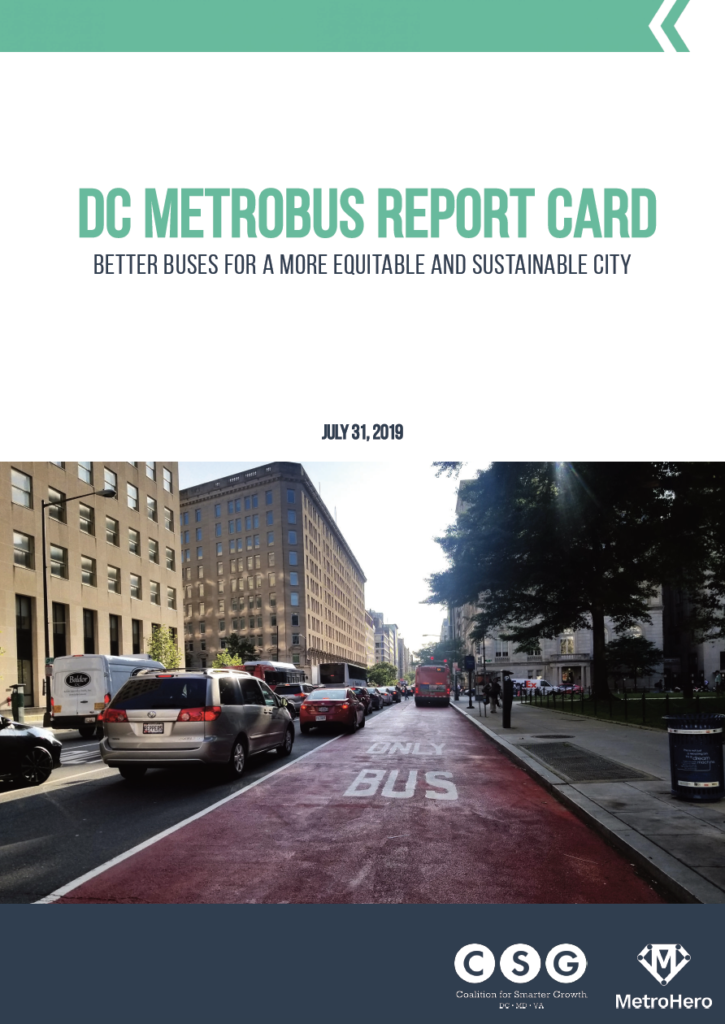
For a month, Metrobus has been under the microscope. MetroHero, an app created by local transit enthusiasts to help track trains and buses, partnered with the Coalition for Smarter Growth to examine routes for speed and reliability. Now the Metrobus Report Card is out and the results are not good. The group gave Metrobus a “D” grade.

Stewart Schwartz and Cheryl Cort of the Coalition for Smarter Growth said they want to use the results to advocate for more traffic signal prioritization, among other measures, to speed buses up and keep them running on time.
“The bus performance scores aren’t great, but it’s our hope that our findings spark more action on dedicated bus lanes and other bus improvements,” Schwartz said.
The report says more riders will take the bus if service is reliable, trip times are predictable and buses come frequently.
See the full WAMU story here.
 by Jordan Pascale,