
In this year’s Maryland legislative session, CSG has helped get some promising housing and transportation bills through the Maryland House and Senate – and we’re still tracking others that may need a push.
Category: Zoning
🌸 All Things Montgomery: March 2026 🌸
Spring is here! 🌸 And with it comes many upcoming opportunities to take action all over Montgomery County—some new, and some familiar.
Testimony: Support for the 2026 Maryland Housing and Transit Opportunity Act (TOD Bill)
Transit-oriented development (TOD) plays a critical role in addressing two key Maryland challenges: housing and transportation. Workers and families benefit from expanded transportation and housing options and greater affordability through TOD.

Two community events in Alexandria: Duke Street & Housing 2040
Alexandria is holding two community open houses next week where you can offer your input on two major ongoing projects: the Duke Street Land Use Plan and Housing 2040.
DC testimony in support of alley lots for housing
January 10, 2026
Mr. Anthony Hood, Chairman
Zoning Commission of the District of Columbia
441 4th Street, NW, Suite 210S
Washington, DC 20001
RE: Support with amendments for Zoning Case No. 25-06 – Amendment to the Zoning Regulations Governing Alley Lots
Dear Chair Hood and Members of the Zoning Commission:
Please accept this testimony in overall support for this case on behalf of the Coalition for Smarter Growth. We are a nonprofit organization advocating for walkable, bikeable, inclusive, transit-oriented communities as the most sustainable and equitable way for the Washington, DC region to grow and provide opportunities for all.
First, we want to express our gratitude to the Office of Planning staff and the Zoning Commission for responding to our requests to reconsider certain restrictions on alley lot development from earlier cases and this case.
We recognize that alley lots, while a modest resource for our city to address its housing needs, are also unique, distinctive assets that offer smaller housing opportunities in a variety of settings throughout our city. The proposed revisions to alley lot development regulations will help to advance the District’s goal of fostering more housing to meet the needs of our diverse community, including smaller, more naturally affordable homes for DC residents. This advances economic and racial equity with distinctive opportunity sites. We appreciate the Zoning Commission giving more focus to how zoning regulations can be more responsive to the range of housing needs that address affordability, and ensuring that growth does not have to come at the expense of pushing out others. Improving our zoning regulations can help make the most of all of our opportunities to create more housing and equitably meet our housing needs.
Overall, we want to register our support for these proposals. Below are our particular items we wish to comment on.
Eliminate parking minimums: first we want to highlight something that is not proposed in this case — eliminating parking requirements for alley lots. A parking requirement is a major barrier to using underutilized space for people’ homes. We urge the Zoning Commission to move beyond the flexibility of a Special Exception (which we support) and eliminate altogether the onerous requirement that vehicle parking be provided for any alley lot development. The Comp Plan seeks to provide more housing opportunities and more affordable housing. Given the nature of the small, often awkward configurations of many alley lots, parking requirements are especially burdensome. Trading off space for a motor vehicle where an individual or household could live is particularly disappointing because these lots are so constrained but offer unique opportunities to address our housing needs. Residential Parking Permits would be rare for an alley address, thus we expect an alley home occupant to not own a vehicle or rent a parking space. For the sake of expanded housing opportunities on small, challenging sites, we should eliminate parking requirements.
Support for a Special Exception process when seeking relief from minimum requirements for alley lot subdivision and height standards. We are very encouraged that the proposed regulations call for greater flexibility to address the unique circumstances of individual alley lots.
We want to highlight the importance of this set of allowable relief permitted through a Board of Zoning Adjustments (BZA) review. We especially appreciate the addition of some modest flexibility on height where the context and other circumstances are determined to be appropriate by the BZA.
Support the proposed increased height maximum from 20 feet to 22 feet to align with existing accessory building regulations.
Support the proposed residential use on alley lots in R-1 and R-2 zones: this was an overlooked need to align the accommodation of alley lot uses across all zones in the District.
Support allowing a second residential unit within an alley lot building (an accessory dwelling unit or second principal unit, depending on the zone) based on the lot size.
Revise minimum lot size and rear and side yards: we concur with the OAG’s recommendation to revise OP’s proposal. OAG states that: “the minimum yard requirement in the R-1 Zones be reduced to 15 feet from abutting non-alley lots and that the minimum lot size be two-thirds of the minimum required in the zone. Both these changes would still provide for a substantial amount of open space on alley lots while providing greater flexibility for development.”
Revise proposed reduced maximum lot occupancy for alley lots in R-1 and R-2 zones: imposing overly restrictive lot occupancy limits as proposed will work against the goal of creating new housing opportunities across neighborhoods. We concur with OAG to retain existing 80% and 100% requirements rather than impose more restrictive limits.
Revise the minimum lot area for subdivisions from 1,800 square feet to 900 square feet or 450 square feet: the minimum lot area standard for subdivision for new lots should be revised from the overly restrictive requirement of 1,800 square feet. We concur with a OAG recommendation – to establish a 900 SF lot minimum, or 450 square feet. Even at 450 square, other requirements would sufficiently guide what can be constructed on a lot.
Reconsider imposing higher pervious surface requirements on alley lots. Higher pervious surface requirements on typically small lots will make it that much more difficult and costly to build homes. It appears RA zones will be especially affected by a 25% pervious surface requirement. This is counterproductive to the intention of these overall amendments to create new housing opportunities with the more efficient use of land.
15 foot alley width: We are disappointed that the 15 foot alley width allowance has been withdrawn. While we welcome the use of the 15 foot width allowance within 300 feet of a public street, we ask that this issue be further assessed for a future reconsideration.
We appreciate that the Zoning Commission is hearing a number of reforms that we requested from the previous case to revise alley lot standards. We urge you to move forward with the proposed changes, and added recommendations, like removing parking mandates, to untap this unique housing resource.
Thank you for your consideration.
Sincerely,
Cheryl Cort
DC and Prince George’s Policy Director
WIN! Montgomery County Council approves the University Blvd Corridor Plan
On Tuesday, December 9, the Montgomery County Council voted to approve the University Boulevard Corridor Plan by a vote of 7-3. The plan creates a strong framework for safer streets, a wider variety of housing options, a connected bike network, and new homes and retail near transit.
DC Alert: Support more homes for Cleveland Park and Woodley Park
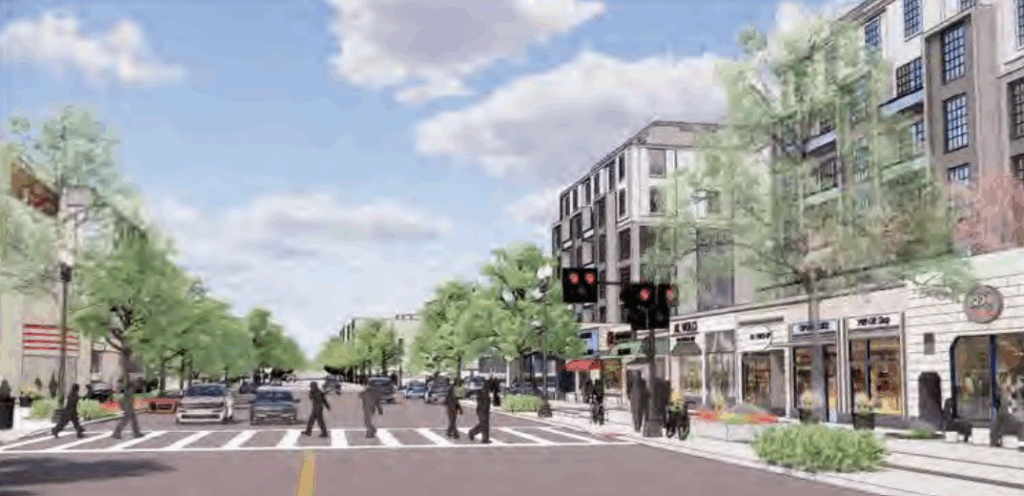
Send a letter of support by Dec. 1, 2025 to the DC Zoning Commission in support of upzoning along Connecticut Avenue, Zoning Case No. 25-09.
Tell the DC Zoning Commission that you support the proposed new mixed-use zones (Zoning Case No. 25-09) to permit taller buildings to allow for more homes, including affordable homes, above shops for the Cleveland Park and Woodley Park business districts on Connecticut Avenue. Any new buildings would be subject to the design guidelines adopted by the Historic Preservation Review Board. The zoning proposal would also remove the cap on restaurants in these business districts, which will help fill in vacant storefronts and attract new businesses. Send your letter before December 1.
Sign up in advance to testify on Dec. 1 at 4 pm. The hearing is virtual!
Image by DC Office of Planning, ZC No. 25-09.
Council needs your input on University Boulevard
Help us get the word out on University Boulevard!
DC Testimony Workshop: Preparing for Wisc. Ave. Rezoning
Date: Nov. 10 2025, 7 – 8:30 pm
AGENDA
Introductions – name, neighborhood, motive
How to testify
- Sign up & what to expect at virtual hearing 4pm, ~5pm proponents start
- Principles for testifying
- Proponent with or without recommended improvements
- What’s motivating you to be here
- Tell your personal housing story, don’t worry about details, don’t be an expert
- Dos/Donts – don’t oppose because it’s not good enough, instead support & urge to make it better; do make it personal rather than being an expert; only speak for allotted 3 minutes; always be polite & respectful of commissioners & all others – including opponents; don’t worry – Commissioners want to hear from you they are not are not out to get you
- Sample testimony- below
Peter Shapiro – How to have the most impact
How to testify – check in
- Ask participants: What’s your main argument – why do you care about approving this upzoning? (one sentence)
3. Q & A – resource people
Resources
Support transit and inclusive housing options in the University Boulevard Corridor Plan
The University Boulevard Corridor Plan envisions a community with safer streets, thriving local businesses, better public transit, and more housing choices to meet people’s needs at all ages and stages of life.
Visit our landing page at smartergrowth.net/ubc to take action and learn more about the plan.