
During his campaign, Governor McAuliffe said he would take a hard-look at the controversial $440 million Bi-County Parkway, reevaluating this project and others proposed by VDOT. In his campaign platform, under the section titled “Pick the right projects; build the best ones,” he stated:
Category: Transportation
Letter to Montgomery County Planning Board Re: State Transportation Funding Priorities
Dear Planning Board: Thank you for this opportunity to comment on the county’s Transportation Priority Letter. My name is Cheryl Cort and I am speaking on behalf of the Coalition for Smarter Growth, the leading non-profit group advocating for transit and walkable communities in the DC region, which counts thousands of supporters in Montgomery County. We’d like to remind the Board that state law governing the priority letter process “requires MDOT and the local jurisdictions seeking project fundi…
Letter of support for Alexandria’s King Street Bike Lanes
Mayor Euille and Members of Council: I have been quite surprised and concerned that opponents to safe, connected bike lanes on King Street between the Metro and Janneys Lane have elevated the issue to make it a national cause célèbre in conservative circles with extremely hostile OpEds in the Wall Street Journal and the American Spectator. They are bringing negative publicity upon Alexandria and threaten the ability of our city to attract young, well-educated, creative, entrepreneurial workers that are so critical to the future of our economy and tax base. Alexandria has been making great progress in bringing sustainable new development, investing in new transit, setting up bike-sharing, and more, but this particular debate is casting a shadow on that progress and will chase away the creative economy workforce and the businesses they attract…
Testimony to Alexandria Traffic & Parking Board Re: King St Bike Lanes
In the most recent version of the King Street Bicycle and Pedestrian Improvements proposal, we are concerned by the removal of a continuous bicycle lane from Cedar Street to Janneys Lane. Alexandria adopted a Complete Streets policy almost three years ago to ensure balance in planning for the transportation needs of its residents. A key part of this should be a King Street that allows cyclists and pedestrians to travel through the neighborhood more safely.
Testimony to DC Zoning Commission on Zoning Update (ZC 08-06A Subtitles X, Y and Z, General Processes and BZA/ZC Procedures)
Dear Chairman Hood and members of the Commission: Please accept these comments on behalf of the Coalition for Smarter Growth. The Coalition for Smarter Growth is the leading organization in the Washington, D.C. region dedicated to making the case for smart growth. Our mission is to promote walkable, inclusive, and transit-oriented communities, and the land use and transportation policies and investments needed to make those communities flourish.

CSG Chat: The Future of Metro – the Momentum Plan
WMATA’s Momentum program could be one of the most important transit initiatives for our region in decades. What does the plan include? How will it help Metro to become more reliable? What obstacles do we need to overcome to succeed? How are we going to pay for it? Watch the full video from this live interactive webchat with WMATA’s Shyam Kannan.
Will Montgomery County Fall Into the Zombie Highway Trap?
There ought to be a statute of limitations on highway plans, because chances are, if a transportation project was conceived of at a time when rotary phones were the norm, it is just as outdated.
But these zombie highway projects from another era still hold a powerful allure over public officials, even in places where they really ought to know better.
Montgomery County, Maryland, has a reputation for being pretty forward thinking on transportation, but an undead highway is clawing its way out of the grave.
At Greater Greater Washington, Kelly Blynn reports that local officials are under the spell of a 1960s vision called the Midcounty Highway Extended, or M83. Worst of all, they seem to be settling on the most costly intervention, fiscally and environmentally:
Last night, the Maryland Department of the Environment and the Army Corps of Engineers held a public hearing at Seneca Valley High School in Germantown regarding whether they should grant a joint permit to impact wetlands and streams in the highway’s path. Dozens of highway opponents from the Transit Alternatives to the Midcounty Highway Extended (TAME) Coalition, many of whom have fought the project for years, turned out in force to testify against the project.
MCDOT originally evaluated 11 alternatives, and has since narrowed the field down to just 6, including a no-build option. Alternatives 4, 8, and 9 are the most controversial and involve the most new pavement and right-of-way through environmentally sensitive areas and existing neighborhoods. They also happen to be MCDOT’s preferred alternatives. MCDOT estimates that Alternative 9 would cost $350 million to build, though local activists say it could be double that.
Alternative 2, the cheapest option, would make improvements to Route 355 and use transportation demand management (TDM) to give travelers other ways to get around, while alternative 5 involves widening it. MCDOT did not look at any transit alternatives. Their report contains a footnote saying that the community requested a transit alternative, but says that the county’s Bus Rapid Transit plan is still too nascent to be considered.
The county leaders will decide soon whether to include the money for this project in next year’s budget. Blynn says, “It remains to be seen whether the County leaders will continue their progressive planning tradition by investing scarce local dollars in transit and smart growth, or whether they sink hundreds of millions into a 1960′s-era sprawl highway.”
Elsewhere on the Network today: Mobilizing the Region sheds light on some of the perilous situations faced by pedestrians in south Jersey. Cap’n Transit theorizes that two schools of thought on transit planning emerge from two difference conceptions of the city and suburbs. And I Bike TO criticizes the Toronto police department’s decision to stop tracking “dooring” crashes.
Most of new $1B transportation package for Montgomery is for Purple Line
Montgomery County’s push for transportation investment paid a billion-dollar dividend Monday when the state committed money to eight county road, rail and bus priorities.
The lion’s share of funding — $680 million — will go to the Purple Line, a 16-mile light rail line planned to connect Bethesda and New Carrollton through Silver Spring. That includes $400 million for construction and $280 million already marked to buy land and finish the project’s design.
The state will seek a private company to run the light rail system.
Other projects, such as the Corridor Cities Transitway, Ride On Bus system and road improvements, will see smaller funding commitments from the state.
Standing above the Bethesda Metro station on Monday, Gov. Martin O’Malley announced the investments, saying they will bring needed jobs and traffic relief.
Led by County Executive Isiah Leggett (D), Montgomery pushed for an increase in the statewide gasoline tax in the 2013 legislative session. It sought a cash commitment from the state to the $2.2 billion Purple Line, as well as the Corridors Cities Transitway, a 15-mile bus rapid transit line connecting Clarksburg to the Shady Grove Metro station, estimated to cost $545 million.
Over the “last few decades,” Maryland stopped making necessary investments to build and maintain its transportation infrastructure, O’Malley (D) said Monday.
“The failure to act, the failure to make those better decisions, had a huge cost,” he said.
Time, jobs and the environment were sacrificed, he said.
Not everyone who heard the news on Monday was on board.
Opponents included about two dozen members of Friends of the Capital Crescent Trail, some of whom waved signs while others shouted slogans.
The western portion of the light rail is set to run along the Georgetown Branch section of the Capital Crescent Trail, from downtown Bethesda through the Columbia Country Club and across Connecticut Avenue.
“You couldn’t buy 20 acres inside the Beltway today to build a park. Why would you tear one down?” Ajay Bhatt, president of the group, asked in an email.
Running the Purple Line next to the trail, Bhatt said, would be “turning a serene tree-canopied nature trail through quiet neighborhoods enjoyed by thousands of young and old bikers, walkers and runners weekly into a shade-less ribbon of asphalt alongside twin sets of railroad tracks beneath high-power electrical lines with 250 daily trains passing at 45 mph.”
Deborah Vollmer of Chevy Chase said the rail line will lead to incalculable loss along the hiker-biker trail that, at points, parallels the Purple Line’s planned path. She said she is not opposed to mass transit, but the rail should be buried to avoid damaging the park-like atmosphere of the trail.
Another vocal opponent is Chevy Chase Councilman John Bickerman, who took issue with the announcement that the state would seek a private company to run the system.
“It’s an abomination, farming out this basic government service to the private sector,” Bickerman said. “It shouldn’t be contracted out. What if the revenues come in lower? What if the contractor doesn’t get the return that he’s expecting and the contractor goes belly up? Then what happens?”
Maryland lawmakers this spring passed the Transportation Infrastructure Investment Act — which raised taxes on gasoline and diesel — to bring $4.4 billion in new investment and 57,000 jobs in the next six years, officials said.
Flanked by dozens of state lawmakers, local leaders and members of the building trade, O’Malley said Montgomery’s share of that money will include the following:
• $400 million for construction of the Purple Line, which comes on top of $280 million announced previously to buy land and finish the project’s design.
• $125 million to construct a new interchange along Interstate 270 at Watkins Mill Road.
• $100 million to buy land and design the Corridor Cities Transitway.
• $85 million for Montgomery’s Ride On Bus system.
• $25 million to build and relocate a section of Md. 97 (Georgia Avenue) to bypass the center of Brookeville.
• $7 million to build interchanges at U.S. 29 and Musgrove Road and at U.S. 29 and Fairland Road.
• $3 million to design the widening of Md. 124 (Woodfield Road) from Midcounty Highway to south of Airpark Road.
• $3 million for planning to evaluate possible improvements in the Md. 28/Md. 198 corridor between Md. 97 and Interstate 95.
Lt. Gov. Anthony Brown shepherded a bill through the General Assembly this year that became the state’s new public-private partnership law. He said the state will deliver the Purple Line as its first and largest transit partnership with private industry. The state will seek a private company to build and operate the line.
“It’s a project that is going to connect our communities and grow our economy,” said Brown (D), who is running for governor in 2014, when O’Malley can’t run again because of term limits. “With the additional $400 million the governor just announced, we are showing how serious we are to delivering the Purple Line now.”
Montgomery looks to add 100,000 jobs through its efforts in the Great Seneca Science Corridor, Shady Grove, White Flint and White Oak, Leggett said.
“However, all of that depends on improvement in our transportation infrastructure,” Leggett (D) said. “Without that [investment], those jobs may come to a screeching halt.”
County leaders warned in December that without dedicated funding and clear state commitment to the project, the Purple Line, which is almost completely designed, would stall in its tracks.
“All of this is about better choices,” O’Malley said.
For transit advocates, the state commitment for the Purple Line was tempered by concerns over continued investment in highway projects.
Cheryl Cort, policy director of the Coalition for Smarter Growth, said investing in highway expansion projects only gives drivers temporary traffic relief and encourages more driving, not the transportation choices residents deserve.
Staff Writers Agnes Blum and Sylvia Carignan contributed to this report.
State earmarks $1 billion in transportation money for Montgomery
Montgomery County’s push for transportation investment paid a billion-dollar dividend Monday when the state committed money to eight county road, rail and bus priorities.
The lion’s share of funding, $680 million, will go to the Purple Line, a 16-mile light rail line planned to connect Bethesda and New Carrollton. Other projects, like the Corridor Cities Transitway, Ride On Bus system and road improvements, will see smaller cash commitments from the state.
Standing above the Bethesda Metro Station Monday, Gov. Martin O’Malley announced the investments, saying that they will bring needed jobs and traffic relief.
Led by County Executive Isiah Leggett (D), Montgomery pushed for an increase in the statewide gasoline tax in the 2013 legislative session. It sought a cash commitment from the state to the $2.2 billion Purple Line as well as the Corridors Cities Transitway — a 15-mile bus rapid transit line that will connect Clarksburg to the Shady Grove Metro Station, estimated to cost $545 million.
Over the “last few decades,” Maryland stopped making necessary investments to build and maintain its transportation infrastructure, O’Malley (D) said Monday.
“The failure to act, the failure to make those better decisions, had a huge cost,” he said.
Time, jobs and the environment were sacrificed, he said.
Maryland lawmakers passed the Transportation Infrastructure Investment Act this spring to bring $4.4 billion in new investment and 57,000 jobs in the next six years.
Flanked by dozens of state lawmakers, local leaders and members of the building trade, O’Malley said Montgomery’s cut of that money will include:
— $400 million for construction of the Purple Line, which comes on top of $280 million announced previously to buy land and finish the project’s design
— $125 million to construct a new interchange along I-270 at Watkins Mill Road
— $100 million to buy land and design the Corridor Cities Transitway
— $85 million for Montgomery’s Ride On Bus system
— $25 million to build relocate a section of Md. 97 (Georgia Avenue) to bypass the Town of Brookeville
— $7 million to build interchanges at U.S. 29 and Musgrove Road and at U.S. 29 and Fairland Road
— $3 million to design the widening of Md. 124 (Woodfield Road) from Midcounty Highway to south of Airpark Road
— $3 million for planning to evaluate possible improvements in the Md. 28/Md. 198 corridor between Md. 97 and I-95.
Lt. Gov. Anthony Brown, who shepherded a bill through the General Assembly this year that became the state’s new public-private partnership law, said the state will deliver the Purple Line as the state first and largest transit partnership with private industry. The state will seek a private company to build and operate the line.
“It’s a project that is going to connect our communities and grow our economy,” Brown (D) said. “With the additional $400 million the governor just announced, we are showing how serious we are to delivering the Purple line now.”
Montgomery looks to add 100,000 jobs through its efforts in the Great Seneca Science Corridor, Shady Grove, White Flint, and White Oak, Leggett said.
“However, all of that depends on improvement in our transportation infrastructure,” Leggett (D) said. “Without that [investment] those jobs may come to a screeching halt.”
Montgomery leaders warned last December that without dedicated funding and clear state commitment to the project, the almost completely designed Purple Line would stall in its tracks.
“All of this is about better choices,” O’Malley said.
But not everyone gathered on the Metro plaza supported the projects, namely the Purple Line.
Shouting “Bury the rail, save the trail,” opponents of the Purple Line frequently voiced their position over those who spoke.
Deborah Vollmer of Chevy Chase said the rail line will lead to incalculable loss along the Capital Crescent Trail, a hiker-biker trail that, at points, parallels the Purple Line’s planned path. Not opposed to mass transit, she said the rail should be buried to avoid impacting the park-like atmosphere of the trail.
Ajay Bhatt, president of Friends of the Capital Crescent Trail, said the announcement was bad news for the county’s green spaces.
“They talked a lot about development and a lot about growth in Maryland, but where are the parks going to come into play?” he said.
His organization is concerned that the Purple Line will take away the trail’s ambiance by placing parts of it next to the planned light rail.
After the announcement in Bethesda, Bhatt argued the Capital Crescent Trail is a valuable resource for downcounty residents.
“If you go on the Capital Crescent Trail between here and Georgia Avenue, it’s packed,” he said.
For transit advocates, the state commitment for the Purple Line was tempered by concerns over continued investment in highway projects.
Cheryl Cort, policy director of the Coalition for Smarter Growth, said investing in highway expansion projects only gives drivers temporary traffic relief and encourages more driving. It does not give resident the transportation choices they deserves, Cort said.
Bi-County Parkway Means Traffic Solution or Fresh Mess
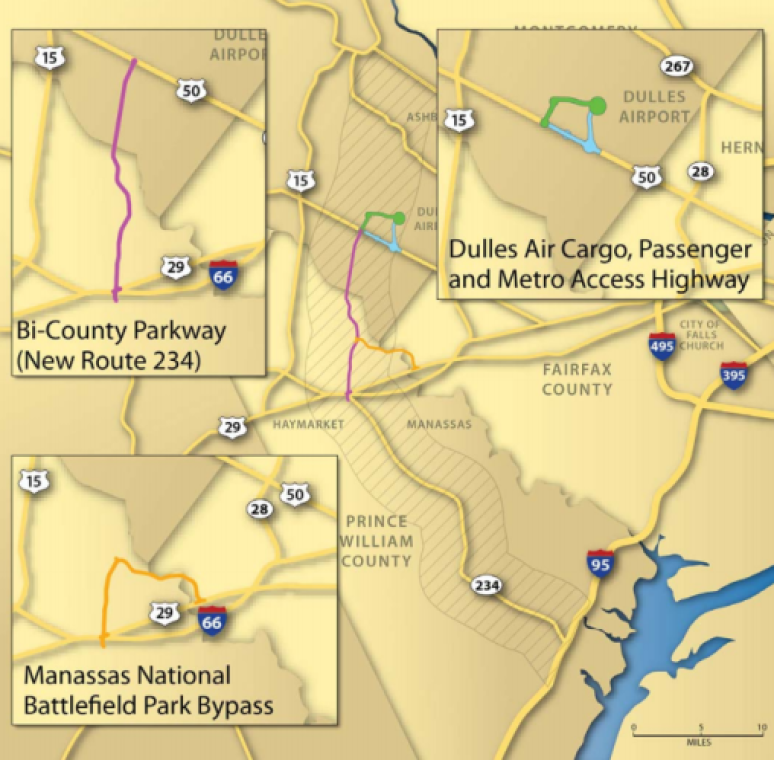 A new route through some of Prince William County’s rural north is pitched as pro-business and part of the area’s transportation solution, but critics have lined up to push back on a new run of pavement through a part of the region happy to be away from gridlock.
The Commonwealth Transportation Board recently approved a master-plan study for what’s become known as the “Bi-County Parkway,” a 10-mile road that would connect I-66 in Prince William County with Route 50 in Loudon County.
“This parkway would make people’s lives better,” said Bob Chase, president of the Northern Virginia Transportation Alliance. “It provides faster, safer transportation, and takes people off local roads.”
The road’s purpose is to ease the horrendous traffic that currently plagues the area, while also providing easier access to the Washington Dulles International Airport for residents of these counties. The Virginia Department of Transportation estimates that the road could carry nearly 42,000 vehicles a day by 2020 to combat the area’s exploding population.
“We see this as a vital north-south link for Prince William and Loudon,” Chase said. “It’s a common sense solution that makes employment centers accessible and takes traffic off existing roads.”
The parkway is also seen as an economic boon for the region.
“Not only will the road reduce traffic congestion between the counties, but it will also help the region connect with the airport,” said Leo Schefer, president of the Washington Airports Task Force. “The airport’s an economic engine for the area, and better access to it helps encourage businesses to locate nearby.”
The road also has the potential to benefit the airport itself by increasing the number of passengers and encouraging more cargo to pass through Dulles.
“It would allow for a better flow of passengers and information through the airport, and cargo is a part of that,” said Christopher Paolino, media relations manager for the Metropolitan Washington Airports Authority. “That would be a net positive for everyone, since as the airport grows, the region grows, and vice versa.”
But critics of the parkway are worried that road may harm the nearby Manassas Battlefield and Prince William’s Rural Crescent.
“This road could forever harm the landscape and the acres of historic sites it would cut through,” said Stewart Schwartz, executive director of the Coalition for Smarter Growth. “Residents have real concerns about the damage that this could cause to the community.”
Schwartz’s coalition has worked with other groups in developing a study finding that the parkway will only add traffic to the area, not ease it.
“If you build it, people will try to use it, and that creates congestion,” Schwartz said. “It’s also likely that this will bring pressure from developers to convert the Rural Crescent, and that will bring even more traffic.”
The group has also developed an alternative plan aimed at dispersing traffic by improving the interchange between Route 28 and I-66 and extending Metrorail service to Centreville, avoiding the need for the parkway.
“Our best hope is to improve our existing transit options and to build compact, walkable neighborhoods with public transportation,” Schwartz said.
Some local politicians echo the road rage, particularly Del. Tim Hugo (R-Centreville).
Transportation officials were trying to get the road done quietly, Hugo said. “But people woke up.”
The fight over the road has sent longtime political allies in Prince William County to opposing corners. Hugo argues support for the project is developer-driven.
“This is the wrong project at the wrong time, and the response from the people has been overwhelmingly in opposition,” Hugo said. “This road could create a commuter crisis from Fauquier to Fairfax.”
Proponents argue the goal is to get cars from one end of this rural area to the other, not increasing development within these communities. Shefer said the parkway can include easements around the road and limits on the number of exits to restrict development.
“If it’s designed the right way, then the parkway won’t harm the rural presence, but preserve it,” Schefer said.
Some changes have already been made to resolve some concerns about access and impacts on historical sites. As the project continues to take shape, Schefer and others are hopeful that the final product is controversy-free.
“The key is for everyone to work together, in order to help improve connectivity and save people time,” Schefer said. “There’s no reason this can’t be a win-win for everyone.”
Photo courtesy of VDOT.